Shed Solar, Priced Honestly: Six Kits From $359 to $1,899
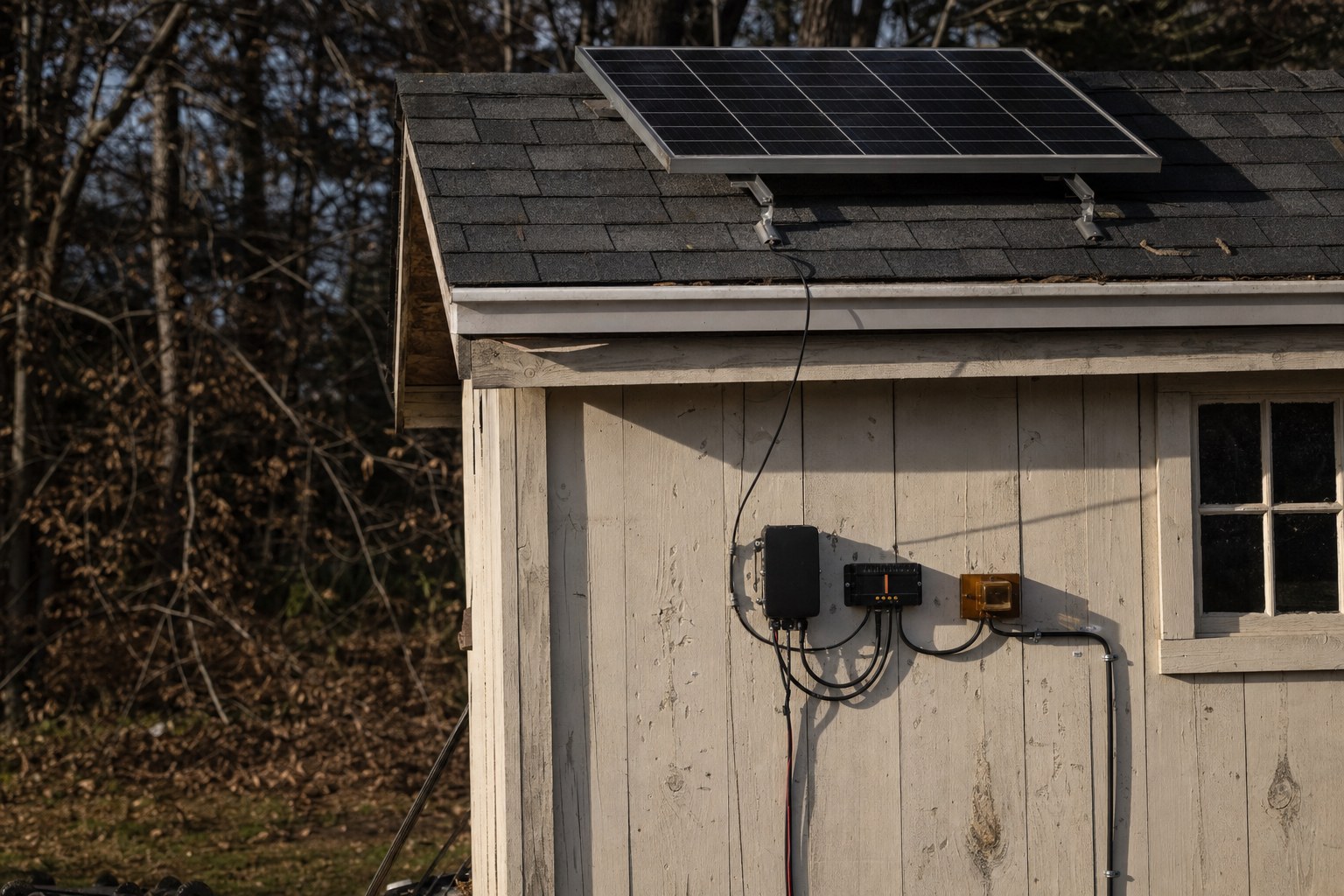
Price a solar setup for a shed and you will meet two numbers that cannot both be true. Competing guides quote $11,000. Our kit database says a complete build lands somewhere between $359 and $1,899. That gap is not a sale. It is a category error. The $11,000 figure describes a grid-tied residential rooftop array, copied onto a shed page without anyone rerunning the arithmetic, and it lands as a 30x markup on the wrong product.
The bottom of the real window buys a plug-and-play power station that lights a garden shed. The top buys a wired 400W array sitting on 2,560Wh of LiFePO4, which is a working shop. Between those poles the market sorts into three tiers: lights and device charging at $359-$449, power tools and small appliances at $449-$575, and a full workshop at $1,259-$1,899. Every kit named here carries verified specs and live pricing pulled from our catalog of 419 kits.
Then there is what the sticker leaves out. A kit is not a system until it is wired, and most guides stop counting at checkout. Wire runs: $50-$100. Metal conduit: $30-$50. Mounting hardware: $50-$80. Add every one of those to the most capable system on this page and the all-in total still sits under $2,080. Set that against the alternative most people assume they need: trenching conventional electrical out to a detached shed runs $5,000-$8,500 once you count a 100-foot trench, permits, and an electrician's hours.
Two ratios frame everything below. Five of the six kits here store energy in LiFePO4 and exactly one uses AGM, which the cost-per-cycle math explains. And completion percentages span 71% to 100%, meaning a single kit arrives with every part a functioning system needs. Cost per Wh, the number that decides the build, runs from $0.44 (Anker SOLIX C1000 Gen2 1024Wh / 2000W + 600W Panels) to $1.05 (WindyNation 400W Complete Off-Grid Kit (AGM)). A 2.4x spread on identical work.
What follows: load profiles by use case, the specs that decide each component, the chemistry math, the six kits, then the build-side detail (voltage, wiring, mounting, code) that generic solar content never covers for a shed. If your loads are already listed, run your shed's numbers and skip ahead.
Start With Watt-Hours, Not Watts
Panels, battery, inverter: all three fall out of one number, and it is not a wattage. It is daily watt-hours. Without it, everything downstream is a guess wearing a spec sheet.
The Garden Shed Load: 180Wh a Day
Four LED fixtures drawing 40W between them, on for 4 hours, come to 160Wh. A phone charging at 10W for 2 hours adds 20Wh. Call the day 180Wh/day. A 200W panel system covers it without strain, and anything in the $359-$449 band clears the bar. The BLUETTI AC50P 200W / 504Wh Portable Power Station holds 504Wh for $359, which ends a Tier 1 day with 324Wh still in the tank. This is the seasonal storage building, the hobby space, the garden shed: places where light and a charged phone are the entire ask, and the extension cord from the house can go away.
The Tool Bench Load: 560Wh a Day
Take the 180Wh above and start stacking. A drill charger at 80W for 1 hour is 80Wh. A radio at 15W for 4 hours is 60Wh. A small fan at 60W for 4 hours is 240Wh. The day closes at 560Wh/day, which wants 200-400W of panel and no less than 1,000Wh of storage behind it.
The ECO-WORTHY 200W 12V Complete Kit with 100Ah LiFePO4 Battery answers that profile for $540: 200W of panel, 1,280Wh of LiFePO4, a 1,100W inverter. At $0.45/Wh it stores energy more cheaply than any other wired kit on this page, with enough reserve to ride out a run of gray days rather than just a single Tier 2 evening.
The Workshop Load: 1,800 to 2,500Wh a Day
Now the numbers get serious. A miter saw at 1,500W used intermittently for 0.5 hours is 750Wh. A shop vac at 1,200W for 0.25 hours is 300Wh. Work lights at 200W for 4 hours are 800Wh. The day lands at 1,800-2,500Wh/day, which needs 600W+ of panel and 200Ah+ of LiFePO4 underneath it.
A documented Chicago 12x12 build shows what that looks like in the field: 800W of panel, 2x200Ah of LiFePO4, a 2,400W all-in-one inverter, carrying roughly 185W of average continuous draw across interior LEDs, an outdoor beer fridge, and exterior lighting, with a Raspberry Pi running solar-assistant.io watching the output.
Turning Daily Wh Into Panel Watts
(Daily Wh / Peak Sun Hours) x 1.15 = DC watts needed
That 1.15 is not padding. It absorbs inverter losses, wiring losses, and temperature derating. Peak sun hours sit at 3-5 hours/day across most of the country and climb to 6.41-6.77 in the Southwest, which is why a Seattle shed needs close to twice the panel of a Phoenix shed doing identical work.
Run the Tier 2 case: 560Wh / 4 PSH x 1.15 = 161W of minimum panel capacity. Then ignore the minimum. A system built to exactly 161W banks nothing on an overcast day and has no room for the fan or second charger you will inevitably add. Buy 200-400W instead. The ECO-WORTHY 200W 12V Complete Kit with 100Ah LiFePO4 Battery gives 24% headroom over that 161W floor at 200W. The Renogy 400W 12V Complete Solar Kit with 200Ah LiFePO4 gives 148% headroom at 400W, enough slack to swallow Tier 3 loads if the shed's job grows. Shed kits, ranked
The classic error is sizing to the average day rather than the worst second. One builder began at 300W of inverter and had to buy a 1,000W replacement once the tools showed up. Size the inverter to the largest single device, never to the average. Put your loads into the calculator
Four Parts, Four Specs That Decide the Build
Four components, and one spec on each separates a system that runs your tools from a system that trips its breaker the first time the miter saw spins up. Taken in the order they kill builds.
Inverters: Surge, Not Running Watts
Pure sine wave is non-negotiable the moment a motor is involved: tools, fans, compressors. Modified sine wave cooks motors, trips thermal shutdowns, and can take out sensitive electronics like battery chargers and laptop supplies.
The spec that matters is continuous watts versus surge watts. A saw rated 1,500W continuous can pull 2,200W+ the instant it starts. The inverter has to survive that spike, not the running figure. The Renogy 400W 12V Complete Solar Kit with 200Ah LiFePO4 brings 2,000W of pure sine wave. The BLUETTI AC50P 200W / 504Wh Portable Power Station's built-in 700W inverter (with 1,200W Power Lifting Mode) is a Tier 1 device and nothing more. The Anker SOLIX C1000 Gen2 1024Wh / 2000W + 600W Panels splits the difference, putting a 2,000W inverter inside a portable body. Size to the biggest tool's surge every time.
Storage: Usable Wh Is the Only Number
Batteries are where the money and the value both live. Two chemistries own shed solar, LiFePO4 and AGM, and the spec that decides between them is usable watt-hours, not the rating printed on the case.
Watch what that does to two kits of the same nominal size. The Renogy 400W 12V Complete Solar Kit with 200Ah LiFePO4 carries 200Ah of LiFePO4, 2,560Wh total, roughly 2,048Wh usable at an 80% depth of discharge. The WindyNation 400W Complete Off-Grid Kit (AGM) carries 1,200Wh of AGM, of which 600Wh is usable once you respect the 50% depth-of-discharge limit. Same class of bank on paper, 3.4x apart in what you can actually spend. The chemistry section works the rest of it. Batteries sorted by chemistry
Panels: Watts per Dollar, and Roof Weight
Monocrystalline is the default cell type here, and shed-relevant panels run 100W to 600W. Watch watts per dollar. The Anker SOLIX C1000 Gen2 1024Wh / 2000W + 600W Panels bundles 600W of panel into a $449 package, which prices out at $0.75/W. The ECO-WORTHY 200W 12V Complete Kit with 100Ah LiFePO4 Battery prices at $2.88/W. The Anker hands over 3x the panel for $91 less, because its panels ride along with a portable station rather than anchoring a standalone wired build.
Form factor is a real decision, not a preference. Fold-up portable panels fit sheds where permanent mounting is impractical or the building sits idle half the year. Rigid panels return more efficiency per dollar on a permanent install and age better outdoors. Weight is the constraint nobody checks: standard residential panels come in at 40-50 lbs apiece and add 2-4 lbs per square foot of roof load. NEC building codes generally want a minimum 20 lbs/sq ft live load capacity, and prefab or older sheds roofed in thin OSB can need structural reinforcement before a panel goes up. Every panel we track
Controllers: When MPPT Earns Its Premium
MPPT pulls 20-30% more power out of the same array than PWM, running at 96-99% efficiency against PWM's 75-80%. It also costs more: $15-$30 for PWM, $80-$150 for MPPT.
The premium pays above roughly 170W of panel, and it pays in any cold climate regardless of array size. Cold air lifts a panel's open-circuit voltage (Voc), and MPPT turns that surplus voltage into charging current while PWM dumps it as heat. Practically, most shed systems past 200W belong on MPPT. Renogy ships its kit with a 40A MPPT Rover. Eco-Worthy and WindyNation both ship PWM, which is fine for sub-400W arrays in warm places and quietly forfeits 20-30% of the harvest anywhere cold.
Four parts, and they only count when all four are in the box. The Renogy 400W 12V Complete Solar Kit with 200Ah LiFePO4 is the only kit in this shed selection at 100% completeness, 100% complete with nothing left to add. The rest sit at 71-86% and finish the job with a second order.
The Chemistry Question, Settled by Cost per Cycle
AGM wins on the price tag. It loses on every other line of the ledger, and the ledger is what you actually pay. Start with the number that ends the argument.
Dollars per Cycle
The WindyNation 400W Complete Off-Grid Kit (AGM) carries 1,200Wh of AGM at a $1,259 real build cost. Derate to 50% depth of discharge and 600Wh is usable. Divide by 1,000 cycles, the middle of AGM's range, and the number is $1.26/cycle.
The Renogy 400W 12V Complete Solar Kit with 200Ah LiFePO4 carries 2,560Wh at $1,899. Derate to 80% and 2,048Wh is usable. Divide by 5,000 cycles, the middle of LiFePO4's range, and the number is $0.38/cycle. The battery that costs $640 more at checkout costs 70% less per cycle.
Stretch that to a decade of daily cycling and the AGM kit swallows two complete battery replacements, one every 3-5 years, at roughly $300-$400 per set for the WindyNation system. The LiFePO4 kit finishes the decade on the batteries it shipped with.
Cost per Wh from our kit data lands in the same place. The ECO-WORTHY 200W 12V Complete Kit with 100Ah LiFePO4 Battery stores at $0.45/Wh on LiFePO4. The WindyNation 400W Complete Off-Grid Kit (AGM) stores at $1.05/Wh on AGM. The AGM kit charges more per stored watt-hour, hands back fewer usable ones, and needs replacing sooner. The full battery list
Rated Capacity Lies, Usable Capacity Doesn't
Run the same 100Ah label through both chemistries. AGM at 50% depth of discharge yields 600Wh. LiFePO4 at 80% yields 1,024Wh. It takes very nearly two AGM batteries to match one LiFePO4 in the real world, and that pairing doubles the weight, doubles the shelf, and still runs out of cycles first.
The Rest of the Spec Sheet
| Spec | AGM | LiFePO4 |
|---|---|---|
| Weight (100Ah) | ~65 lbs | ~25 lbs |
| Depth of discharge | 50% max | 80-100% |
| Round-trip efficiency | 80-85% | >95% |
| Cycle life | 500-1,500 cycles | 3,000-7,000 cycles |
| Typical lifespan | 3-5 years | 8-15 years |
Not one row goes to AGM, and none of the margins are close. LiFePO4 survives 4-7x more cycles, returns 60-100% more usable capacity from the same amp-hour rating, and wastes less of the harvest as heat on the way in and out. Weight tells in a shed: a 200Ah AGM bank lands around 130 lbs against roughly 50 lbs of equivalent LiFePO4. Round-trip efficiency compounds daily, since 95% against 80% means 15% more of every collected watt-hour reaches the tool instead of the air.
What Freezing Temperatures Do
A LiFePO4 BMS refuses to charge below 32F, which matters enormously in an unheated shed. The field fix is cheap: an insulated battery box built from 2-inch pink foam (R10 rating), plus a seedling heating mat on a 110V controller set to 50F. The mat pulls about 40W and cycles roughly 2 minutes out of every 15. That is the Chicago builder's setup, and it runs year-round. Renogy sidesteps the problem entirely with self-heating BMS batteries.
AGM will not lock you out, which sounds like an advantage until you notice it simply loses 30-40% of its capacity in the cold and never says so. Those 600Wh of usable AGM quietly become 360-420Wh once it freezes.
AGM earns a place only under two conditions at once: the upfront budget is genuinely rigid, and the shed will see under 200 cycles a year. Anything used regularly pays back LiFePO4 in 2-3 years. Our real build cost method
Six Kits, Three Tiers, Real Prices
Six kits mapped onto the load profiles above. Prices, specs, and completion percentages all come out of our 419-kit database.
Lighting and Charging: $359 to $437
BLUETTI AC50P 200W / 504Wh Portable Power Station -- $359
200W of panel, 504Wh of LiFePO4, a 700W inverter, 86% complete. Nothing to wire, nothing to mount, nothing to think about: panels in, devices out. The 504Wh covers roughly 2.5 hours of Tier 1 draw before it wants sun, and a full solar recharge takes about 3 hours in direct light. It also walks, which is the quiet argument for it: shed today, campsite this weekend, kitchen counter during the next outage. Cost per Wh: $0.71.
EcoFlow RIVER 2 MAX 512Wh / 500W + 160W Panel -- $437
160W of panel, 512Wh of LiFePO4, a 600W inverter, 86% complete. It is the Bluetti's twin in convenience and its inferior on the ledger: $78 more in advertised price, a 100W smaller inverter, and $0.85/Wh against the Bluetti's $0.71/Wh.
Tools and Appliances: $449 to $575
Anker SOLIX C1000 Gen2 1024Wh / 2000W + 600W Panels -- $449
600W of panel, 1,024Wh of LiFePO4, a 2,000W inverter, 86% complete. The hybrid: a portable station's zero-install convenience with an inverter big enough for tools past 1,500W. At $0.44/Wh it is the cheapest energy of any kit on this page. Storage is the catch, and 1,024Wh is a real ceiling, so read it as a kit for daily tool charging and intermittent cutting rather than sustained heavy work. Concretely: 1,024Wh is about 40 minutes of a 1,500W miter saw actually cutting, or 12+ hours of drill charging.
ECO-WORTHY 200W 12V Complete Kit with 100Ah LiFePO4 Battery -- $540 advertised / $575 real build cost
200W of panel, 1,280Wh of LiFePO4, a 1,100W inverter, 71% complete. This one asks for mounting and wiring in exchange for 2.5x the storage of a portable station and the cheapest energy in its tier at $0.45/Wh. Read the 71% literally: $35 of required parts are missing (wire lugs, DC fuses), and the broader install materials (mounting hardware, conduit, wire runs) add another $80-$130 depending on the shed. The charge controller is PWM.
Full Workshop: $1,259 to $1,899
Renogy 400W 12V Complete Solar Kit with 200Ah LiFePO4 -- $1,899
400W of panel, 2,560Wh of LiFePO4, a 2,000W pure sine wave inverter, an MPPT charge controller, 100% complete. Panels, batteries, controller, inverter, wiring, connectors: this is the one kit in the shed selection where the box holds the whole system. For a Chicago-style workshop, a second 200Ah LiFePO4 bank (roughly $400-$500) buys genuine all-day capacity. Cost per Wh: $0.74. Self-heating BMS batteries close out the cold-weather charging problem with no external heater.
Why not the WindyNation 400W Complete Off-Grid Kit (AGM)? It is $640 cheaper at a $1,259 real build cost, and that is the end of the good news. Its AGM bank yields 600Wh usable against the Renogy's 2,048Wh, it stores at $1.05/Wh against $0.74/Wh, and its batteries want replacing in 3-5 years. The controller is PWM, not MPPT. The $1,149 advertised price also omits $110 of required missing parts.
_Prices for WindyNation 400W Complete and Renogy 400W LiFePO4 verified March 23, 2026. Verify current pricing before purchase._
Put the ceiling in context. The Renogy at $1,899, plus $130 of conduit and wire run extras, totals about $2,030. That is the most capable shed solar system available, fully installed, at a fraction of the $11,000 myth.
Price history is worth a glance before you buy. The Bluetti AC50P has moved between $319 and $359 over the past year, averaging $344. The Eco-Worthy 200W has swung from $400 to $640, averaging $562, which puts today's $540 below its own mean. Watching a chart for a week beats overpaying by hundreds. Put them side by side -- The whole shed ranking
Why 24V Stops Being Optional Past 1,500W
A shed builder on DIY Renewable named the regret plainly after living with his choice: "12V draws more current, causing more heat and increasing the need for thicker cables." He wished he had bought the 24V inverter instead. It is the most common voltage mistake in this category.
The physics is not subtle. Power is voltage times current, so a 1,500W load pulls 125A off a 12V bank and 62.5A off a 24V bank. Halving the current thins the wire, shrinks the voltage drop, and cools every termination in the run.
Wire gauge makes it tangible. AWG 10 is good for 30A, which is 360W at 12V. Push 1,000W through 12V and you are at 83A, which means AWG 2: costly, stiff, awkward to route through a shed wall. The same 1,000W at 24V is 42A, comfortable on AWG 8. Distance compounds it. Over a 30-foot panel-to-battery run, a typical shed distance, a 1V drop costs 8.3% of a 12V system's power. The identical 1V drop on 24V costs 4.2%.
The line falls at 1,500W of total load. Below it, 12V works and keeps the build simpler. Above it, 24V is the default. Mapped onto the tiers: Tier 1 and most of Tier 2 stay 12V, while a Tier 3 workshop should be born at 24V. NEC's 125% continuous current rule sharpens the point. A 1,500W continuous load at 12V demands wire rated 156A (125A x 1.25), which is AWG 1/0. At 24V the same load needs 78A of rating, and AWG 4 handles it.
Most kits between $359 and $1,259 are 12V, which fits their wattage class honestly. The Renogy 400W 12V Complete Solar Kit with 200Ah LiFePO4 is 12V behind a 2,000W inverter. If your plan lives near that 2,000W ceiling continuously, design for 24V on day one.
There is a second, quieter argument for 24V: charge controllers meter amps, not watts. A 40A controller passes 480W of panel at 12V and 960W at 24V. Same hardware, double the solar input. Choosing 24V up front costs almost nothing. Converting a finished 12V system to 24V costs a great deal.
So: one tool under 1,500W, never run alongside another, and 12V is the right call. A real workshop starts at 24V and skips the rewire entirely. Add up your load first
Five Things a Shed Does That a House Roof Doesn't
Generic solar content is written for a residential roof. Sheds break five of its assumptions.
Bolting to Corrugated Metal
Standard solar mounts are engineered for composite shingles. Sheds wear corrugated metal or thin asphalt, and each wants a different answer. Corrugated metal takes through-bolt mounts with rubber gaskets (EPDM-booted lag bolts) to keep water out. Standing seam takes clamp-on brackets and needs no penetration at all.
Builders have documented a budget path that works: four 36-inch lengths of 2x4 (~$5 in lumber) fastened with galvanized roofing screws, sealed in silicone, with aluminum L-channel cleats holding panels to the rails. Figure $50-$80 for hardware. Where the roof pitch is wrong or the shade is bad, ground mounts and lean-to frames are the honest alternative.
One Shaded Cell, 40% Gone
Shade a single cell, 1.5% of the panel's face, and 35-40% of that panel's output can disappear. Cells run in series, so the darkest one throttles the whole string.
Sheds live closer to trees, fences, and taller buildings than houses do, which makes this a shed problem specifically. One builder logged a neighbor's house killing all generation until 10am, and winter tree shade dragging a rated 480W array down to a measured 390W, an 18.75% loss to partial shading alone. Wiring in parallel rather than series keeps one dim panel from dragging the array with it. Per-panel microinverters do the same job differently. The cheapest fix is the one people skip: walk the shade across a few hours and a couple of seasons before committing to a mounting spot.
Distance, Gauge, and Voltage Drop
Panel-to-battery distances of 15-50 feet are normal on a shed, and every foot of that at 12V feeds the voltage drop. The gauge reference: AWG 12 carries 20A, AWG 10 carries 30A, AWG 8 carries 55A.
NEC wants wire rated to 125% of continuous current, so a 40A continuous load takes 50A-rated wire as a floor. On a 30-foot run at 12V carrying 20A, AWG 10 is legal and AWG 8 is smart. Budget $50-$100 for a typical shed run.
The Conduit Rule Nobody Reads
NEC Article 690 requires metal conduit for DC wiring run inside a structure. PVC does not qualify. This is the single most-skipped rule in DIY shed solar, it applies from the roof penetration to the first disconnect switch, and it adds $30-$50 to a build that is already cheap.
Paperwork You Get to Skip
Off-grid systems are exempt from rapid shutdown equipment, one of the line items inflating grid-tied residential quotes. Most jurisdictions also skip permitting entirely for small off-grid systems under 600V DC, and rural properties, especially those sitting more than 1,000 feet from a power line, tend to face the lightest restrictions.
This is the underrated advantage of shed solar: no interconnection application, no net metering agreement, no mandatory inspection in most areas. Set it against the alternative one more time. Conventional electrical to a detached shed runs $5,000-$8,500 for the 100-foot trench, the permits, and the electrician. A kit at $540-$1,899 undercuts the trench by itself. Confirm your local code first, then expect a much shorter list than any grid-tied build. How we price a full install
The Sizing Tool We're Building
A shed-specific sizing tool is in development here. Inputs: shed dimensions, a ZIP code that pulls your location's peak sun hours out of NREL data, and a tool-and-appliance checklist whose wattages are verified against manufacturer specs. It will return a daily Wh figure, a recommended panel wattage, battery capacity in Wh, a minimum inverter size with surge headroom already included, and kits from the 419-kit database ranked by how well they fit.
The formula (Daily Wh / PSH x 1.15) was never the hard part. The inputs are. Runtime hours get underestimated, standby draw on things like refrigerators gets forgotten, and national-average sun hours get used where local numbers were needed. A Tucson shed at 6.5 PSH needs 40% less panel than the same shed in Portland at 3.7 PSH. Pulling location data automatically takes that whole class of error off the table.
Meanwhile the general sizing calculator already does shed work. It carries 62 appliances across 10 categories with wattages pre-filled, and the arithmetic does not care whether the loads came from a house or a shed. It already adjusts for MPPT versus PWM efficiency and for LiFePO4 versus AGM depth of discharge when it computes storage. It already ranks all 419 kits in the database against your computed solar, storage, and inverter requirements. Enter shed loads instead of home loads and it works. Open the sizing calculator
Which kits actually fit a shed
The Honest Math, In Three Steps
The whole buying process is three moves.
Step 1: Write down every device the shed will run. Watts times hours for each, then sum. Lighting a garden shed is 180Wh/day. Running tools is 560Wh/day and up.
Step 2: Look up your local peak sun hours and run (Daily Wh / PSH) x 1.15 = DC watts needed. Location does real work here: a Southwest shed at 6.5 PSH needs 40% less panel than the identical shed in the Pacific Northwest at 3.5 PSH. Land on a tier.
Step 3: Buy the kit for that tier. Tier 1 opens at $359, Tier 2 at $449, Tier 3 at $1,899. Anything wired takes another $100-$180 of wiring and mounting. All-in, the range is $359-$2,080.
The mistakes, priced. An undersized inverter forces a replacement and strands the original: $150-$300. Choosing 12V when the loads climb past 1,500W means a rewire down to the batteries, the controller, and every gauge in the shed. Choosing AGM where LiFePO4 pays back in 2-3 years burns $300-$400 on every replacement cycle. Mounting panels without a shade study can forfeit 35-40% of output permanently. Running PWM above 200W of panel leaves 20-30% of the harvest uncollected every day the system exists.
One number to close on: buy 20% more panel than the formula asks for. Builders say this repeatedly, in retrospect, and the logic is plain. Panels are the cheapest thing in the system and loads only ever grow. At $0.75/W, the Anker SOLIX C1000 Gen2 1024Wh / 2000W + 600W Panels makes oversizing the cheapest insurance in the build.
Start with the calculator -- See every shed kit -- Run a head-to-head
Questions We Get About Shed Solar
What happens to shed solar batteries in winter?
A LiFePO4 BMS stops charging under 32F, which an insulated box and a $15-$20 seedling heating mat solve. AGM keeps charging but silently gives up 30-40% of its capacity.
Will solar panels work on a metal shed roof?
Yes. Corrugated metal takes through-bolt mounts with rubber gaskets. Standing seam takes clamps and no holes. A ground mount works when the roof does not.
Is 12V or 24V better for a shed?
Under 1,500W, 12V is fine. Over 1,500W, 24V halves the current and lets you buy thinner, cheaper wire.
How long do solar batteries last in a shed?
LiFePO4 runs 3,000-7,000 cycles, or 8-15 years. AGM runs 500-1,500 cycles, or 3-5. Per cycle, LiFePO4 is cheaper despite costing more at checkout.
Can I run power tools on solar?
Yes, on a pure sine wave inverter rated above the tool. A 1,500W miter saw wants at least 2,000W of inverter to survive its startup surge.
Do I need a permit for shed solar?
Usually not for small off-grid systems, and no rapid shutdown equipment is required the way it is on grid-tied. Confirm your local code first.
How many solar panels do I need for a shed?
Run Daily Wh / Peak Sun Hours x 1.15. That lands most sheds at 200-600W, or 1-3 standard panels. Size it in the calculator
How much does a solar shed kit cost?
$359 at the lighting end, $1,899 for a full workshop. Wired systems add $100-$180 of wiring and mounting hardware.
Read Next
Explore the Data
Track the prices, not the hype
We track real build costs across 400+ off-grid kits and email the biggest verified price drops every week. See this week’s drops.