Watts, Amps, Volts Conversions: Sizing a Solar Build From One Equation
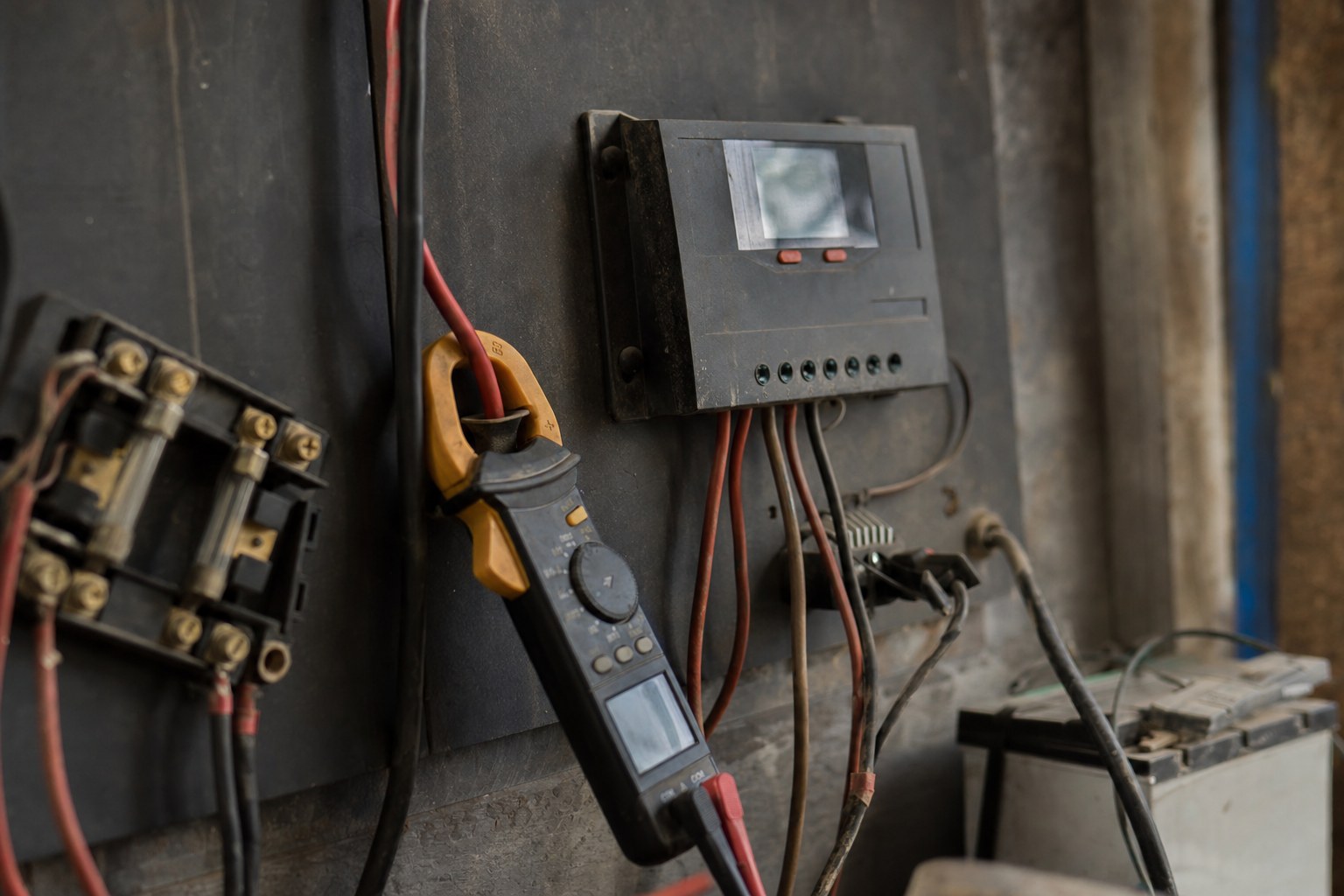
Wire a 200W panel into a 12V bank and 16.7A travels the cable between panel and controller. Put that on 16 AWG and the conductor sits 25% over its NEC ampacity ceiling. Watts, amps, volts conversions are not theory-shelf trivia, then. They are the arithmetic that decides whether a build runs for a decade or slowly cooks its own wiring. Fuse rating, conductor size, controller capacity: each one is derived from this single relationship.
Van build, 400W RV roof, permanent cabin array, the numbers behave identically. The tool underneath does the conversion, then hands back voltage drop, controller size, and a gauge, all in one pass.
I know these two values:
Amps =
Enter two values above
Wire Gauge Min
—
NEC 125% factor applied
MPPT Min
—
uses charging voltage
System Voltage
—
enter watts to see
For full system sizing (battery, panels, inverter), use the Solar Sizing Calculator.
Two Equations Behind Every Circuit in the Build
Three quantities describe any solar circuit:
- Amps (A) = current, the rate electrons move through a wire.
- Volts (V) = pressure, the force sending that current down a conductor.
- Watts (W) = power, the rate energy gets consumed.
The Relationship Everything Else Derives From
P = V x I
P is watts, V is volts, I is amps. Rearranged three ways, it covers every conversion on this page:
| Unknown | Worked on a 100W panel, 12V system | Rearrangement |
|---|---|---|
| Amps | 100W / 12V = 8.3A | Watts / Volts |
| Volts | 100W / 8.3A = 12V | Watts / Amps |
| Watts | 12V x 8.3A = 100W | Volts x Amps |
Where Ohm Comes In
Resistance and voltage drop need a second equation:
V = I x R
Here V is the voltage lost, I is current in amps, R is resistance in ohms. It puts a number on the power a cable burns off inside itself, which is why it dominates long panel-to-battery runs and barely registers on short ones.
What a Panel Spec Sheet Actually Gives You
A data sheet never prints one plain "watts" figure. Five values carry the design:
- Pmax -- power output at standard test conditions (STC). The wattage on the box.
- Vmp -- the voltage the panel sits at while delivering Pmax.
- Imp -- the current the panel delivers at Pmax.
- Voc -- open circuit voltage, measured with no load. Always above Vmp, and the value controller input limits get checked against.
- Isc -- short circuit current, the ceiling on what the panel can push. Always above Imp, and the value NEC 690.8 sizes wire and fuses from.
Conversions run on Pmax and Vmp: Imp = Pmax / Vmp. Safety math runs on Isc.
The Renogy 100W Kit, Converted
Renogy's 100W 12V Starter Kit lists at $160 (Apr 2026) and carries one monocrystalline 100W panel. 100W / 12V = 8.3A. Conductor size, fuse rating, controller capacity: each decision downstream traces back to that 8.3A.
Reading What the Calculator Hands Back
Step 1: Pick the pair already in hand: Amps + Volts, Watts + Amps, or Watts + Volts. Most builders arrive holding a system voltage and panel wattage.
Step 2: Type them in. Panel wattage comes off the spec sheet as Pmax. For voltage, feed it the bus (48V, 24V, or 12V) when the goal is conductor sizing, or Vmp when the goal is maximum power point math.
Step 3: Take the output. Alongside the missing third value come three derived numbers: a note on the bus, an MPPT floor, and a gauge that already carries the 125% NEC factor.
Two details in that output are worth knowing. Gauge comes from Isc x 1.25 rather than Imp, per NEC 690.8. Controller size comes from charging voltage rather than nominal: 57.6V on a 48V bank, 28.8V on a 24V bank, 14.4V on a 12V bank. Swap 14.4V for 12V and the current figure lands roughly 20% high.
Pmax, Vmp, Imp, Voc, Isc: every panel ships all five, either on a sticker stuck to its rear or inside the listing.
Voltage Is the Lever That Moves Wire Cost
The relationship runs inverse. Freeze the watts, cut the voltage, and current climbs to compensate. More current buys thicker conductor, bigger fuses, and a costlier parts list at every point in the system.
The Same 600W at Three Voltages
| System | Copper for a 20ft run (40ft of wire) | Cost/ft | Gauge | Current |
|---|---|---|---|---|
| 48V | ~$7.20 | ~$0.18 | 14 AWG | 12.5A |
| 24V | ~$24 | ~$0.60 | 10 AWG | 25A |
| 12V | ~$160 | ~$4.00 | 6 AWG | 50A |
That last column counts 40ft of wire for a 20ft run, positive and negative conductors both. Copper THWN-2, ordinary retail pricing.
Read the spread rather than the rows. Wiring 600W at 12V means 50A through 6 AWG, roughly $4.00/ft, so $160 of copper for one 20ft run. The identical 600W at 48V is 12.5A through 14 AWG at roughly $0.18/ft: $7.20.
A $153 gap, one run, same power. That gap is why serious off-grid installs above 800W land on 48V with near-total consistency. Panels cost what panels cost. Batteries do carry a per-cell premium once they get strung in series. The conductor savings, though, repeat on every circuit in the build.
Picking a Voltage
12V, under <data>300W</data>, mostly DC loads. Single-panel RV setups, small van builds, anything where lights, USB, and water pumps pull straight off 12V DC. Automotive and marine accessories are 12V native almost without exception. Copper stays cheap as long as runs stay under 10ft and current stays under 25A.
24V, mid-size RV and portable stations, <data>300W</data> through <data>800W</data>. Current halves against 12V. NUE's SunCase 605, $980 as of Apr 2026, runs 24V internally and moves 400W on the gauge a 12V build would burn on 200W. Add air conditioning or an induction cooktop to an RV and 24V keeps the wiring bill down without pushing anyone into specialist components.
48V, <data>800W</data> and up, cabin and homestead. The default for anything permanent. Portable stations do it too: Anker's SOLIX C1000 Gen2, $449 as of Apr 2026, is 48V on the inside even while accepting 12V input, because lower internal current buys smaller busbars, thinner PCB traces, and less weight. BLUETTI's AC70P, $499 as of Apr 2026, is built the same way.
Settle this before anything gets ordered. Changing system voltage after installation means a new charge controller, a rewired battery bank, and most likely a new inverter.
Five Real Kits Through the Same Arithmetic
Three system voltages, five kits, the conversion applied to each:
| Kit | Bus | Panels | Sticker | Current (W/V) | Gauge floor (NEC x1.25) | MPPT floor |
|---|---|---|---|---|---|---|
| Anker SOLIX C1000 Gen2 | 48V | 600W | $449 (Apr 2026) | 12.5A | 14 AWG | 15A |
| BLUETTI AC70P | 48V | 500W | $499 (Apr 2026) | 10.4A | 14 AWG | 15A |
| NUE SunCase 605 | 24V | 400W | $980 (Apr 2026) | 16.7A | 12 AWG | 20A |
| Eco-Worthy 200W 12V | 12V | 200W | $170 (Apr 2026) | 16.7A | 12 AWG | 25A |
| Renogy 100W 12V Starter | 12V | 100W | $160 (Apr 2026) | 8.3A | 14 AWG | 15A |
Panel wattage is not what drives the copper bill in that table. System voltage is.
Compare two rows. Eco-Worthy's 200W kit at 12V pulls 16.7A. Anker's SOLIX C1000 Gen2 at 48V pulls 12.5A while making three times the power. The two gauges land close together, and yet 600W travels on 14 AWG inside the Anker while 200W demands 12 AWG in the Eco-Worthy.
Turning Amps Into a Wire Gauge
American Wire Gauge numbers set a safe current ceiling for each conductor size. The scale runs backwards: a smaller AWG number means thicker wire and more ampacity.
Free-Air Ampacity, Gauge by Gauge (75°C, per NEC 310.15)
| Gauge | Where it lands in solar | Ceiling |
|---|---|---|
| 4 AWG | 800W+ at 12V | 70A |
| 6 AWG | 600W+ at 12V | 55A |
| 8 AWG | 400-480W at 12V | 40A |
| 10 AWG | 300-360W at 12V | 30A |
| 12 AWG | 200-240W at 12V; 400W at 24V | 20A |
| 14 AWG | 400-600W at 48V; 100-150W at 12V | 15A |
| 16 AWG | Under 150W at 12V | 13A |
Why Code Adds 25%
Running current is not what solar wire gets sized against. NEC 690.8 sizes it against Isc x 1.25. Isc sits above Imp by definition, being the most current a panel can push under any condition the day throws at it.
Isc lives on the spec sheet under "Short Circuit Current (Isc)." A typical 100W monocrystalline panel lists 5.5-6.0A. A 200W panel lists 10-11A.
The Conduit Penalty
Free air is what the table above assumes. Pull the same wire through conduit and NEC 310.15(B)(3) forces an upsize: put 4-6 current-carrying conductors in one conduit and the free air rating drops to 80%. In the field that lands on a single gauge step up.
Eco-Worthy 200W 12V, Worked
Eco-Worthy's 200W kit, $170 as of Apr 2026, carries a nominal array current of 16.7A. Apply code: 16.7A x 1.25 = 20.8A. Against the table, 14 AWG tops out at 15A and 12 AWG at 20A, so both come up short of 20.8A. The panel-to-controller run needs 10 AWG (30A rated) to be legal. Gauge for the wiring in the box goes unstated in the product listing.
Sizing the Charge Controller From the Amps
Go too small on the controller and it clips output, throwing away harvest already paid for. Go too big and money sits parked in a spec the system never reaches. Either way the sizing formula wants amps, so panel watts have to be converted first.
The Formula
Controller amps = (array watts / charging voltage) x 1.25
Charging voltage. Not nominal. That is where most builders slip: a 12V bank never actually charges at 12V, it sits at 14.4V, the LiFePO4 absorption target. Substitute 12V for 14.4V and the answer arrives 20% high, enough to talk a buyer into a controller one size past what the build needed.
| Bank | Absorption target |
|---|---|
| 48V | 57.6V |
| 24V | 28.8V |
| 12V | 14.4V |
Three Systems, Worked
| Build | Controller it needs | Arithmetic | Charge V | Array |
|---|---|---|---|---|
| NUE SunCase 400W/24V | 17.4A -- 20A MPPT (built-in) | (400 / 28.8) x 1.25 | 28.8V | 400W |
| Eco-Worthy 200W/12V | 17.4A -- 20A MPPT | (200 / 14.4) x 1.25 | 14.4V | 200W |
| Renogy 100W/12V | 10A min, 15A standard (9.7A) | (100 / 14.4) x 1.25 | 14.4V | 100W |
Renogy's 100W build lands at 9.7A, well inside the 15A unit that is the smallest size anyone really sells. Eco-Worthy's 200W lands at 17.4A and needs a 20A MPPT. Drop a 15A unit in instead and roughly 15% of a clear day's harvest gets clipped away.
MPPT Against PWM
Panel voltage a battery cannot use gets turned into charging current by an MPPT, and across most conditions that is worth 20-30% more energy than PWM delivers. Anything past 200W of panel capacity leaves no real alternative. PWM ($20-50) keeps a niche: uncomplicated sub-200W builds in mild climates, where losing 20-30% of the harvest is a fair price for the cheaper part.
The Input Ceiling Nobody Checks
Amps are only half of controller sizing. The other half is maximum input voltage. Take Voc, multiply through by however many panels sit in series, then by 1.2 for cold weather, and check the result against the controller's rated input maximum. Cold pushes Voc up by roughly 20%. Cross that ceiling and the controller is destroyed permanently, not merely tripped.
The Long-Run Problem: Voltage Drop
Ampacity sets the gauge that will not catch fire. Voltage drop sets the gauge that will not waste the harvest. Once runs get long, the second number is routinely the larger of the two, and ampacity stops being the binding constraint.
Putting a Number on What the Cable Eats
Vdrop = 2 x run length (ft) x current (A) x resistance (ohm/ft)
That 2 is the round trip: out on the positive conductor, back on the negative.
Copper resistance, per foot:
| Gauge | Ohms per foot of copper |
|---|---|
| 8 AWG | 0.000641 |
| 10 AWG | 0.00102 |
| 12 AWG | 0.00162 |
The Eco-Worthy 200W Again: 20ft of Run at <data>16.7A</data>
- 8 AWG loses 0.43V (2 x 20 x 16.7 x 0.000641), or 3.6% of 12V. Over the 2% ideal, but installations live with it.
- 10 AWG loses 0.68V (2 x 20 x 16.7 x 0.00102), or 5.7% of 12V. Not acceptable.
- 12 AWG loses 1.08V (2 x 20 x 16.7 x 0.00162), or 9.0% of 12V. Badly out.
On 12V, then, 16.7A over 20ft bottoms out at 8 AWG, two full sizes above what ampacity by itself would have called for. On 12V that penalty compounds with every foot added. It is the argument for 24V and 48V again, arriving from a different direction.
Rule of thumb: over 10ft on a panel-to-controller run, add one AWG to the ampacity minimum. Under 10ft, ampacity alone is enough.
Voltage drop is folded into the calculator automatically, computed from the run length entered.
Questions Builders Send Us
A 100W solar panel produces how many amps?
System voltage decides it. 100W / 12V = 8.3A; 100W / 24V = 4.2A. Controller sizing wants a different number: take Isc off the spec sheet (5.5-6.0A is typical on a 100W monocrystalline panel) and multiply by 1.25 per NEC 690.8. Wire and fuse sizing follow Isc, never the calculated Imp.
Which wire gauge does a 200W solar panel need?
200W at 12V is 16.7A, and the 125% code factor lifts the floor to 20.8A. 12 AWG is rated 20A, just under, so the answer is 10 AWG (rated 30A). Past 15ft, step to 8 AWG so voltage drop stays under 3%. Eco-Worthy's 200W Starter Kit, $170 as of Apr 2026, leaves its included wiring's gauge unstated.
Watts or amps for charge controller sizing, does the difference matter?
It does, because controllers are sold in amps. Convert first: controller amps = (panel watts / charging voltage) x 1.25, where charging voltage is 57.6V on 48V, 28.8V on 24V, and 14.4V on 12V. Feed it nominal voltage (12V) in place of charging voltage (14.4V) and the answer lands roughly 17% low, which is how buyers end up a tier short.
Why does every conversion calculator return a different number?
Each one answers a different question. Most run Pmax / Vmp off the spec sheet; some substitute Voc or Vnom. Controller sizing wants Isc x 1.25. Wire sizing wants Pmax / system voltage x 1.25. Operating efficiency, worst-case safety margin, and NEC compliance are three separate constraints, so they get three separate formulas.
Is 24V worth the added complexity over 12V?
Over 400W of solar capacity, yes. Halving the current takes a 400W system from 8 AWG down to 12 AWG. Under 200W on a van or simple RV build, 12V costs nothing extra, and every standard DC accessory (fans, lights, USB outlets) is 12V native anyway. The crossover falls near 300-400W, and wire run length moves it.
Will the calculator handle AC loads behind an inverter?
It will, with one correction. Inverters land near 90% efficiency, so divide the AC figure by 0.90 to reach DC watts. An AC load of 1,000W pulls 1,111W off the battery side. Enter 1,111W rather than 1,000W and the wire and controller numbers come out right. Battery capacity and array dimensions are a bigger question; the solar sizing calculator covers those.
Read Next
Explore the Data
Track the prices, not the hype
We track real build costs across 400+ off-grid kits and email the biggest verified price drops every week. See this week’s drops.