Solar Panel Kits and Bundles: 344 Audited, Only 2 Ship Complete
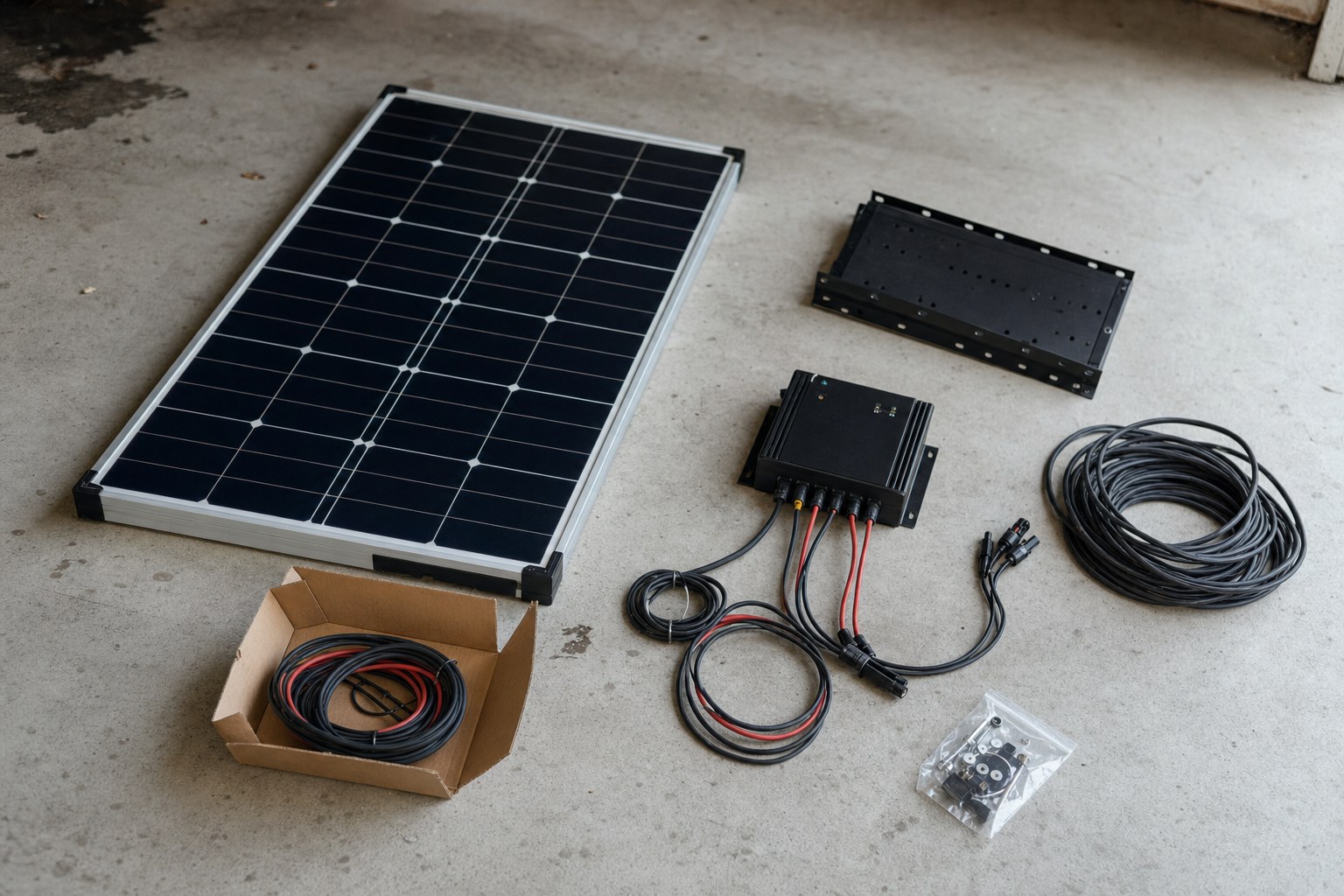
Two. That is how many of the 344 bundles in our solar database arrive holding every part a working system needs. The other 342 demand a second purchase before they can make usable power, and nothing on the price tag admits it.
Those listings refresh every 6 hours against live retail feeds. Advertised prices top out at $2,799 and start at $221, covering everything from a weekend camping bundle to a cabin that will never see a utility pole. Average completeness across the catalog: 74.0%. Chemistry has consolidated hard, and 89.8% of what we track is now built on LiFePO4.
The number that should decide a purchase is cost per Wh, and it spreads 2x here: the Eco-Worthy 400W Ultra delivers energy at $0.39/Wh while the EcoFlow River 2 Max charges $0.85/Wh. Sticker price communicates none of that. Below is the parts audit, the sizing math worth running before you shop, and what each price bracket really buys once its gaps get closed. Every kit carries a Completion Gap Receipt setting the advertised number beside real build cost, and each figure here is pulled live.
See all 344 kits in the database
Seven Roles, and the Ones the Box Skips
The same post cycles through r/solar and r/vandwellers every few weeks. Somebody buys a "complete solar kit," cuts the tape, and finds a couple of panels next to a charge controller. Nothing that stores power. Nothing that converts it. Several hundred dollars still standing between them and one working outlet.
Blame the word "complete," which vendors attach to any bundle at all. Our audit ignores the marketing and scores the parts list against 7 jobs no off-grid system can run without:
- Panels -- turn sunlight into DC current.
- Charge Controller -- meter what the array sends into the battery, by either MPPT or PWM.
- Battery -- bank the energy for after dark.
- Inverter -- step DC up into household AC.
- Wiring -- cable, connectors, fuses; whatever ties the parts together.
- Mounting -- the brackets, Z-mounts, or tilt rails that hold an array down.
- Monitoring -- some way to read system state, whether a screen, a radio, or a phone.
Run all 344 through that scorecard and the average lands on 74.0%. Holes cluster in predictable places. Inverter absent: 32.3%. Charge controller absent: 27.9%. No battery whatsoever: 11.0%. Somebody still has to buy those parts, so the inverter listings and battery listings show what closing each hole costs.
Renogy's 200W RV Kit (renogy-200w-rv-kit) is the clean case study. Its listing says $221. The carton holds monocrystalline panel totaling 200W, plus a PWM charge controller rated 30A, and after that, nothing. No storage, no inverter, no monitoring. Audit score: 57%.
Powering an actual load off it means buying LiFePO4 storage at roughly ~$150-200, then an inverter for another ~$70-100. Real build cost reaches ~$440+, double what the listing advertises. Its Completion Gap Receipt lays all of it out: sticker on top, each mandatory missing part with an estimated cost, real build cost at the bottom.
Two kits in the catalog audit at 100%. Jackery's 1000 Plus (jackery-1000plus-2x100w) is one, $899. Renogy's 400W Complete LiFePO4 (renogy-400w-complete-lifepo4) is the other, $1,899. Everything else in the database is a partial system wearing a finished system's price tag.
Which makes the habit worth building a boring one. Read the parts list against all 7 jobs, price whatever is absent, add it to the sticker, and compare kits only after that. Our gap pricing leans on what mid-range LiFePO4 costs today (~$0.40/Wh), what pure sine inverters cost today, and standard cable cost for whichever voltage class the kit runs.
Size the Watt-Hours Before You Shop the Kits
One r/solar post captures the failure mode whole: a 100W kit bought to run a 12V fridge, which managed 4 hours at max output and then quit.
That buyer was not unlucky. Arithmetic beat them at the order page. Working off 4 peak sun hours, average conditions give a 100W panel something like 400Wh/day. A compressor fridge on 12V, meanwhile, never really stops: 30-60W continuously, which totals 720-1,440Wh/day. The panel was 3x too small before it shipped.
Daily watt-hours, not panel wattage, decide which bracket you belong in. Four of them cover nearly everybody:
Weekend camper, <span class="font-mono">200-300 Wh/day</span>. Phones, LED lights, a small fan. Kits under $500 exist for this exact load. Draw 300Wh/day and an EcoFlow River 2 Pro, holding 768Wh, rides out two full sunless days.
Full-time RV, <span class="font-mono">1,000-2,000 Wh/day</span>. Water pump, 12V fridge, laptop, lights. Storage and panel wattage inside $500-$1,000 cover it. The standout, holding 1,264Wh, is Jackery's 1000 Plus, the one kit in the bracket audited 100% complete, and it meets minimum daily need with no follow-up purchase.
Off-grid cabin, basic, <span class="font-mono">3,000-5,000 Wh/day</span>. A short appliance list, plus fridge, lights, well pump. Kits from $900 up to $2,000 hold anywhere in 2,048-3,584Wh. Topping that range with 3,584Wh, Eco-Worthy's 400W Ultra buys a single day of autonomy at minimum cabin load. Anything cloudier calls for a generator or more battery.
Whole-home off-grid, <span class="font-mono">5,000-8,000 Wh/day</span>. Everything, HVAC included. Kits over $2,000 reach only the bottom edge of that band. Our biggest system here, Bluetti's RV5, holds 5,120Wh, and most real whole-home builds end up custom 48V configurations running several battery banks.
Whatever number you land on, pad it. Aim 1.5x past whatever daily Wh you calculated, absorbing cloud cover, seasonal swing, and the capacity every pack loses as it ages, so a cabin pulling 3,000Wh/day goes shopping for 4,500Wh of nameplate. Then remember nameplate is not what you get to spend. LiFePO4 keeps its value best above 20% state of charge, putting the working ceiling at 80% of rated capacity. Practically, Eco-Worthy's 3,584Wh is closer to 2,867Wh a cycle.
Run your daily Wh through the calculator
Voltage Is the One Decision You Cannot Undo Cheaply
Copper prices this mistake. Cable a load of 3,000W and 48V costs $12-20 where 12V costs $80-120, a 6-10x swing on an otherwise identical system. Voltage dictates gauge, cable spend, how far an array can sit from the battery, and which controllers are even eligible.
12V handles systems up to 300W. Weekend camping, vans, boats, smaller RVs. Portable kits default here, and each of the three under-$500 kits runs 12V nominal inside an integrated station. Gauge stays cheap while wattage stays low, then current turns hostile past 300W. Even 300W of load pulls 25A, wanting 10 AWG on runs longer than 10 feet.
24V covers 300W to 1,500W. Workshops, sheds, big RVs. Doubling voltage halves current, which buys thinner wire and longer runs: 1,000W pulls ~42A here, against ~83A down on 12V. Both Eco-Worthy's 400W Ultra and Renogy's 400W Complete support it, and it pays back over long panel-to-battery runs.
48V is for anything above 1,500W. Cabin, whole-home. Even at 48V, a system of 2kW+ starts at 2/0 AWG between battery and inverter. Drop the same system to 12V and the spec climbs to 4/0 AWG or heavier, the point where wiring quits being practical. Nothing pre-built here runs 48V natively, so a whole-home 48V build means custom sizing outside the kit market. The 48V-capable batteries are where that begins.
Changing your mind later is not a settings change. It is a new controller, a new bank, and every DC cable pulled and replaced. Pick once.
Size the system in the calculator
Under $500: Three Kits, and the Cheapest Is Not the Cheapest
Below $500 there are three. Each pairs an integrated station with folding panels, each audits 86% complete, and each runs LiFePO4 rated for 3,000+ cycles. Storage reaches 768Wh at the top and 504Wh at the floor. Energy price runs $0.85/Wh down to $0.61/Wh.
Bluetti 200W + AC50P (bluetti-200w-ac50p) lists at $359 and audits 86%. Inside sits 504Wh, fed by folding panel totaling 200W, pricing out at $0.71/Wh. Best panel wattage per dollar down here, and given a full 200W in direct sun the pack refills in about 2.5 hours.
EcoFlow River 2 Max + 160W (ecoflow-160w-max-ecoflow-river-2-max-160w-panel) wants $437 and returns 512Wh behind panel totaling 160W. Its audit matches the neighbors at 86%, but the math lands on $0.85/Wh, the worst energy price anywhere in this guide.
EcoFlow River 2 Pro + 160W (ecoflow-river2pro-160w) takes $469 for 768Wh off panel totaling 160W: $0.61/Wh, audit 86%, price trending down.
Read those three in order and the premise of this site falls out. Bluetti wins the price war at $359 and loses the value war. Pay 31% more for the River 2 Pro, $469, and 52% more energy comes back. Cost per Wh knows that. Sticker price does not.
The 86% deserves a footnote, coming off the same 7-job audit, since an integrated station already buries controller, inverter, and battery inside one case. Its missing 14% is normally a standalone monitor, or hardware for mounting, and neither stops a kit generating or storing power. All 3 work out of the carton. Anywhere inside 200-300Wh/day, any of them yields 1.5-3 days of runtime with no sun at all.
PREMIUM 50 AC50P 504Wh/700W
RIVER 2 Pro 768Wh + 160W Panel
Every kit under $500 | Put these three head to head
$500 to $1,000: The Tier Where Completeness Finally Shows Up
One of the catalog's two 100% kits lives in this bracket, Jackery's 1000 Plus, priced $899 and falling. Storage covers a 65% spread, 1,264Wh at the ceiling over 768Wh at the floor, while energy price compresses into $0.66-$0.71/Wh. Being the most consistently priced tier we track moves the decision off value math, onto what physically ships.
EcoFlow River 2 Pro + 160W Panel (ecoflow-160w-pro-ecoflow-river-2-pro-160w-solar-panel) houses the same hardware as the budget-tier River 2 Pro, carried by a different retailer at a different number: $519, 768Wh, panel totaling 160W, audit 86%, $0.68/Wh.
Bluetti AC70P Eclipse Kit (bluetti-500w-ac70p-eclipse-kit-1-x-200w-folding-panels) throws panel totaling 500W at 864Wh of storage for $609, which is 2.5x the glass of anything else here. Audit 86%, energy price $0.70/Wh.
Jackery 1000 v2 + 200W (jackery-1000v2-200w-panel) turns $709 into 1,070Wh behind panel totaling 200W: $0.66/Wh, audit 86%.
Jackery 1000 Plus + 2x100W (jackery-1000plus-2x100w) is the complete one. Audited 100%, holding 1,264Wh behind panel totaling 200W, $0.71/Wh, priced $899 and falling.
The AC70P is the odd unit, and worth understanding. Priced $609, its solar array of 500W gives it the fastest refill in the bracket: direct sun fills those 864Wh inside 2 hours. For an RV parked between drives for a few hours, refill rate is the constraint that actually bites, not storage volume.
Then the completeness question. Jackery's 1000 Plus runs $0.05/Wh over its own 1000 v2, and that nickel buys monitoring, wiring, and mounting hardware the v2 leaves out. Audit 100% means the receipt shows nothing beneath the sticker line. Anyone needing to unbox and run the same afternoon pays that premium for parts, not for a badge.
1000 Plus + 2x SolarSaga 100W, 1264Wh Expandable
Top RV kits | Line these four up
$900 to $2,000: A 2x Cost Gap Hiding Behind Matching Spec Sheets
Three cabin kits, each carrying panel totaling 400W, each running LiFePO4 rated 3,000-6,000 cycles, which is 8-16 years at a cycle a day. On paper: three versions of one product. Energy price disagrees. Eco-Worthy delivers at $0.39/Wh, Renogy's Complete at $0.74/Wh. Nearly 2x apart, identical glass.
EcoFlow DELTA 2 Max + 400W (ecoflow-delta2max-400w) is the integrated pick: $899, holding 2,048Wh behind panel totaling 400W, $0.44/Wh, audit 86%, expandable on add-on batteries out to 6kWh.
Eco-Worthy 400W Ultra + 280Ah (eco-worthy-400w-ultra-280ah) sells the cheapest energy on the site, $0.39/Wh, out of 3,584Wh behind panel totaling 400W, priced $1,400 and falling. Audit 86%. It sits effectively parked on the ~$0.40/Wh LiFePO4 market floor, and that floor moved fast: 2024 had mid-range cells at ~$1.00/Wh.
Renogy 400W Complete LiFePO4 (renogy-400w-complete-lifepo4) is the catalog's other 100% kit: $1,899, holding 2,560Wh behind panel totaling 400W, $0.74/Wh, with Bluetooth monitoring, complete wiring, and mounting hardware all boxed.
Set the extremes together. Eco-Worthy holds 40% more energy for $499 less. Renogy charges $0.35/Wh for being complete, and what that premium delivers is a Bluetooth monitor plus a name-brand ecosystem. Rational or not depends entirely on which you optimize: plug-and-play, or cost per Wh.
Format, more than price, is the true fault line in this bracket. The DELTA 2 Max is a station, so panels plug in and it works. Eco-Worthy and Renogy are component builds, where you wire array to controller to battery to inverter yourself, in 10-4 AWG depending on run length, over another $30-80 of cable nobody boxed. The DELTA 2 Max also scales to 6kWh on add-on batteries, letting it grow into premium-tier storage with no rewire.
400W 12V — 200Ah LiFePO4
Cabin kit shortlist | Run a cabin comparison
Above $2,000: Four-Figure Prices, Still 86% Complete
Here is the finding this bracket deserves to be known for. Audit every kit over $2,000 and they all score 86%. Not one hits 100%. Outspending the other three tiers combined buys no finished parts list, and both kits that do audit complete cost less than anything on this list. Glass ranges 2,400W down to 350W, storage 5,120Wh down to 2,764Wh.
Anker SOLIX F3000 Quad Kit (anker-2400w-anker-solix-quad-kit-4-x-200w-rigid-solar-panels) leads on glass, its array totaling 2,400W, some 6x the next largest up here, feeding 3,072Wh. Listed $2,072, audited 86%, priced $0.67/Wh.
Bluetti AC300 + B300K + PV350 (bluetti-ac300-b300k-pv350) is modular and expandable, and the weakest value up here. Its $2,299 covers 2,764Wh behind panel totaling 350W, working out to $0.83/Wh at audit 86%: least storage, worst energy price on the list.
Jackery 2000 Plus + 4,085Wh (jackery-2000plus-4085wh-2x200w) banks 4,085Wh behind panel totaling 400W, priced $2,349 and falling: $0.58/Wh, audit 86%.
Bluetti RV5 Basic Solution (bluetti-1800w-bluetti-rv-basic-solution-set-rv5-power-hub-b4810-b) is the biggest system we list, 5,120Wh against an array totaling 1,800W, priced $2,799 at $0.55/Wh, audit 86%, built around a dedicated power hub for permanent RV installation.
The Anker's ratio is unusual enough to flag. Aim an array of 2,400W at storage of only 3,072Wh and full sun refills the entire pack inside roughly 1.3 hours. That is a daytime-load machine, built to run things while the sun is up rather than coast on reserves. Take grid and generator away and its 3,072Wh lasts about a day at a cabin's draw.
The bracket's real decision sets Jackery's 2000 Plus against Bluetti's RV5. Bluetti asks $450 more, handing back 1,035Wh of extra storage and 1,400W of extra glass. It is also bolted-down hardware, engineered around a power hub for permanent installation. Jackery stays portable, and that is what matters if you split time between locations or carry the unit inside for winter. Chemistry is a wash, both LiFePO4 at 3,000+ cycles.
2000 Plus + PackPlus E2000 Battery + 2x 200W Panels (4085Wh)
RV5 - /5,000W + RV5 Power Hub + B4810 Battery
Every kit over $2,000 | Compare the premium four
Four Details That Decide the Build
Where MPPT Earns Its Price Premium
An MPPT (Maximum Power Point Tracking) controller turns surplus array voltage into extra charging amps, harvesting 5-30% beyond what a PWM (Pulse Width Modulation) unit recovers. It costs roughly 2x as much.
PWM works by dragging array voltage down to battery voltage, then dumping the difference as heat. None of it returns. Put an array of 200W on 12V and 30-60W of generation goes out the vents.
The threshold is simple. Choose MPPT once array voltage sits more than 5V above the battery, or once the array clears 200W. The market already agrees: in this guide, every kit priced over $500 runs MPPT or an integrated equivalent, and PWM survives only at the smallest scale, as on Renogy's 200W RV Kit. Proprietary charge regulation inside stations from Bluetti, EcoFlow, and Jackery performs at MPPT-equivalent efficiency.
Copper, and the Bill Nobody Budgets For
Wire that is too thin drops voltage across the run, and whatever the drop takes never arrives at battery or inverter. Distance compounds it.
Concrete numbers: an inverter of 2kW+ needs 2/0 AWG minimum from the battery on 48V, or 4/0 AWG and heavier to do the identical job on 12V. Cable a load of 3,000W and 48V costs $12-20 where 12V costs $80-120. Cabins and whole-home builds run 48V because of that line item, not out of preference.
A hard ceiling sits on the array side too. MC4 connectors are rated to 30A, so an array pushing past ~360W on 12V is over the limit and gets split into parallel strings or moved up in voltage. Anker's SOLIX F3000, at 2,400W, runs several parallel strings for exactly that reason.
Chemistry Is Already Settled
LiFePO4 (lithium iron phosphate) now ships in 89.8% of what we track. AGM (absorbed glass mat) has fallen under 1%.
Cycle ratings explain it. Where AGM manages 500-1,200 cycles, LiFePO4 runs 3,000-6,000. Cycle a pack daily and the difference is 1.5-3 years of service against 8-16 years.
Price closed AGM's last argument. 2025 put mid-range LiFePO4 at ~$0.40/Wh, down from ~$1.00/Wh in 2024, and Eco-Worthy's 400W Ultra at $0.39/Wh shows the chemistry has reached the number AGM held two years back. Stretch the horizon to ten years and every cycle off LiFePO4 costs less, whatever the upfront figure says.
Audit the Bill of Materials Before You Pay
To restate the finding governing every bracket above: of 344 kits, 2 reach 100%, the catalog averages 74.0%, and the jobs likeliest to go unfilled are the inverter (missing from 32.3%) and the charge controller (missing from 27.9%).
Real build cost exists to make kits comparable. Price the mandatory missing parts, report what a functioning system costs, and you have the only number worth setting beside another kit's. Each detail page carries its own Completion Gap Receipt with the line-by-line breakdown, and every kit here links to one.
Every Kit, Ranked by Cost per Wh
All 15 audited here, cheapest energy first, since that is the order sticker price hides. [C] marks a kit audited 100% complete. [F] marks a falling price.
| Kit | Cost per Wh | Advertised Price | Completeness | Panels (W) | Storage (Wh) |
|---|---|---|---|---|---|
| Eco-Worthy 400W Ultra + 280Ah [F] | $0.39/Wh | $1,400 | 86% | 400 | 3,584 |
| EcoFlow DELTA 2 Max + 400W | $0.44/Wh | $899 | 86% | 400 | 2,048 |
| Bluetti RV5 Basic Solution | $0.55/Wh | $2,799 | 86% | 1,800 | 5,120 |
| Jackery 2000 Plus + 4,085Wh [F] | $0.58/Wh | $2,349 | 86% | 400 | 4,085 |
| EcoFlow River 2 Pro + 160W [F] | $0.61/Wh | $469 | 86% | 160 | 768 |
| Jackery 1000 v2 + 200W | $0.66/Wh | $709 | 86% | 200 | 1,070 |
| Anker SOLIX F3000 Quad Kit | $0.67/Wh | $2,072 | 86% | 2,400 | 3,072 |
| EcoFlow River 2 Pro + 160W (Shop Solar) | $0.68/Wh | $519 | 86% | 160 | 768 |
| Bluetti AC70P Eclipse Kit | $0.70/Wh | $609 | 86% | 500 | 864 |
| Bluetti 200W + AC50P | $0.71/Wh | $359 | 86% | 200 | 504 |
| Jackery 1000 Plus + 2x100W [C] [F] | $0.71/Wh | $899 | 100% | 200 | 1,264 |
| Renogy 400W Complete LiFePO4 [C] | $0.74/Wh | $1,899 | 100% | 400 | 2,560 |
| Bluetti AC300 + B300K + PV350 | $0.83/Wh | $2,299 | 86% | 350 | 2,764 |
| EcoFlow River 2 Max + 160W | $0.85/Wh | $437 | 86% | 160 | 512 |
| Renogy 200W RV Kit | N/A (no battery) | $221 | 57% -- real build cost ~$440 | 200 | 0 |
Stack 2-4 kits against each other | Open the kit database
Common Questions
Does a solar panel kit include a battery?
Usually. Of our 344 listings, 89.0% arrive with storage. The 11.0% going without are panel-and-controller bundles pitched at people who own a bank already, Renogy's 200W RV Kit being the archetype. Integrated station kits from Bluetti, EcoFlow, and Jackery have LiFePO4 built into the case every time.
How big should an RV solar kit be?
Budget 1,000-2,000 Wh/day for full-time RV living, pointing you at storage of 1,000Wh or better behind panel of at least 200W+. Inside $500-$1,000 exactly one kit needs no follow-up purchase: Jackery's 1000 Plus, 1,264Wh, audited 100%. Filter to RV kits for the rest.
Is a kit cheaper than buying the components separately?
Typically by 15-30%, and it removes compatibility risk between controller, battery, and array too. What gets traded away is flexibility, since a kit locks you into one brand's ecosystem. Under 2,000Wh, take the kit. Over 2,000Wh, a DIY component build leaves more room on voltage and capacity.
MPPT or PWM: what actually changes?
MPPT converts surplus array voltage into amperage and pulls 5-30% more power. PWM clips output at battery voltage, shedding the rest as heat. Above 200W of array, the extra harvest pays MPPT's price difference back inside a year.
Can a kit run a whole house?
Roughly 5,000-8,000 Wh/day is what a house wants. Our largest, Bluetti's RV5 Basic Solution at 5,120Wh, only touches minimum daily need, and only for a day. Genuine whole-home off-grid means professional installation, a dedicated inverter panel, several battery banks, and a custom 48V build. Cable alone tells the story: on 48V a whole-home system of 5,000W stays under $40 of wire, where 12V runs past $200. Model it in the sizing calculator.
How many years will the battery last?
LiFePO4 sits in 89.8% of kits, rated 3,000-6,000 cycles, or 8-16 years at a cycle a day. The same duty gets 500-1,200 cycles out of AGM, which is 1.5-3 years.
LiFePO4 asks more per Wh at checkout and returns a far lower lifecycle cost. Compare battery chemistries across every type we track.
Read Next
Explore the Data
Track the prices, not the hype
We track real build costs across 400+ off-grid kits and email the biggest verified price drops every week. See this week’s drops.