Where the $/Wh Floor Sits: 173 Portable Power Stations, Priced by the Watt-Hour
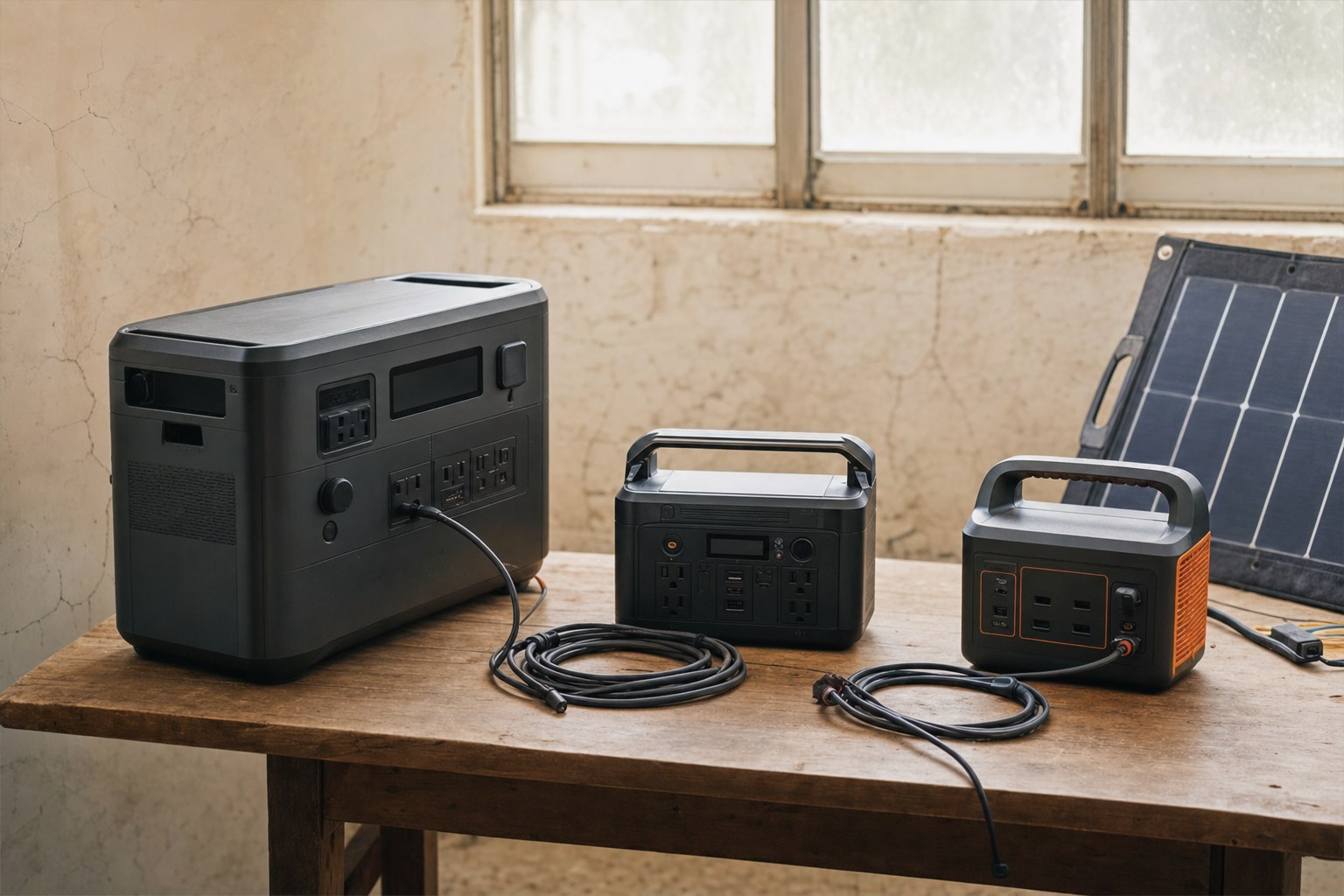
Badged Jackery, Bluetti, Anker, or EcoFlow, the 173 portable power stations in our catalog advertise anywhere from $199 to $3,500, and the rate you pay for storage runs $0.39 to $1.60+ per watt-hour. That spread is the story. Roundups hand out trophies; we publish the spec sheet (capacity, output, chemistry, cost per Wh) and hand you the filters, because the only question worth settling is whether a given box covers your loads at a rate you should accept.
Filter the full 173-unit table by price, capacity, and $/Wh
The Short Version: Three Prices Do All the Work
Cheap is not where the bargain lives. Three price points carry this whole category, and the rest of the field pays a toll to sit between them.
$449 buys 1,024Wh from the Anker SOLIX C1000 Gen2 at $0.44/Wh, the best rate under $500 by a wide margin. $799 buys 2,048Wh at $0.39/Wh from either the EcoFlow Delta 3 Max or the Anker C2000 Gen2, which is the floor across all 173 units we track. $1,299 buys 3,072Wh at $0.42/Wh from the Anker F3000 or the EcoFlow Delta 3 Ultra.
How those three hold up, and what the ground between them costs, is the rest of this page.
Reading the $/Wh Column
Every unit here is sorted on cost per watt-hour, which is real build cost spread over the storage you can actually use. Standalone stations keep that arithmetic honest, because what they cost to build and what they cost to buy are one number. A station arrives complete, with no part left off the box that you have to go buy before it does its job. So $799 against 2,048Wh of storage lands at $0.39/Wh, while $299 against 268Wh lands at $1.12/Wh, close to three times the rate for a fraction of the storage.
Bundles (a station shipped with panels) need a caveat. They carry a higher sticker and deliver more system, but the $/Wh we print is calculated on battery capacity alone. Panel output does not enter the divisor. If you are weighing a bundle against a bare unit you already have panels for, put your own loads through our sizing tool first and compare the two builds, not the two stickers.
What Each Tier Actually Holds
| Tier | Units | Capacity | $/Wh | What the tier looks like |
|---|---|---|---|---|
| Under $500 | 16 | 245–1,024Wh | $0.44–$1.60 | Most stop near 512Wh; Anker's C1000 Gen2 breaks the pattern at 1,024Wh |
| $500–$1,500 | 41 | 512–2,304Wh | $0.39–$0.94 | The cheapest watt-hours we track; C2000 Gen2 and Delta 3 Max both land at $0.39/Wh |
| $1,500–$3,500 | 44 | 2,048–4,096Wh | $0.42–$1.24 | Big banks, a few semi-stationary, expansion modules on offer |
Read the middle row twice. The lowest rate in the database is not in the budget tier and never was. It sits in the $700-$800 band, where 2,048Wh units from EcoFlow and Anker settle at $0.39/Wh. Step up to $1,299 and you get 3,072Wh at $0.42/Wh, which is 50% more capacity for $500 more money.
Four Specs Decide Fit; the Rest Is Trim
Marketing pages list a dozen numbers. Four of them change the answer.
Storage, Measured in Watt-Hours
Watt-hours are the fuel tank. Put a 100W load on a 1,000Wh station and you get roughly 8–9 hours once the inverter takes its cut. That cut is not small and it is not constant: independent testing puts real-world efficiency at 77–90% under heavy draw and 49–77% under light draw, so a trickle load wastes a larger share of the bank than a hard one does. Useful reference draws: laptop 60W, phone charger 18W, mini fridge 50W averaged across its cycling, CPAP 60W, power drill 700W at peak.
Sizing follows from there. 512Wh covers a weekend of phones, lights, and a laptop. 1,000–2,000Wh covers a multi-day trip or a 12–24 hour outage at home. Keeping food cold for days, or running tools for hours, means 2,000Wh+, and there is no clever way around it.
Continuous Watts, and the Surge Behind Them
Continuous output caps what you can run at once. Surge rating, usually 1.5–2x the continuous number, decides whether a motor will start at all. An 1,800W continuous station drives a 1,200W microwave without complaint, then balks at a 1,500W air conditioner, because that compressor demands 3,000–5,000W for the instant it spins up. Two cases from our catalog: the EcoFlow Delta 3 Max holds 2,400W continuous, while Jackery's Solar Generator 1000 v2 (a 200W panel over a 1,070Wh LiFePO4 bank) holds 2,000W. Anything with a motor in it, check both ratings before you buy.
Cell Chemistry: LiFePO4, NCM, and One Sodium-Ion Outlier
LiFePO4 has taken over this price range, and deservedly. It survives 3,000–4,000 cycles before falling to 80% of rated capacity, which is 8–11 years if you drain and refill it daily. NCM still shows up in a handful of budget units, trading longevity for density: more watt-hours in a smaller shell, but only 500–1,000 lifecycles. Sodium-ion is the third option, currently one model (the Bluetti Pioneer Na), built for the cold. It discharges down to -13°F and accepts charge to 5°F, at the cost of a lower cycle rating. Unless you work in that kind of weather, buy LiFePO4.
Refill Speed From Panels
Max solar input sets how long the station stays empty. Cap the input at 200W and a 1,000Wh bank needs about 5–7 hours of decent sun to fill. Raise the cap to 600W and the same bank fills in 2–3 hours. Every station we track has an MPPT controller built in, which pulls 10–30% more out of the same panels than a PWM controller would, so that is table stakes rather than a selling point. The spec to actually verify is the input voltage window (something like 11–58V), which has to match what your panels put out. Third-party panels are where that goes wrong.
Size a bank against your own load list
The Sub-$500 Shelf: One Outlier, Then Steep Rates
16 units live under $500, spanning 245Wh (the EcoFlow River 3) up to 512Wh for most of the shelf. One refuses to behave. At $449, Anker's SOLIX C1000 Gen2 carries 1,024Wh and prices at $0.44/Wh, which is roughly twice what its price neighbors store, at a lower rate than any of them charge.
Drop below that $449 line and the rate climbs fast. EcoFlow's RIVER 2 MAX, 512Wh behind a 500W inverter, asks $269 and works out to $0.53/Wh, a fair number for something sized to car camping and day trips. Under $300, though, the shelf averages $0.85–$1.40/Wh. That premium buys one thing, and it is not energy: it is a package you can carry (under 10 lbs) without thinking about it. Pay it only when weight is the binding constraint.
RIVER 2 MAX 512Wh / 500W + Main Unit Only
SOLIX C1000 Gen2 1,024Wh/2,000W + Main Unit Only
See every unit we track below $500
$500 to $1,500: The Cheapest Watt-Hours We Track
41 units, and the database floor of $0.39/Wh sits inside them, at $799.
Work up through the tier. EcoFlow's DELTA 2 pairs 1,024Wh with a 220W panel for $449: $0.44/Wh counting storage alone, plus a panel you would otherwise be shopping for. Bluetti's Premium 150 (the AC180P) asks $699 for 1,440Wh, or $0.49/Wh, the best rate anywhere between 1,000Wh and 1,500Wh. Jackery's 1000 v2 goes for $709 carrying 1,070Wh plus a 200W panel, and reads as $0.66/Wh against the bank. That gap is the panel showing up in the divisor, not a markup on the battery.
Then the break. At $799, EcoFlow's Delta 3 Max and Anker's SOLIX C2000 Gen2 both put 2,048Wh on the table at $0.39/Wh. Measured against the $449 Anker C1000 Gen2, that is $500 more for 1,024Wh more, an incremental rate of $0.49/Wh on everything you add. The extra watt-hours cost more than the first ones did, and the blended result still beats anything else in the catalog. Between the two, Anker publishes the longer spec sheet: 4,000W peak surge, a 58-minute recharge, expansion to 4kWh, and a 5-year warranty.
DELTA 2 1024Wh + 220W Panel
Solar Generator 1000 v2 + 200W Panel, 1070Wh LiFePO4
Premium 150 AC180P + Main Unit Only
DELTA 3 Max – 2,048Wh / 2,400W + Main Unit Only
Run the Delta 3 Max against the C2000 Gen2
Open this tier in the filter table
$1,500 to $3,500: Wheels, Expansion, and a $0.42 Rate
44 units, holding 2,048Wh to 4,096Wh as standalone boxes, with solar bundles running larger still.
The rung here is $1,299, where Anker's SOLIX F3000 and EcoFlow's Delta 3 Ultra both deliver 3,072Wh at $0.42/Wh. Against the $799 tier, the ladder repeats itself exactly: $500 more for 1,024Wh more, $0.49/Wh on the increment. The F3000 is the more open-ended of the pair: 3,600W out, 2,400W of solar in, room to expand to 12,288Wh, and a 5-year warranty.
Above that, the machines change character. EcoFlow's DELTA Pro bundles a 400W panel with a 3,600Wh station for $1,899, and at that bank size the thing stops being portable in any honest sense. Past $2,000 they arrive with wheels and a pull handle and weigh 40–74 lbs. You can move one across a garage. You are not carrying it to a campsite.
Expansion is the tier's real argument. Anker's F3800 and EcoFlow's Delta Pro both accept bolt-on modules that push storage to 6,000–8,000Wh+ without retiring the base unit, which changes the math on buying big up front.
SOLIX F3000 3,072Wh/3,600W + Main Unit Only
DELTA Pro + 400W Panel
Run the F3000 against the Delta 3 Ultra
What the Spread Comes Down To
The category is a staircase with three steps: $449 for 1,024Wh at $0.44/Wh, $799 for 2,048Wh at $0.39/Wh, $1,299 for 3,072Wh at $0.42/Wh. Each step costs $500 and hands back 1,024Wh, an incremental $0.49/Wh both times you climb.
Stand between the steps and you pay more per watt-hour for the privilege. That is what the data says, and it says nothing kinder about the units priced there. Size your loads first, then buy the nearest step at or above them.
Work out your watt-hours first
Then set two candidates against each other
Questions We Get
How many watt-hours is enough?
Take every device, multiply its watts by the hours you will run it, and total the list. Then add 20–30% on top for what the inverter burns converting DC to AC, more if your loads are small, since efficiency sags below 50W (figure 77–90% when the station is working hard). Worked example: a laptop at 60W and a phone charger at 18W, both going for 8 hours, come to roughly 830Wh once losses land. A 1,000Wh station covers that with margin left. Model your own device list in the calculator.
Battery box or gas generator: what is the real difference?
Fuel and noise. One stores its energy in cells, runs silent, and vents nothing, so it can sit beside you indoors. The other burns fuel and has to put the exhaust somewhere, which means outdoors, always. The tradeoff cuts both ways: a generator runs as long as you keep feeding it, while a station stops when the bank is empty and has to refill from a wall outlet, a car port, or panels (2–7 hours on solar, depending on the input cap and the panel). For indoor work, home backup, or anywhere quiet matters, the station is the right tool.
How many years will one of these last?
Count cycles, not years. A LiFePO4 unit rated 3,000–4,000 cycles still holds 80% of its capacity when it gets there, so a full drain and refill every single day works out to 8–11 years before you would notice the fade. NCM units, rated 500–1,000 cycles, reach the same point in 1–3 years on that schedule. Most people never cycle fully anyway, and shallow use (20–40% of the bank per session) stretches the calendar for every chemistry here.
Will a portable power station keep a refrigerator running?
A full-size fridge pulls 150–400W while it runs and spikes to 600–1,500W when the compressor kicks on. Clear both figures or it fails: the steady rating has to beat the first, the surge rating the second. An 1,800W continuous unit with 3,600W of surge (the EcoFlow Delta 3 Max) handles a mid-size fridge. At the other end, a 512Wh station keeps a mini fridge (50W averaged) cold for about 8–10 hours before it needs a refill.
What counts as a fair cost per watt-hour in 2026?
As of April 2026, the pricing we track puts mainstream LiFePO4 stations at $0.39–$0.55/Wh. Above $0.70/Wh you are paying for something other than energy: a small light shell, a brand you know, or a feature with a narrow use case (deep-cold operation, IP-rated weatherproofing, built-in lighting). Below the mainstream names, budget boxes ask $0.60–$1.00/Wh and shorten the warranty to 2–3 years against the 5 years the established brands write.
Read Next
Explore the Data
Track the prices, not the hype
We track real build costs across 400+ off-grid kits and email the biggest verified price drops every week. See this week’s drops.