Backup Power for a House: What the Four Options Cost After the Hidden Parts
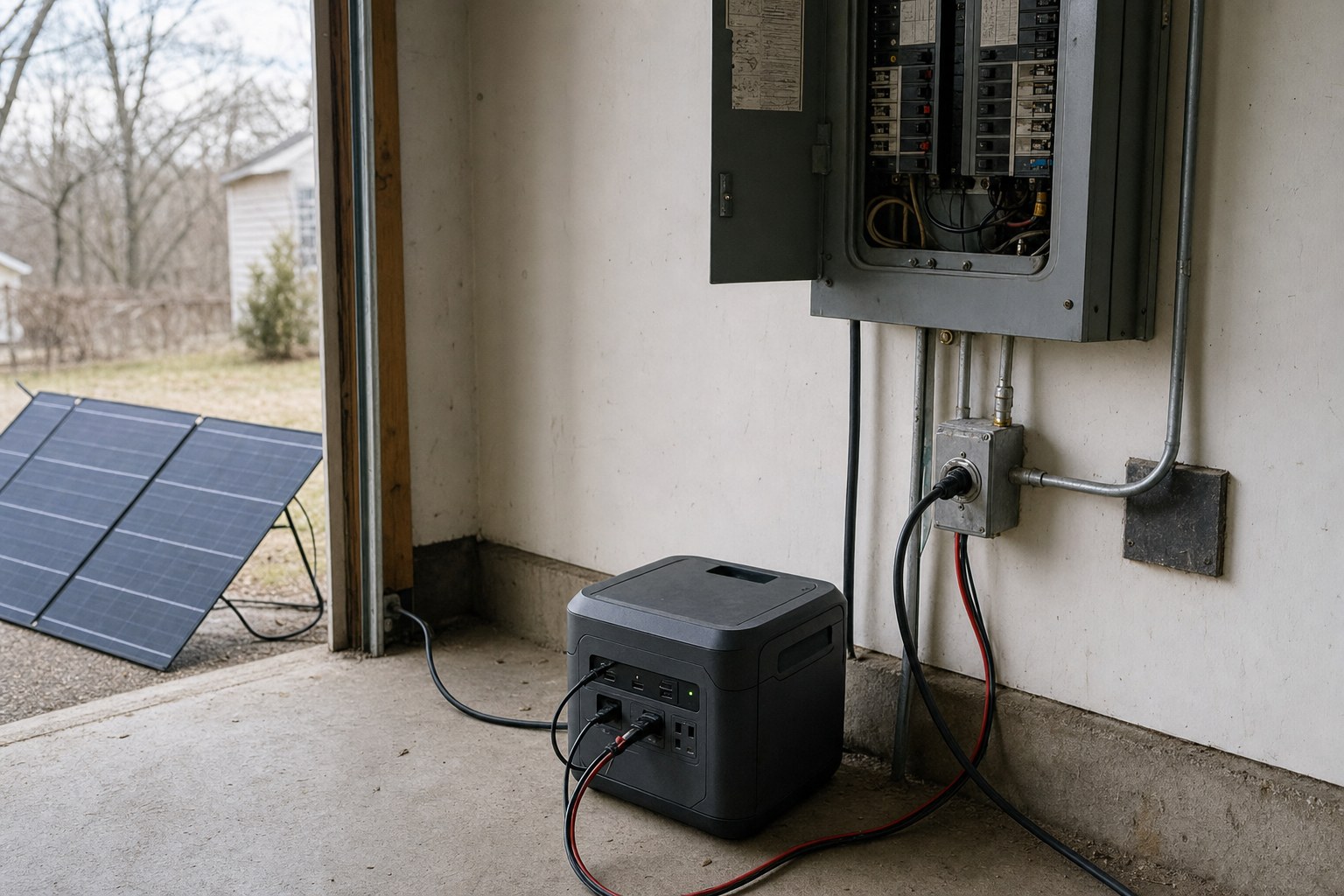
Pull up any generator listing and you get one number. That number is wrong, and predictably so. The Westinghouse WGen3600DF shows a shelf price of $599. Nothing on that page mentions that it cannot legally touch a house circuit until another $320 of transfer switch and cord joins the cart, which makes the working price $919. That markup lives entirely outside the listing.
We tracked 7 units across every backup category we carry and priced each one the way you will actually pay for it. Home generators and backup power span four categories, not the one or two most buying guides bother to name: gasoline portables, permanently installed standby units, portable power stations, and whole-house battery banks. Skipping three of them is how households end up with a machine sized for a hurricane when their outages run six hours, or with a bargain generator that turned out to need an electrician.
We rank nothing here. Each category answers a different question, and the answer changes with outage length, critical load, budget, and how close your neighbors are. Below: surge and running watts, burn rates, sound levels, runtime arithmetic, and a working price for every unit.
One safety figure belongs in the opening rather than buried in a footnote. Portable generators kill an average of 73 people a year through carbon monoxide poisoning (CPSC, 2015-2020).
Prices checked Apr 5, 2026. Current prices may differ.
Size your load first with the backup power calculator. Every one of our 301 tracked power stations carries a working price, not a sticker price.
The Four Options, Side by Side
Before the section-by-section teardown, here is the shape of the whole decision. Capacity, sound, and working cost move together, and the table below is where most people find their category in about ten seconds.
| Factor | Portable Generator | Standby Generator | Portable Power Station | Home Battery |
|---|---|---|---|---|
| Capacity range | 1,700-13,000W | 10,000-26,000W | 500-3,600Wh | 5,000-18,000Wh |
| Real build cost range | $699-$1,549 | $8,000-$16,000 | $699-$999 | $8,299+ |
| Noise (dBA) | 48-74 | 60-70 | 30-50 | 30-50 |
| Fuel required | Gasoline / Propane | Natural Gas / Propane | None (electricity) | None (electricity) |
| Indoor safe | No | No | Yes | Yes |
| Auto-start | No (manual) | Yes (ATS) | No (manual) | Optional |
Two rows carry most of the weight. "Indoor safe" splits the four into things that combust and things that don't, and that split governs where the box can sit and whether an HOA will tolerate it. "Real build cost range" is the row that shrinks the distance between a generator and a battery down to far less than the shelf prices suggest.
The Line Item That Never Appears in the Quote
Anywhere from $25 to $2,000 rides on top of every generator purchase, and it is the same part every time. A generator makes power at its own outlets; getting that power into your walls means a switch that isolates the house from the utility first. The alternative, running the generator backward into a wall outlet and letting current climb through the panel, is called backfeeding. It is against code in every US jurisdiction, and the reason is not paperwork: the current keeps going out to the transformer, where a lineman is working to bring your street back.
Because we treat this part as mandatory (it is), it lives inside every generator price on this page.
Three Ways to Wire It
Interlock kit: $25-$200. A steel plate on the breaker panel that makes it mechanically impossible to have the main breaker and the generator breaker closed at once. Cheapest path by an order of magnitude, DIY-legal in most places, and you throw the breakers yourself every outage. It has to match your exact panel brand and model, which is where most people get stuck.
Manual transfer switch: $200-$600 all in, of which $300-$500 is the electrician. You get a small subpanel wired to whichever circuits you nominated as critical, and one lever moves the house between grid and generator. Not a DIY job.
Automatic Transfer Switch (ATS): $600-$2,000+ all in. Senses the outage, cranks the generator, hands the house back to the utility when it returns. You do nothing. Every standby installation includes one, which is a large part of why standby costs what it does.
What It Does to Four Price Tags
| System | Advertised Price | Transfer Switch Cost | Real Build Cost |
|---|---|---|---|
| Champion 100692 | $449 | +$250 | $699 |
| Westinghouse WGen3600DF | $599 | +$320 | $919 |
| Westinghouse WGen9500DF | $999 | +$550 | $1,549 |
| EcoFlow DELTA 3 Max | $799 | +$0 | $799 |
The last row is the interesting one. A power station feeds appliances through its own outlets or a wall cord, so the panel is never involved: no switch, no electrician, no permit. Hold that thought through the rest of the page, because it is why the two categories finish much closer than their listings imply.
Compare real build costs across categories, or open a component-level breakdown on any unit.
Sizing: the Surge Number Is the One That Counts
The most common sizing mistake is reading the wrong watt figure off the appliance. A full-size refrigerator settles at 150W once it is humming, and that 150W is what gets quoted. Every time the compressor kicks over it pulls 1,200W for an instant. Buy to the steady number and the machine stalls the first time a motor turns. Anything with a motor in it (fridges, sump pumps, furnace blowers, air conditioners) wants 2-3x its running draw to get moving.
Startup Draw by Appliance
| Appliance | Running Watts | Starting (Surge) Watts |
|---|---|---|
| Full-size refrigerator | 150W | 1,200W |
| Sump pump | 800W | 2,100W |
| Furnace fan (1/2 HP) | 800W | 2,350W |
| Central AC (3 ton) | 3,500W | 10,500W |
| Lights + phones + router | 300W | ~0W |
Scenario A: Fridge, Sump, and Lights
Add those three and you are running 1,250W, with the pump spiking to 2,100W when it wakes up. Call it 2,000W+ of starting capacity on the engine side, or 1,500Wh+ of storage on the battery side. The Champion 100692 (1,700W running, 2,000W starting) technically covers it, with the caveat that nothing is left in reserve if the pump fires while the fridge compressor is already spinning.
Go the battery route and the arithmetic gets easier. The EcoFlow DELTA 3 Max carries 2,048Wh behind a 2,400W inverter, swallows the 1,250W without complaint, and gives you about 13 hours (2,048 x 0.80 / 1,250). Nothing to fuel, nothing to vent, no switch to install. Its smaller sibling is out of the running entirely: the DELTA 3 Plus (1,024Wh) has an 800W inverter, 450W shy of the 1,250W this load needs just to idle.
Scenario B: Add Heat and a Television
Now put the furnace blower and a TV on top. Running climbs to 2,800W, and if the blower and the pump happen to start together you are asking for 4,450W. That wants 5,000W+. The Champion, at 2,000W starting, misses by 2,450W. The DELTA 3 Max handles the steady 2,800W but its 2,400W inverter will not absorb two motors starting at once, and no power station we track will.
Which restates the rule: buy to the surge. The Westinghouse WGen3600DF (3,600W running, 4,650W starting) clears Scenario B with room left over, and holds 14 hours on 4 gallons, longer than most regional outages last. The Champion (1,700W running) does not clear it at any price.
Put your own appliance list into the load calculator for a real number, then compare generators and power stations at working prices.
Gasoline and Dual-Fuel Portables
This is the category everyone pictures, and the one where the listing misleads hardest. Open-frame engines covering 1,700W through 13,000W, the loudest thing in this article at 68-74 dBA, and the only category that produces carbon monoxide. Both Westinghouse units here are dual-fuel, meaning they take gasoline or propane, which stops mattering right up until the storm closes every pump within twenty miles. Gasoline-only models list cheaper and tie you to one fuel that needs stabilizer if it is going to sit.
The 30% That Ships Separately
| Generator | Advertised Price | Required Missing Parts | Real Build Cost |
|---|---|---|---|
| Champion 100692 (2,000W) | $449 | $250 (transfer switch + cord) | $699 |
| Westinghouse WGen3600DF (3,600W) | $599 | $320 (transfer switch + cord) | $919 |
| Westinghouse WGen9500DF (9,500W) | $999 | $550 (transfer switch + cord) | $1,549 |
Read the pattern rather than the rows: each of these arrives roughly 70% built. The last 30% is switch, cord, and hardware, and it scales with the unit, so the bigger the engine, the wider the gap between what you were quoted and what you pay.
The Quieter Sub-Category
Inverter generators condition their output into a pure sine wave, so laptops and appliance boards survive the experience. They also drop the noise floor hard, 48-57 dBA against 68-74 dBA for open-frame. What you give up is ceiling and cost efficiency: most stop somewhere between 2,000-3,500W, and each watt costs more than the open-frame equivalent. Our example is the Champion 100692: 1,700W running, 2,000W starting, 53 dBA, 39 lbs, and 11.5 hours off a 1.05-gallon tank at quarter load.
Where the Noise Puts You
Decibel figures on a spec sheet do not convey much, so anchor them. 68 dBA is two people talking loudly next to you, continuously, for as long as the outage lasts. 74 dBA is closer to a mower. HOA rules typically draw the line for sustained outdoor noise somewhere in the 55-65 dBA band, which quietly deletes the entire conventional portable category and leaves inverter units and power stations standing. The Champion's 53 dBA ducks under nearly every threshold. The WGen3600DF's 68 dBA does not.
Carbon Monoxide Is Not a Footnote
Back to the 73 deaths a year (CPSC, 2015-2020 average). Regulators moved on it: the CPSC's 2023 rule makes new portable generators shut themselves off once CO builds to unsafe indoor concentrations. The rule that has not changed and will not is placement. 20+ feet from the structure, exhaust pointed away from every window and door.
Placement is necessary and it is not sufficient, which is the part worth internalizing. During Hurricane Idalia a homeowner sited a unit outdoors, by the book. Heavy wet air pushed the exhaust back at the house anyway and the CO alarm went off. They replaced the generator with solar and a battery afterward. Outdoors lowers the risk. It does not zero it, and weather gets a vote.
Every generator we track carries a working price on the comparison tool. Open any kit breakdown for the part-by-part accounting.
Batteries: Nothing to Burn, Nothing Left to Buy
Here is the comparison that reframes the category. The EcoFlow DELTA 3 Max lists at $799 and costs $799 to put to work, because there is no second purchase. The WGen3600DF lists at $599 and reaches $919. On the shelf the battery looks $200 more expensive. In your house it is $120 cheaper.
Portable power stations are a LiFePO4 pack and an inverter in one case. No fuel, no exhaust, no CO. They sit at 30-50 dBA, below your refrigerator, and they are safe on a kitchen counter, in a garage, or in a closet.
The Arithmetic
Hours = Wh x 0.80 / Device watts
That 0.80 is not padding. Converting DC to AC costs you about a fifth of the pack, so the watt-hours printed on the case are gross, not net (source: EcoFlow engineering). Any runtime claim that skips the multiplier is off by 20%.
Three Units Against One Refrigerator (150W Running)
| Power Station | Capacity | Inverter | Calculation | Fridge Runtime |
|---|---|---|---|---|
| EcoFlow DELTA 3 Plus | 1,024Wh | 800W | 1,024 x 0.80 / 150 | 5.5 hours |
| EcoFlow DELTA 3 Max | 2,048Wh | 2,400W | 2,048 x 0.80 / 150 | 10.9 hours |
| Bluetti AC180T | 1,433Wh | 1,800W | 1,433 x 0.80 / 150 | 7.6 hours |
Ecoflow DELTA 3 PLUS 1,024Wh + Main Unit Only
DELTA 3 Max – 2,048Wh / 2,400W + Main Unit Only
AC180T 1433Wh / 1800W
Across our whole catalog the pricing story for this category is boring in the best way: advertised equals working cost, every unit, because the box is the system. Engines want $250-$550 of switch, cord, and hardware before they reach a circuit. Batteries also refill three ways (solar, a wall outlet, a car's 12V socket), which no engine offers.
The Inverter Sets the Ceiling, Not the Pack
Capacity buys hours. The inverter decides what you are allowed to plug in, and people shop the wrong one. The DELTA 3 Plus's 800W inverter means a sump pump (800W running, 2,100W surge) is simply not on its menu, no matter how long the battery would have lasted. The DELTA 3 Max's 2,400W takes the pump, a space heater, or several things at once. The Bluetti AC180T's 1,800W lands in between. Spec the inverter against your surge, then spec capacity against your hours.
Scaling the Same Idea to the Whole House
A home battery is the power station concept with a bigger pack and a permanent home. The Anker SOLIX 18kWh stores 18,000Wh of LiFePO4, and the listing and the working price are the same figure, $8,299, with nothing required to complete it. A 400W panel comes along for daytime replenishment.
Run the formula on a 450W critical load (fridge, lights, router): 18,000 x 0.80 / 450 = 32 hours. Cut back to fridge and lights, roughly ~200W, and you are at 72 hours. Let the panel push charge back in during daylight and the ceiling comes off entirely, provided the sun cooperates.
SOLIX E10 Whole Home Backup System
What Twenty Years Costs
Purchase price is a rounding error at this timescale. EnergySage's 2026 figures:
- Gas generator system: $91,319 over 20 years (purchase + fuel + maintenance). That is $4,566/year.
- Solar + battery system: $60,961 over 20 years (purchase, zero fuel). That is $3,048/year.
A $30,358 spread, or 33% less to own the battery. The mechanism is dull and reliable: one system buys fuel and service every year of its life while the other buys neither, and fuel tracks energy prices upward while a battery's operating cost sits still. On longevity, LiFePO4 cells hold 3,000-5,000 cycles before they fade to 80% of rated capacity, which is 8-14 years if you cycle one every single day.
Browse all 301 portable power stations at working prices. Put any two head to head. The portable power station guide goes deeper on the specs, and home battery systems covers the fixed installs.
Standby: Automatic, and Expensive in Both Directions
A Generac 22kW at half load drinks 2.53 gallons per hour of propane. You will not find that on the product page, in the reviews, or in the dealer's quote, and it is the number that decides whether your 500-gallon tank is a 4-day answer or a 10-day one. Propane at $2.50-$3.50/gal makes that $6.33-$8.86/hr, or $152-$213/day, for as long as the lights stay out.
What you buy for that is the thing no other category offers: total automation. A standby unit is bolted down, plumbed into natural gas or propane, and watching the utility through an automatic transfer switch. Power drops, it starts, and 10-30 seconds later the house is back, whether or not anyone is home. Output runs 10 kW to 26 kW, the only range in this article that carries central air.
What It Costs Installed
The 22kW unit itself is $5,500-$7,000. Installed, expect $8,000-$16,000: concrete pad, automatic transfer switch, gas line run, permit, and a licensed electrician's hours. The width of that range is local, not brand. Permit fees, how far the gas line has to travel, and what contractors charge in your county explain the spread. Drop to a 10kW unit, which covers fridge, sump, furnace fan, and lights, and installation lands at $5,000-$8,000, about half the 22kW figure.
Propane Burn Rate, by Model
| Model | 50% Load (gal/hr propane) | 100% Load (gal/hr propane) | Daily Cost at 50% ($3/gal) |
|---|---|---|---|
| 10 kW | 0.97 | 1.48 | $69.84 |
| 14 kW | 1.81 | 3.07 | $130.32 |
| 22 kW | 2.53 | 3.90 | $182.16 |
Turning Burn Rate Into Days
| Tank + Generator | Runtime at 50% Load |
|---|---|
| 500-gal tank + 10 kW | 7-10 days |
| 500-gal tank + 22 kW | ~4 days |
| 100-gal tank + 10 kW | ~24 hours |
Piping in natural gas appears to solve runtime forever, and on paper it does. The failure mode correlates with exactly the event you bought the thing for: a wide-area emergency can pull pressure down across the distribution network. Texas, February 2021, is the case study. Pressure sagged statewide and gas-fired units quit at the worst possible hour. A propane tank in the yard does not care what the pipeline is doing.
It Needs Attention Every Year
Oil, air filter, plugs, load test. Manufacturers generally want a professional at it every 200 hours of runtime or annually, whichever arrives first, and a service contract runs $200-$500 a year. On its own the unit also exercises itself weekly for 15-20 minutes, which keeps the engine oiled and proves it will actually start when the grid finally fails.
Standby earns its price in three situations: central AC has to stay on, medical equipment cannot pause, or nobody will be home to flip a switch. Below $8,000 installed, the category does not exist. We do not list standby units as individual kits, because installation swings too wide to publish as a number we would stand behind.
Check whether your load genuinely needs this much machine with the calculator, and see whole-home backup options for the alternatives.
Working the Decision in Four Questions
Default behavior is to buy a portable generator, mostly because it is the only category with a household name. Take the four questions in order instead. Duration knocks out whole categories, load narrows the survivors, and budget and constraints finish the job.
First: How Long Do Your Outages Actually Run?
- Under 8 hours: Portable power station. A 1,024Wh unit covers fridge + lights for the duration.
- 8-48 hours: Portable generator or large power station (2,048Wh+).
- 2-7 days: Standby generator or home battery + solar panels.
- 7+ days: Standby generator with a 500-gallon propane tank.
Second: What Has to Stay On?
- Fridge + lights + phones (~500W): Power station at $699-$999 real build cost.
- Add sump pump + furnace fan (~2,000W): Mid-range generator at $919 real build cost or 2,400W power station at $799.
- Add central AC (10,500W surge): Standby generator only at $8,000-$16,000 installed.
Third: What Will You Spend?
- Under $1,000: EcoFlow DELTA 3 Plus ($699 real build cost, 1,024Wh), EcoFlow DELTA 3 Max ($799 real build cost), or Westinghouse WGen3600DF ($919 real build cost).
- $1,000-$3,000: Large power station + solar panels, Bluetti AC180T ($999 real build cost), or Westinghouse WGen9500DF ($1,549 real build cost).
- $3,000-$10,000: Anker SOLIX 18kWh ($8,299) or entry-level standby generator.
- $10,000+: Standby generator fully installed.
Fourth: Who Has to Listen to It, and Where Will It Sit?
- HOA restrictions, indoor use, or zero CO risk required: Portable power station only (30-50 dBA).
- Neighbors close but outdoor use acceptable: Inverter generator (53 dBA) or power station.
- Rural property, no restrictions: Any category works. Prioritize by outage duration and budget.
DELTA 3 Max – 2,048Wh / 2,400W + Main Unit Only
Feed your own appliances into the calculator, then put working prices side by side or browse all 301 tracked power stations.
The Honest Math
Three findings survive the whole teardown.
The listing is the wrong number. WGen3600DF: $599 advertised, $919 working. DELTA 3 Max: $799 advertised, $799 working. Shop the listings and the engine wins by $200. Shop what leaves your account and the battery wins by $120. Same two products, opposite conclusions, decided entirely by which number you compared.
Most households buy too much machine. Outages under 12 hours, load of fridge and lights and phones: an $799 power station does that silently, indoors, with nothing to store or source. The $919 generator does the same job and hands you fuel storage, CO exposure, a mandatory outdoor spot, and an electrician's appointment.
Central AC is the one thing that forces an engine. 10,500W of surge from a 3-ton compressor is beyond every power station on the market. Carrying it means standby ($8,000-$16,000 installed) or a home battery paired with solar. Take central AC off the critical list, and the argument for owning a generator at all mostly evaporates.
We are not picking for you. Size the load in the calculator, then compare working prices across all four categories. Every one of our 301 tracked portable power stations is listed at what it really costs.
Common Questions
How big a generator does it take to run a house?
Buy to starting watts, never running watts. A critical set (fridge, sump pump, furnace fan, lights) idles near 1,250W but peaks at 2,350W when a motor turns over. Anything 3,600W+ carries that with reserve. Central air changes the answer completely: its 10,500W surge requires a standby unit of 10 kW+. The load calculator will give you a figure for your exact appliances.
Is a power station enough, or is a generator still necessary?
Under 12 hours, with critical loads only (fridge, lights, phones, router), a battery is enough. The EcoFlow DELTA 3 Max (2,048Wh) holds a full-size fridge for 10.9 hours (2,048 x 0.80 / 150W), and the Bluetti AC180T (1,433Wh) manages 7.6 hours at a $999 working price. Once you are into multi-day outages, or asking for more than 2,400W at once, the answer moves to a generator or a home battery.
How many hours does one tank of gas buy?
Size and load both move it. The Westinghouse WGen9500DF gets 12 hours out of its 6.6-gallon tank at half load. On the standby side, a Generac 22kW pulling 2.53 gal/hr of propane at 50% load empties a 500-gallon tank in roughly 4 days, while a 10kW unit on a 100-gallon tank gives you about 24 hours.
Is a transfer switch really mandatory?
Yes, on both counts. Skip it and the only way into your circuits is backfeeding the panel, which is illegal everywhere in the US and can kill the lineman restoring your street. The floor is an interlock kit at $25; a manual transfer switch installed runs $200-$600. We fold that cost into every generator's real build cost rather than leaving it off the page.
How safely can a portable generator be run during an outage?
Outdoors only, 20+ feet out, exhaust turned away from every window and door. The toll is 73 CO deaths annually (CPSC, 2015-2020 average). The CPSC's 2023 rule makes new units cut themselves off at unsafe CO levels, but where you put the machine is still the variable that decides the outcome. Power stations emit no CO and run indoors without any of this.
Over 20 years, does a generator or a solar battery cost less?
The battery, by 33%. EnergySage's 2026 figures: solar + battery at $60,961 across 20 years ($3,048/year) against $91,319 for a gas generator system ($4,566/year). The difference is fuel and maintenance, paid every year, rising with energy prices.
Read Next
Explore the Data
Track the prices, not the hype
We track real build costs across 400+ off-grid kits and email the biggest verified price drops every week. See this week’s drops.