Portable Solar Panels and Chargers: Why the Same Watt-Hour Costs $0.39 or $1.81
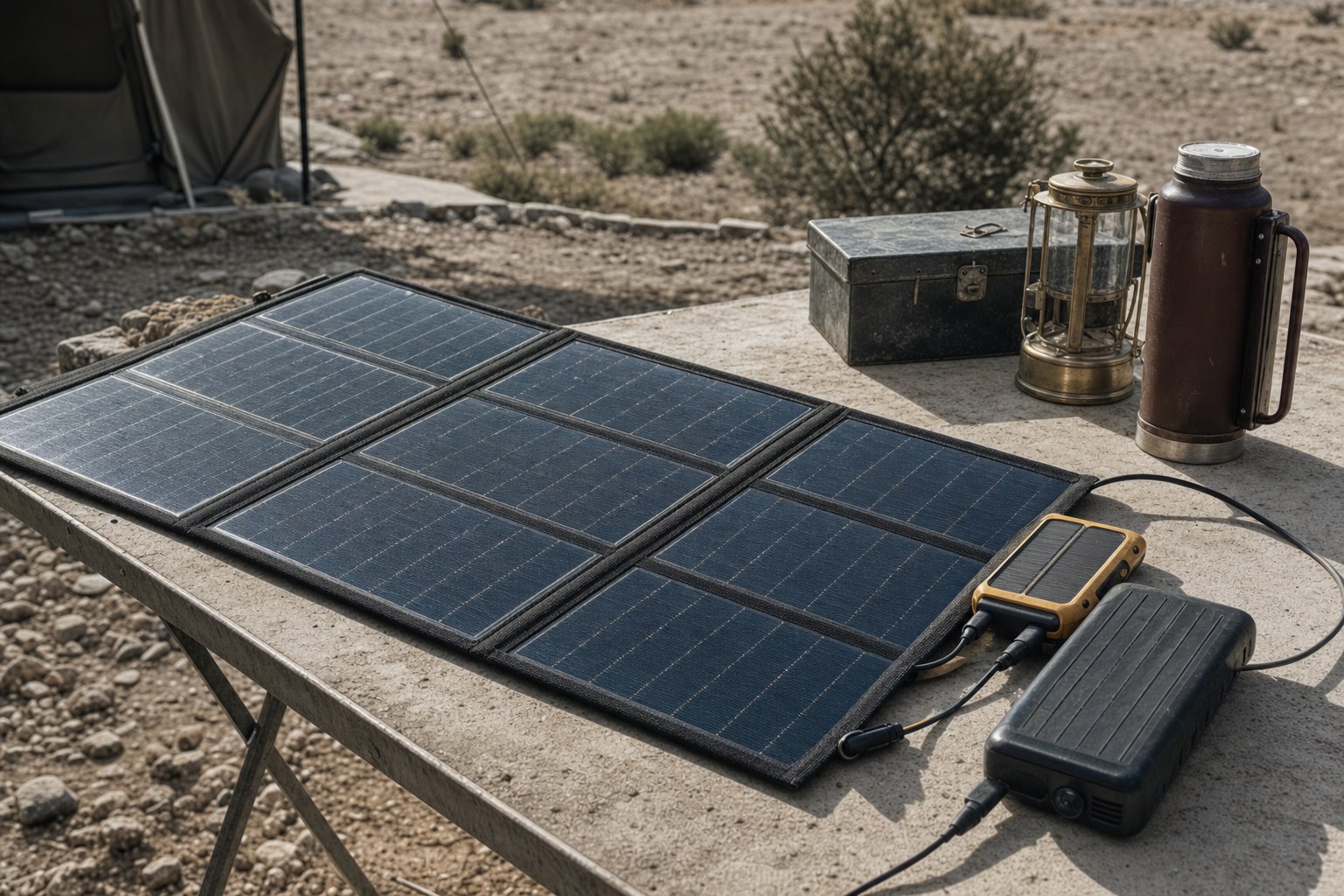
We track 29 portable solar systems. Sticker prices start at $199 and top out at $4,560, and sticker is the number every listing leads with. Divide it by storage and the category stops looking orderly: a stored watt-hour runs $0.39/Wh at best, $1.81/Wh at worst, a 4.6x spread inside one product class. Banks run 245Wh to 5,120Wh, all LiFePO4, at 57% to 86% completeness. Below: where the spread comes from, and which side each system lands on.
See all 29 systems with the filters on
What the Sticker Price Hides
Good news first. On an integrated station, sticker and our real build cost are the same number. Battery, charge controller, and inverter are sealed into one enclosure, so no second bill arrives after checkout. Completeness moving from 57% to 86% tracks one thing: whether panels and hard mounting hardware ride along in the box. It is not a signal that electronics are missing. A 57% unit works as a battery bank the day it lands, and needs a panel bought separately before it can refill itself off-grid.
So the hidden cost is not an absent part. It is the price of a watt-hour, which no listing prints. Every field on a kit record (completeness, inverter wattage, storage in Wh, panel input wattage, real build cost, advertised price) exists to get that figure onto the page.
The Two Numbers That Decide the Build
Storage (Wh) sets how long the gear keeps running. Panel input (W) sets how fast the box refills. Sizing a portable build is the work of holding those two in proportion.
Panel input is a ceiling, not a target: it caps what the built-in MPPT controller draws from whatever gets connected. Overshoot and nothing breaks, the controller clamps at its rated figure while the extra panel sits idle and paid for. Undershoot badly and the refill outruns a day of sun.
Size the storage and panel input against your own loads
Ranked by What a Watt-Hour Actually Costs
Sorted by price, this shelf looks like a ladder. Sorted by $/Wh, it scrambles. That is the view worth having.
The $0.39 to $0.49 Band: Cheap Watt-Hours
The Anker SOLIX C2000 Gen2 sets the floor at $799: 2,048Wh behind a 2,400W inverter, or $0.39/Wh, lowest of any portable in our database. The EcoFlow DELTA 3 Max ties it at that price. No bundled panels puts completeness at 71%; folding panels get added separately to unlock solar recharging.
Step down in size and the math barely suffers. The Anker SOLIX C1000 Gen2, $449, holds 1,024Wh behind a 2,000W inverter and its MPPT controller accepts 600W: 86% complete, $0.44/Wh. That undercuts the RIVER 3 further down this page by $0.37/Wh per watt-hour stored. Feed it the full 600W in clear sun and a refill runs about 2 hours (2.01, from 1,024Wh / (600W x 0.85)). On AC, 49 minutes.
SOLIX C1000 Gen2 1,024Wh/2,000W + Main Unit Only
The Bluetti AC180P, $699, is the cheapest watt-hour that arrives with its own glass: a 500W array, 1,440Wh, an 1,800W inverter, 86% complete, $0.49/Wh. Refilling at 500W takes roughly 3.4 hours (3.39, from 1,440Wh / (500W x 0.85)).
Premium 150 AC180P + Main Unit Only
The $0.58 to $0.81 Band: Paying for Small
Storage gets pricier as the boxes shrink. A bundled array softens the hit.
The Bluetti AC70P, $499, puts a 500W array in front of 864Wh and a 1,000W inverter at $0.58/Wh, refilling in about 2 hours (2.03, from 864Wh / (500W x 0.85)). EcoFlow's DELTA 3 Plus asks $699 for 1,024Wh and an 800W inverter, no panels in the box, so it reads 71% complete and folding panels connect later through the MC4 port. Set it beside the AC180P: identical sticker, $0.68/Wh against $0.49/Wh for the storage.
Put the AC180P and the DELTA 3 Plus head to head
Cheapest complete build on the board is the Bluetti AC50P, $359. Built-in MPPT, a 700W inverter, 504Wh behind a matched 200W array: 86% complete, $0.71/Wh, full-sun refill near 3 hours (2.96, from 504Wh / (200W x 0.85)).
PREMIUM 50 AC50P 504Wh/700W
Then the entry point, where the sticker is lowest and the watt-hours are not. The EcoFlow RIVER 3 opens at $199: 245Wh of LiFePO4 with battery, charge controller, and inverter in one unit. No panels and no hard mounting hardware means 57% complete, with an MC4 port waiting for a folding panel. At $0.81/Wh the trade is plain: portability and a low opening cost, bought with the priciest storage here outside the hardcase tier.
Above $1.00/Wh: Paying for the Case
One system sits apart, and it is honest about why. New Use Energy's SunCase 605 asks $980 for a briefcase build: 540Wh, a 400W inverter, 400W of folding panels built into the lid, 86% complete. That is $1.81/Wh, the highest in our database at this storage size. Ruggedized hardcase construction is what the premium buys. Storage density is not.
Every System, Side by Side
Cheapest watt-hours at the top. The last column is full-sun refill time, worked below.
| Kit | $/Wh | Price (Apr 2026) | Storage | Panels | Inverter | Complete | Full refill |
|---|---|---|---|---|---|---|---|
| Anker SOLIX C2000 Gen2 | $0.39 | $799 | 2,048Wh | none | 2,400W | 71% | n/a |
| Anker SOLIX C1000 Gen2 | $0.44 | $449 | 1,024Wh | 600W | 2,000W | 86% | ~2.0 hours |
| Bluetti AC180P + 500W | $0.49 | $699 | 1,440Wh | 500W | 1,800W | 86% | ~3.4 hours |
| Bluetti AC70P + 500W | $0.58 | $499 | 864Wh | 500W | 1,000W | 86% | ~2.0 hours |
| EcoFlow DELTA 3 Plus | $0.68 | $699 | 1,024Wh | none | 800W | 71% | n/a |
| Bluetti AC50P + 200W | $0.71 | $359 | 504Wh | 200W | 700W | 86% | ~3.0 hours |
| EcoFlow RIVER 3 | $0.81 | $199 | 245Wh | none | n/a | 57% | n/a |
| New Use Energy SunCase 605 | $1.81 | $980 | 540Wh | 400W | 400W | 86% | n/a |
"None" in the panels column means no panels ship with that kit. Those units still take solar; how much they accept varies by model, and each kit page carries the figure. Refill time reads n/a wherever we have not worked a figure we can stand behind.
Filter the full 29-kit set yourself
Refill Time, and the 0.85 You Cannot Skip
One formula carries the whole sizing decision:
Hours = Storage (Wh) / (Panel W x 0.85)
The 0.85 is doing real work. It absorbs MPPT conversion losses plus the gap between a panel's nameplate rating and the irradiance it sees. Folding panels in full sun return roughly 70-90% of the number printed on the back. The 0.85 sits at the cautious end of that band on purpose.
Set the refill column above against a 4-5 peak-sun-hour day. A 3-hour refill leaves slack for cloud cover drifting through. Take 600W or more of input, as the Anker C1000 Gen2 does, and 2 hours holds up even on short or partly overcast days.
Before You Plug In a Third-Party Panel
Every station here has its MPPT controller built in, so a foreign panel is a compatibility question, not a wiring project. The manual settles it. Three specs to check:
- Connector type -- MC4 or XT60 on most portable stations, with a manufacturer-supplied adapter cable bridging anything else
- ISC, the short-circuit current -- stays below whatever solar input amperage the station is rated for
- VMP range -- maximum power voltage lands inside the MPPT input window, typically 11V-60V on portable units
Folding panels from Bluetti, Goal Zero, EcoFlow, and Anker arrive pre-wired for their own stations. Mixing brands works with a compatible MC4 adapter once the voltage and current figures clear the checks above.
Run your panel array through the calculator
What the Storage Actually Runs
Watt-hours only mean something against a load. Each cell below is runtime before the next solar recharge, figured at 80% depth of discharge.
| Storage | Phone (15Wh) | Laptop (60Wh) | CPAP (36Wh, 8h no humidifier) | Mini fridge (12V, 50W avg, 400Wh/day) | LED lights (10W x 6h, 60Wh) |
|---|---|---|---|---|---|
| 245Wh | 13 charges | 3 charges | 5 nights | 0.5 days | 3 nights |
| 504Wh | 27 charges | 7 charges | 11 nights | 1.0 days | 7 nights |
| 1,024Wh | 55 charges | 14 charges | 23 nights | 2.0 days | 14 nights |
| 1,440Wh | 77 charges | 19 charges | 32 nights | 2.9 days | 19 nights |
Read the small end honestly. 245Wh covers a CPAP, a laptop, and phones across several nights as long as a panel tops it up daily. Refrigeration is the jump that changes a trip: 1,024Wh holds a portable fridge cold for 2 days between full recharges, enough for a weekend basecamp with no shore power near it.
Questions We Get About Portable Solar
Read Next
Explore the Data
Track the prices, not the hype
We track real build costs across 400+ off-grid kits and email the biggest verified price drops every week. See this week’s drops.