Inverters and Power Conversion: The Waveform, Surge, and Voltage Math Behind a $805 Build
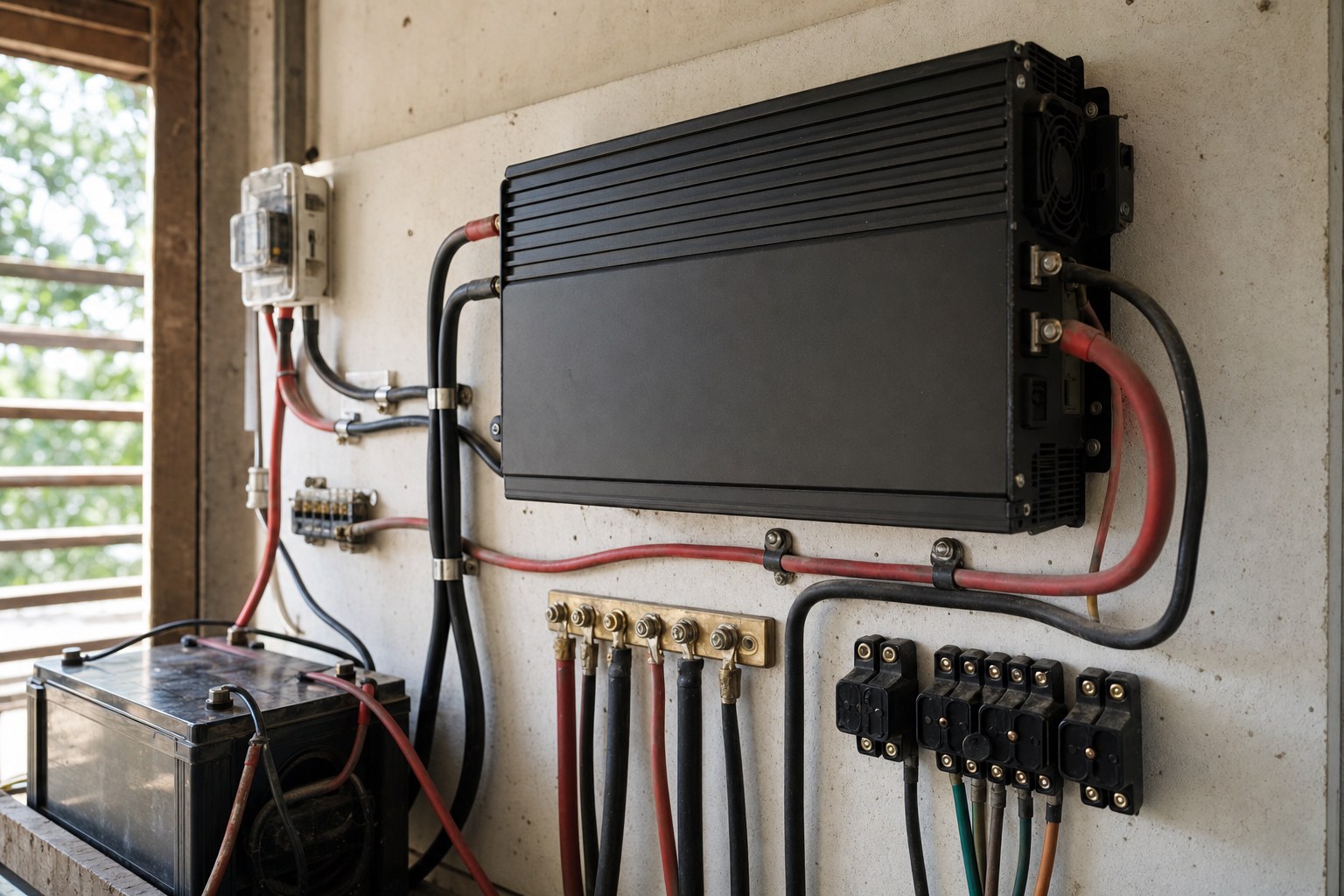
Pricing snapshot taken Apr 5, 2026. What a vendor charges today may differ.
Advertised at $600: the WindyNation 400W Complete Kit with 1500W VertaMax Inverter. Our real build cost lands at $805, because the battery never ships in the box (we price it at $180), and neither do the cables or the fuses. That gap is the ordinary kind. It is at least countable.
The gap nobody counts is the waveform. Bundled into that kit is a VertaMax 1,500W modified sine wave inverter, and a CPAP fed by modified sine wave shows two documented failure modes: therapy pressure falls, and blower motor wear speeds up. The stepped output confuses the machine's pressure regulation circuit. Nothing beeps. Nothing shuts off. The airway support quietly stops matching the prescription, night after night, while an $800+ medical device wears itself out early. Weigh a $600 sticker against that and the arithmetic stops working.
Power conversion settles more of a build's outcome than panel count ever does. The inverter is the line between a system that runs a household and a system that charges phones off a 12V socket. Miss on waveform and electronics degrade. Miss on capacity and the unit trips at the exact moment the load matters. Miss on system voltage and a battery cable that would have cost $10 at 48V bills out past $200+ at 12V.
Four numbers decide a build:
- Waveform -- pure sine, modified sine, or a hybrid inverter-charger
- Capacity -- continuous watts, surge watts, and the 1.25x margin between them
- System voltage -- 12V, 24V, or 48V, which is a copper budget wearing a spec label
- The DC side -- cable gauge, fuse position, and the order the wires go on
Seven kits from our catalog carry this guide, $209 through $3,399. No advertised price appears here without its real build cost riding alongside.
| Kit | Inverter | Waveform | Storage | Advertised | On the spec sheet |
|---|---|---|---|---|---|
| WindyNation 400W Complete Kit (1500W VertaMax) | 1,500W | Modified sine | none, battery not included ($180 est.) | $600 ($805 real build cost) | Panels and controller only |
| Bluetti AC2P [Main Unit Only] | 300W | Pure sine | ~230Wh | $209 | 230.4Wh portable station, bundle options |
| EcoFlow River 2 Max [Main Unit Only] | 600W | Pure sine | 512Wh | $269 | 512Wh / 500W station, bundle options |
| BLUETTI Premium 80 [AC70P], Double Kit [2 x 200W Rigid Panels] | 1,000W | Pure sine | 864Wh | $809 | 3,000 cycles |
| Anker SOLIX C1000 Gen 2 + 1 x 400W Solar Panel | 2,000W (2,700W surge) | Pure sine | 1,024Wh | $870 | 600W solar input, 49-min fast recharge, 5-year warranty |
| Anker F3800 [PLUS], Nomad Kit [F3800P + 2 x Folding 200W Panels] | 6,000W | Pure sine | 3,840Wh | $3,048 | 120V/240V output, 3,200W solar input, 5-year warranty |
| BLUETTI [APEX 300] + 2 x B300K2 | 3,840W | Pure sine | 2,765Wh | $3,399 | 120V/240V dual voltage, modular, 5-year warranty |
See every inverter kit we track
Where the Inverter Sits, and What the Conversion Costs
Panels make DC. Batteries hold DC. The refrigerator, the CPAP, the laptop brick, and the microwave all want AC at 120V/60Hz. The inverter is the translator between those two halves of a system. Without one, panels and a battery reach only DC-native loads: USB ports, 12V lighting, an RV water pump. Anything with a three-prong plug sits downstream of an inverter or it does not run.
The translation is not free. Converting DC to AC burns 5-15% of what passes through, and where a unit lands in that band depends mostly on how hard it is worked. An inverter loafing at 25% of its rating converts less efficiently than the same unit at 75%. Those losses land twice: once when sizing the inverter, again when sizing the bank that feeds it.
The order never changes.
Panel → controller → bank → inverter → outlet
Panels generate. The controller, MPPT or PWM, regulates voltage and current into storage. The bank holds energy. The inverter draws DC back out and hands AC to an outlet, a cord, or a subpanel.
Two Architectures, One Decision
Where the inverter physically lives splits the catalog in half.
Integrated stations seal inverter, battery, charge controller, and BMS into one case. The Bluetti AC2P ($209) asks nothing of a buyer beyond a panel and a plug, and the EcoFlow River 2 Max ($269) works the same way. Both run 12V internally, with the waveform decision already made at the factory, correctly.
Component builds leave the inverter standing on its own. That is the WindyNation kit. Panels and a charge controller arrive; a battery, battery cables, fuses, and every wiring choice do not. In that architecture the waveform is a buyer decision, which is exactly how a modified sine wave unit ends up feeding a CPAP.
Run your own numbers in the calculator
Waveform: Modified Sine, Pure Sine, and the Hybrid Middle
What Modified Sine Wave Actually Damages
A modified sine wave inverter fakes a sine wave. Instead of a curve, its output steps between voltage levels in blocky increments. Feed a purely resistive load, an incandescent bulb, a basic space heater, a soldering iron, and nothing in the device cares what shape the voltage takes. Add a microprocessor, a motor controller, or a transformer and the shape starts costing money.
The VertaMax 1,500W unit inside that $805 build reaches six device categories:
- CPAP machines. Pressure delivery drops, motor wear climbs. A blower running against the stepped output works inefficiently, so air pressure wanders across the night.
- Chargers for laptops and phones. They run hot and refill 20-40% slower, since the internal supply strains to filter a rough input down to clean DC.
- Motors with variable speed. More heat, less torque, shorter life. Ceiling fans, modern washers, HVAC blowers.
- Hair dryers, clothes irons, anything on a thermostat. The thermostat reads stepped voltage wrong, then overheats or cycles at random.
- Dimmers on LED circuits. Visible flicker, or no dimming whatsoever, because the dimmer cannot pull a control signal out of a stepped waveform.
- Laser printers. Paper feed failures, plus fuser damage where the heating element sees uneven power.
Here is the trade in one line. At 1,500W, the spread between a modified sine unit and a pure sine unit runs $50-$150. On the far side of that $150 sits an $800+ CPAP and a $300 laptop. Nobody takes that bet when the kit's price tag makes it visible.
Pure Sine Wave, and Why the Premium Collapsed
Pure sine output is a smooth 60Hz curve, the same signal the utility sends and the same signal every appliance engineer designed against.
Every kit our catalog tracks above $500 runs pure sine: the AC70P Double Kit at $809, the C1000 Gen 2 at $870, the F3800 Nomad Kit at $3,048, the APEX 300 at $3,399. That is arithmetic rather than brand loyalty. No device category anywhere performs better on a stepped waveform than on a clean one, so the only argument modified sine ever had was price, and the price argument has evaporated. A standalone 1,000W pure sine inverter sells for $80-$150 today against $200-$300 five years ago. Sensitive electronics, variable-speed motors, medical gear, and audio all require the clean waveform, and everything else is indifferent to it. Buy the clean waveform.
Hybrid Inverter-Chargers and the 20ms Handoff
A hybrid inverter-charger packs three jobs into one enclosure: inverter, battery charger, automatic transfer switch. With grid or generator power present, it charges the bank and passes power through to the loads. When that source drops, it flips to inverter mode by itself in roughly 20ms, quick enough that most electronics never register the gap.
Two units define the class. The Victron MultiPlus-II 48/3000 puts 3,000W behind a 35A charger for $800-$1,200. The EG4 3000EHV delivers the same 3,000W, split-phase capable, with an 80A MPPT controller folded in, at $699.99 as of April 2026.
The transfer switch is the whole reason to buy one. Without it, moving between generator and solar means throwing a breaker or swapping cables by hand, and every load in the building drops during the changeover. Under 20ms, the fridge, the freezer, and the router never notice.
The EG4's built-in controller cuts the parts list further. A cabin with 4-6 panels and a backup generator otherwise needs five pieces: an inverter, a charger, a transfer switch, a charge controller, and the panels. With the hybrid it lands at three, panels plus hybrid plus bank. Fewer components, fewer terminations, less to torque wrong. Hybrids belong in cabins and homesteads mixing solar with a generator or intermittent grid. An RV, van, or camp build running solar and battery alone has no use for one.
Put the pure sine kits head to head
Sizing: the Surge Number Is the One That Trips You
Undersize the inverter and its overload protection cuts the loads at the worst possible moment. Oversize it and money leaves twice, once at purchase and again every hour as idle draw. The formula:
(Everything running at once x 1.25) + the single largest surge = the smallest inverter that works
That 1.25x is a 25% allowance for reality: voltage sag under load, conversion efficiency of 85-95%, and the loads that never make it onto the spreadsheet.
The Cabin, Worked Through
| Load | Surge (W) | Running (W) |
|---|---|---|
| Well pump, 1HP | 3,000W | 746W |
| Refrigerator | 1,200W | 150W |
| Laptop brick | 65W | 65W |
| LED lighting, 6 bulbs | 60W | 60W |
| Running total | -- | <data>1,021W</data> |
Continuous minimum: 1,021W x 1.25 = 1,276W. Surge minimum: 1,276W + 3,000W, the pump being the largest single spike, so 4,276W.
Look at the fridge row again. Its 1,200W spike is 8x the running figure, because a compressor is an induction motor and every thermostat trigger demands locked-rotor current. That happens 4-8 times an hour, lasts under a second, and the inverter absorbs every one of them or it drops the load. The pump asks 2,200-3,000W against 746W running, call it 3-4x. Start pump and compressor together and inrush touches 4,200W.
Only the largest single surge goes into the formula, never the sum of all of them, because simultaneous multi-motor inrush is statistically unlikely, and the 25% margin is what covers the day it happens anyway.
Against that profile the C1000 Gen 2 ($870, 2,000W continuous, 2,700W surge) clears the running load comfortably and misses the pump surge with the fridge already cycling. It still works in the field on staggered startup: run the pump before the compressor kicks on. That is a real answer, not a failing grade, so long as it is a decision rather than a surprise.
Air Conditioning Breaks the Formula
A 3-ton air conditioner settles near 3,500W. Its compressor startup hits 15,750W, about 4.5x running. Swallowing that raw spike takes an inverter rated above 15,000W, and the inverter alone then costs $5,000+.
A soft starter changes the shape of the problem. The module costs $80-$150 and drops compressor inrush to approximately 6,300W, cutting required inverter capacity by 9,000W+. Thousands of dollars of inverter avoided for the price of the cheapest part in the build makes it the highest-return accessory in any off-grid AC installation. Wire it onto the compressor contactor before the first test run on inverter power.
Rerun the cabin with air conditioning and a soft starter fitted:
Continuous: (1,021W + 3,500W) x 1.25 = 5,651W.
Surge: 5,651W + 6,300W = 11,951W, or 5,651W + 3,000W = 8,651W when the AC already runs as the pump starts.
The F3800 Nomad Kit ($3,048, 6,000W continuous) covers that air-conditioned cabin with a soft starter installed. Without one, no consumer-grade kit in the catalog takes a bare 15,750W startup.
Idle Draw Punishes the Oversized
An energized inverter consumes power with nothing plugged into it at all. A 1,000W unit idles at 10-15W. A 6,000W unit idles at 30-50W.
Left on 24 hours, that is 720-1,200Wh spent on nothing, enough to empty a small bank by sunrise. Size to the load in front of the inverter, not to the biggest number on the shelf.
Size the inverter against your loads | Sort kits by inverter watts
System Voltage: 12V, 24V, 48V, and What the Copper Costs
System voltage has nothing to do with what an inverter can run. Whatever DC arrives, 120V AC leaves. Voltage sets the current on the DC side, and current sets wire gauge, lug ratings, fuse sizes, and a wiring bill that swings by an order of magnitude.
The Current Math
Watts equal volts times amps (P = V x I). Hold watts still and amps climb as volts fall:
| Voltage | Cable Gauge Needed | Amps at 1,200W | Copper per Foot |
|---|---|---|---|
| 12V | 4/0 AWG | 100A | $8-$12/ft |
| 24V | 6 AWG | 50A | $2/ft |
| 48V | 10 AWG | 25A | $0.50/ft |
Ten feet of battery-to-inverter cable, the same 1,200W delivered, three different receipts:
- 12V: $160-$240 of cable
- 24V: $40 of cable
- 48V: $10 of cable
A $150-$230 spread bought by nothing but a voltage label. Money is only half of it. At 12V, 4/0 AWG is about the thickness of a garden hose: stiff, heavy, unpleasant to route through conduit or a wall cavity.
Where 12V Stops
12V runs out of room near 2,000W of inverter capacity. Ask 3,000W of a 12V bank and the DC side carries 250A, a current where connection losses, cable cost, and voltage drop turn a build unreliable and unsafe at once. No experienced installer takes 12V past 2,000W.
Voltage drop is the part that sneaks up, because all cable has resistance. Push 100A down correctly sized 4/0 AWG on a 12V system and 10 feet costs about 0.3V. Push 250A and the drop passes 0.7V, close to 6% of a nominal 12V supply, all of it leaving as heat in the copper. That is capacity bought and never delivered. The same 3,000W at 48V draws 62.5A and the drop stops mattering.
24V splits the difference: 1,200W at 50A drops roughly 0.4V over 10 feet of 6 AWG, near 1.7% of nominal. Workable, and still 3x the loss of the same run at 48V.
How the Catalog Splits
The kits we track land on exactly that line. Small and portable runs 12V: the AC2P at 300W, the River 2 Max at 600W, the WindyNation kit at 1,500W. Mid to large runs 48V: the AC70P Double Kit at 1,000W, the C1000 Gen 2 at 2,000W, the F3800 Nomad Kit at 6,000W.
The Rule
Under 1,000W of inverter in an RV or van, 12V is fine. Cable runs stay short, and 12V lighting, fans, and USB outlets feed straight off the battery with no conversion step at all.
Above 1,000W in a cabin or homestead, go 48V. The bank costs a little more per kWh going in, the wiring savings erase that inside the first build, and expanding later is cheaper too.
24V still exists and still ships, and it is losing the market. Most modern integrated stations run 48V internally whatever the label says. Component builders now tend to skip the tier outright, 12V for portables and 48V for anything past 1,000W. In 2026 the 48V charge controller and inverter ecosystem is both wider and cheaper than the 24V one.
Wiring a Component Build: Fuses, Gauge, and Order of Operations
This section is for anyone wiring a standalone inverter to a separate bank, controller, and array. The Bluetti, EcoFlow, and Anker stations did all of it at the factory. If that is the build, skip to the tier breakdown below.
Fuse Within 18 Inches, Every Time
The fuse or breaker on the positive DC run from bank to inverter belongs no further than 18 inches from the positive terminal on the battery. Three feet away does not count. "Near the battery" does not count. The National Electrical Code (NEC Article 690) draws that distance because every unprotected inch upstream of the fuse is an ignition source waiting on a short.
Nothing starts more DIY solar fires than undersized cable. Put a 12V bank behind 100A and push it through wire too small for the job makes enough heat to melt insulation and start a fire in minutes. A fuse ends that scenario, and only if its position covers the entire run back to the terminal.
Six Steps, in This Order
Sequence is not a preference here. Out of order, the risks are shock, arc flash, and dead equipment.
Step 1: Set the battery. Mount the bank somewhere ventilated and temperature-stable, strapped against shifting or tipping.
Step 2: Battery to inverter. Run correctly sized DC cable positive to positive, negative to negative, with the fuse or breaker on the positive leg inside that 18 inches.
Step 3: Charge controller to battery. Land the controller's battery terminals on the bank. It has to see battery voltage before it ever sees panel voltage.
Step 4: Panels to charge controller, last. Panels make power the moment light lands on them. Connect them to a controller with no battery behind it and the energy has nowhere safe to go.
Step 5: Inverter output to loads. Outlets, a subpanel, or a cord. Anything permanent gets a dedicated subpanel with branch breakers.
Step 6: Test at no load, then climb. Energize with nothing connected and confirm AC output on a multimeter (120V ± 5%). Add loads one at a time from smallest up, watching for voltage sag, warm terminations, or fault codes.
Gauge and Terminations
Pick gauge off maximum continuous current, never average. The table above is the reference. When the answer sits between two sizes, take the heavier one: 6 AWG to 4 AWG across a 10-foot run is a difference under $20, and a cable fire takes the system and possibly the structure holding it.
Terminate with crimped ring terminals or bus bar connections. Twist-and-tape has no business on DC power wiring. Crimps hold their contact resistance against vibration, which never stops mattering in an RV or van, and a loose joint carrying 100A makes enough resistive heat to ignite what surrounds it within minutes. Torque bus bar bolts to spec with an actual torque wrench.
On a component kit like the WindyNation, cables, fuses, and bus bars are all buyer-supplied, adding $50-$100+ depending on voltage and run length. Those dollars belong in the comparison before the card comes out, not after.
Which kits leave the wiring to you
Matching the Setup to the Build: RV, Cabin, Homestead
RV, Van, and Camp
Inverter: 300-600W, pure sine
Voltage: 12V
Budget: $200-$400
At $209 the Bluetti AC2P handles phones, a laptop, LED lighting, and a small fan. A CPAP wants more bank than that: the EcoFlow River 2 Max ($269, 600W, 512Wh) carries a full night of therapy plus the usual device charging.
Pure sine is not negotiable for a CPAP. The WindyNation kit and its modified sine VertaMax should never see a medical device, at any price.
Both stations are integrated: no gauge math, no fuse placement, no terminations. Plug in a panel, plug in a device. On a mobile build that simplicity is a reliability spec as much as the watt rating is.
The Cabin Build
Inverter: 1,000-3,000W, pure sine
Voltage: 48V
Budget: $800-$1,500 for the inverter or station
The AC70P Double Kit ($809, 1,000W, 864Wh) covers the basics: lighting, a laptop, phones, one small appliance. Step to the C1000 Gen 2 ($870, 2,000W, 1,024Wh) and a refrigerator plus a well pump come into range on staggered startup.
Put a backup generator on site and the pick shifts to a hybrid. At $699.99, the EG4 3000EHV arrives with an 80A MPPT controller aboard, deleting a component from the list. Field-proven benchmark for the class: the Victron MultiPlus-II 48/3000, $800-$1,200.
The Homestead Build
Inverter: 3,000-6,000W+, pure sine or hybrid
Voltage: 48V, mandatory
Budget: $3,000-$6,000+
The F3800 Nomad Kit ($3,048, 6,000W, 3,840Wh) is homestead capacity with nothing to wire. The APEX 300 with 2 x B300K2 ($3,399, 3,840W, 2,765Wh) trades some of that inverter headroom for an expansion path: add battery modules, buy days of autonomy.
Any homestead with air conditioning buys a soft starter ($80-$150) for every compressor. Skip it and the 15,750W startup from a 3-ton unit trips the inverter on cycle one. Pair solar with a generator and a hybrid (Victron MultiPlus-II or EG4 3000EHV) collapses transfer switch and charger into a single box.
One slope runs through all three tiers. Demand climbs, voltage moves 12V toward 48V, factory integration gives way to component control, and wiring skill goes from optional to required. Nothing spans all three. Run the calculator against the loads that exist today, not the ones a build might grow into in five years.
Match a kit to your tier | The full kit catalog
Questions We Get About Inverters and Power Conversion
Will a refrigerator run on a modified sine wave inverter?
It will run. It will also run hotter and less efficiently, and compressor life drops from a typical 15-20 years to an estimated 8-12. Pure sine erases the penalty entirely.
How big does an inverter need to be for a CPAP?
A CPAP pulls 30-60W steady, so 300W of pure sine covers it with margin. The Bluetti AC2P ($209, ~230Wh) runs most CPAPs 4-6 hours per charge. The pure sine part is a requirement, not a preference.
Does a bigger inverter always beat a smaller one?
No. Idle draw scales with the rating, 30-50W on a 6,000W unit against 10-15W on a 1,000W unit, burning around the clock whether anything is plugged in or not. Size to the measured load times 1.25.
With a generator on site, is a hybrid inverter necessary?
A hybrid such as the EG4 3000EHV ($699.99) automates the handoff between solar or battery and generator input. Without one, that handoff is a breaker thrown by hand, or a separate transfer switch plus a separate charger.
Why does an all-in-one station cost more per watt than a bare inverter?
Because the watt is not what is being bought. The price covers a battery, a BMS, a charge controller, UL/FCC certification, and a warranty on the assembled system. A bare 1,000W pure sine inverter runs $100-$200; a station delivering 1,000W with storage behind it runs $500-$900.
Can two inverters be paralleled to double the output?
Not with ordinary consumer units. Two inverters never rated to parallel will fight over phase on a shared load and damage each other. When one inverter cannot cover the load, the options are a bigger single unit or a system built to stack, like the APEX 300 and its expansion modules.
Read Next
Explore the Data
Track the prices, not the hype
We track real build costs across 400+ off-grid kits and email the biggest verified price drops every week. See this week’s drops.