Solar Water and Pool Heating: The Honest Ten-Year Math
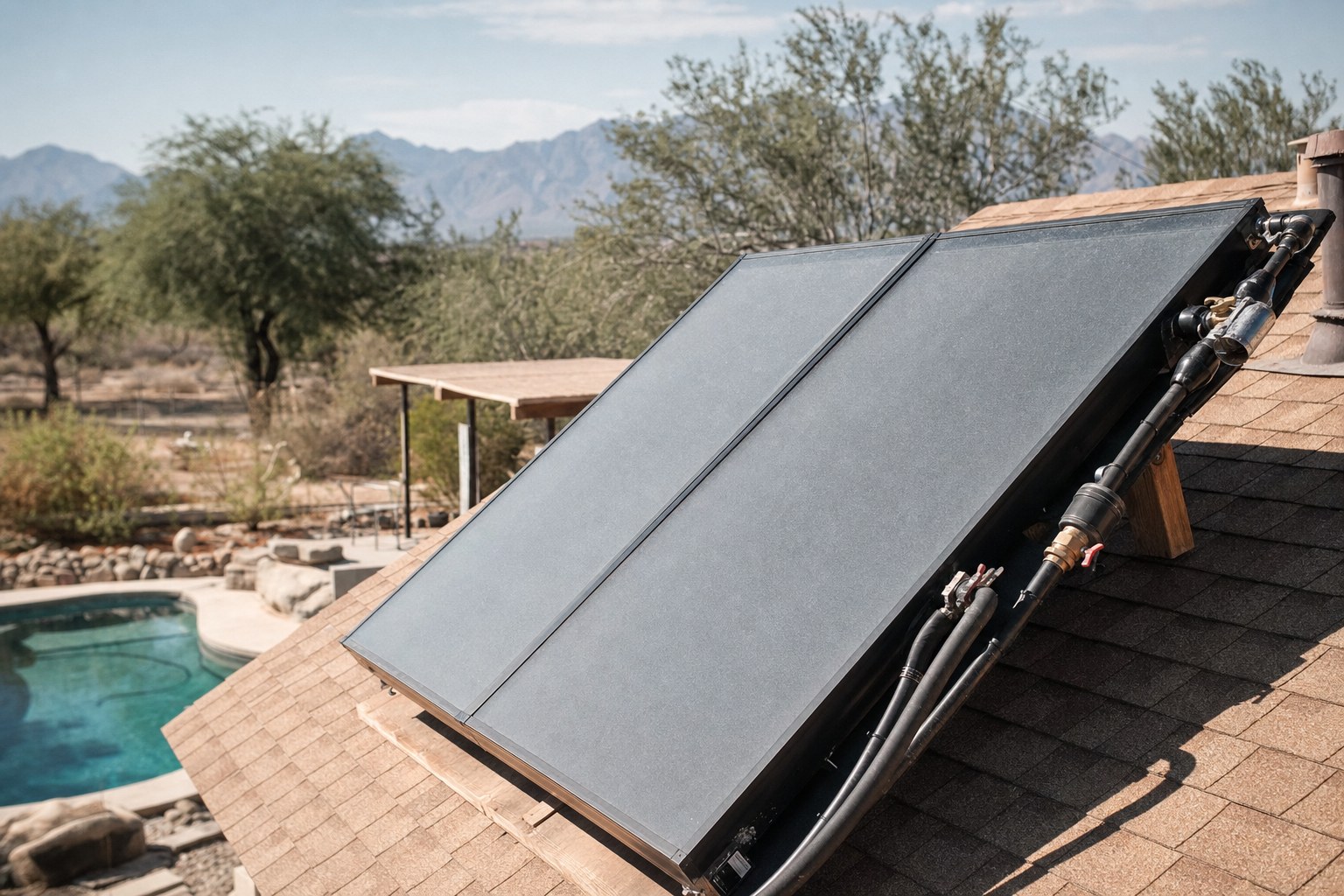
A gas pool heater is cheap on the shelf and brutal at the meter. It costs $800–$1,500 to buy and $36,000–$60,000 to run for ten years, because the burner draws $300–$500/month in fuel whenever it is lit (riverpoolsandspas.com, Apr 2026). Swap the fuel line for sunlight and the yearly operating cost drops to $50–$100. Across a decade that spread reaches $59,000, enough to buy an entire solar water and pool heating system several times over with a contractor doing the labor.
The hidden cost in this category runs backwards from the usual: the option with the frightening install quote is the cheap one, and the bargain on the shelf is the expensive one. What follows prices every rung of the ladder, from $50 of hose coiled on plywood to a $4,000 certified install, sizes both a pool array and a household hot water array against published formulas, and hands over two complete build sheets. Run your pump's PV components through the sizing calculator
The Ten-Year Receipt
Four ways exist to put heat in a pool, and ranking them by purchase price produces exactly the wrong order. The table below carries capital plus fuel across ten years. (This is a whole-system figure over time, separate from the per-kit "real build cost" metric used elsewhere on this site.)
| Cost line | Gas burner | Electric heat pump | DIY solar coil | Installed solar |
|---|---|---|---|---|
| Hardware and install | $800–$1,500 | $2,500–$5,000 | $50–$150 | $2,500–$4,000 |
| Running cost per year | $3,600–$6,000 | $600–$1,200 | $0–$20 | $50–$100 |
| Running cost, 10 years | $36,000–$60,000 | $6,000–$12,000 | $0–$200 | $500–$1,000 |
| Service life | 5–10 yr | ~10 yr | 3–7 yr | 15–20 yr |
| Replacements inside 10 yr | $800–$3,000 | $0–$5,000 | $150–$600 | $0 |
| Ten-year total | $37,600–$64,500 | $8,500–$22,000 | $200–$950 | $3,000–$5,000 |
Sources: Gas operating costs from riverpoolsandspas.com (Apr 2026). Heat pump costs from DOE Energy Saver (Apr 2026). Solar operating costs from diysolarpoolheaterkits.com (Apr 2026).
The gas column lands at roughly 12× the installed-solar column and close to 60× the DIY coil. Nothing exotic drives that. Sunlight has no invoice, and a collector with no moving parts has almost nothing to break.
Where the Payback Actually Lands
Against gas, a $3,000 professional install erases $3,600–$6,000 of fuel every year. Payback: 6–10 months.
Against a heat pump, that same install saves $550–$1,150 a year, so payback stretches to 2.6–5.5 years. Both windows sit comfortably inside the system's 15–20 year service life.
Against gas, the $100 coil build pays back in days rather than months. It does need rebuilding every 3–7 years at $50–$150, which still disappears next to any burner's annual fuel bill.
One honest limit belongs here. Solar stretches a swim season, it does not manufacture one. In northern states the payback concentrates in the shoulder months (March, April, October), and a cold-weather pool still wants a gas heater or heat pump standing behind the collectors.
Put off-grid kits head to head
Two Jobs, Two Machines
Pool water and shower water come off the same physics, and that similarity is where money gets wasted. The two applications diverge on target temperature, and target temperature drives collector type, collector area, and whether a storage tank is needed at all. Buying the wrong one underperforms in a way no amount of extra panel area fixes.
Warming a Pool
Pool water routes straight through the collectors and back, gaining 10–25°F. The pool is its own thermal storage, so nothing insulated needs buying. The tradeoff is footprint: collector area runs 50–100% of the pool's surface area, which makes these the physically largest solar thermal arrays most homeowners will ever own.
Because the target sits at 80–90°F, unglazed panels are enough. Commercial unglazed collectors last 15–20 years under the Solar Rating and Certification Corporation (SRCC) OG-400 standard. Active builds borrow the pool pump that is already running. Passive mat systems ask for no pump at all.
Household Hot Water
Domestic hot water (DHW) has to hit 120–140°F for showers, sinks, and appliances. That target rules unglazed panels out, since they will not reliably reach 120°F in most climates, so the job goes to glazed flat-plate or evacuated tube. A conventional electric or gas heater stays in the loop as backup for nights and overcast stretches.
Demand for a family of four runs 60–80 gallons a day. Two glazed flat-plate collectors (4×8 ft each, 64 sq ft total) cover 50–100% of that in mild climates (DOE, Apr 2026). Add a small pump and differential controller for an active loop, or let a thermosiphon do the same work with no electricity.
The Split, Side by Side
| Factor | Pool heating | Household hot water |
|---|---|---|
| Target temperature | 80–90°F | 120–140°F |
| Collector type required | Unglazed or glazed | Glazed or evacuated tube |
| Typical collector area | 225–450 sq ft (15×30 pool) | 40–80 sq ft (family of 4) |
| Separate storage tank | No (pool is the tank) | Yes (insulated tank, 40–80 gal) |
| Active or passive | Either | Either |
| DIY difficulty | Low–Medium | Medium–High |
| DIY cost range | $50–$3,000 | $200–$2,500 |
| Installed cost | $2,500–$4,000 | $3,000–$8,000 |
What a Thermal Collector Is Doing
A solar thermal collector shares no hardware with a photovoltaic panel. Different technology, different job. Water (or a heat-transfer fluid) runs through an absorber plate sitting in the sun, and the sun heats it directly. There is no inverter, no battery, no charge controller anywhere in the loop.
The cycle takes one sentence to describe: cool water enters at the bottom inlet, picks up heat crossing the absorber, and leaves through the top outlet, headed back to the pool or into a storage tank. A pump moves it in an active system. In a passive system, warm water rising does the same work for free.
Three Absorber Constructions
Three constructions cover the entire market, from summer-only pool mats to hot showers in January. Ranked by what they put out:
| Absorber | How it is built | Yield (BTU/ft²/day) | Price ($/sq ft) | Where it belongs |
|---|---|---|---|---|
| Evacuated tube | Rows of vacuum-insulated glass tubes | ~1,100–1,250 (cold/cloudy climates) | $35–$55 | Peak efficiency; cold country; DHW in all seasons |
| Glazed flat-plate | Tempered glass over an aluminum plate and copper tube | ~1,000–1,050 | $25–$40 | Household hot water; pools kept warm all year |
| Unglazed | Bare UV-treated rubber or plastic, no glazing | ~850 | $5–$15 | Summer pools and indoor pools |
Start from the bottom row, because that is where most pool projects end up. Unglazed panels are the cheapest thing that works, and they work on pools specifically because a pool's 80–90°F target sits near ambient air temperature. Skipping the glass means heat retention is poor, which a pool tolerates and a shower does not.
Glazed flat-plate panels add tempered glass over the absorber, trapping infrared and shutting down convective loss. Same area, 15–20% more output. Paying $25–$40/sq ft instead of $5–$15 earns its keep on domestic hot water, or on pools run year-round where ambient drops under 50°F.
Evacuated tube collectors seal each absorber inside a vacuum sleeve, which removes convective loss altogether. Cold or overcast conditions are where that shows: 20–35% more output than flat-plate, at a 20–40% price premium over glazed flat-plate (solarpanelsplus.com, Apr 2026). Somewhere hot and sunny, flat-plate matches them for less money.
Five Price Points, Five Different Heaters
"Solar pool heater cost" has no single answer, because the phrase covers a free afternoon with scrap hose and a $4,000 warrantied install with equal accuracy. Each rung buys efficiency, service life, and less work.
| Rung | Budget | What you end up with | Gain | Absorber area | Service life | Skill needed |
|---|---|---|---|---|---|---|
| 1 | $0–$50 | Scrounged garden hose, spiraled | 10–15°F | ~50 sq ft | 2–5 yr | Almost none |
| 2 | $50–$150 | UV irrigation hose on its own sump pump | 15–25°F | ~50 sq ft | 3–7 yr | Beginner |
| 3 | $300–$750 | Copper flat-plate you solder yourself | 20–35°F | 24–64 sq ft | 10–15 yr | Hard |
| 4 | $1,500–$3,000 | Off-the-shelf unglazed panel kit | 15–25°F | 80–200 sq ft | 15–20 yr | Moderate |
| 5 | $2,500–$4,000 | Certified system, installed for you | 15–25°F | 100–450 sq ft | 20+ yr | None at all |
Tier 1, $0–$50. Two hundred feet of black garden hose spiraled onto a scrap of plywood, no frame, plumbed into the pump already running. Six hours of direct sun buys 10–15°F. Above-ground pools only, since ordinary hose cannot survive the pressure differential of an in-ground circuit. UV eats untreated hose, so plan on cracks in 2–5 years.
Tier 2, $50–$150. Same idea, better parts. Half-inch UV-stabilized black irrigation hose ($30–$45) on a real frame, optionally under clear plastic. A dedicated $50 sump pump splits the heater onto its own circuit so it runs whenever it wants, independent of the main pool pump. Gain climbs to 15–25°F. Full build sheet is further down this page.
Tier 3, $300–$750. A homemade glazed flat-plate: ½-inch copper tubing soldered into headers, laid on plywood backing, painted with high-temp black, sealed under tempered glass salvaged from a patio table or bought new ($50–$120). Basic plumbing and carpentry required. Output reaches 900–1,000 BTU/ft²/day, and 32 sq ft of it lifts a 10,000-gallon pool 5–8°F a day in full sun.
Tier 4, $1,500–$3,000. Unglazed panel kits meant for homeowner installation come from FAFCO, SmartPool, and SunQuest. Four panels at 4×12 ft each (192 sq ft) match a 15×24 pool at a 100% surface-area ratio. Mounting hardware, hose fittings, and a flow diverter valve come in the box, with nothing to solder or fabricate. Payback against gas: 8–14 months (diysolarpoolheaterkits.com, Apr 2026).
Tier 5, $2,500–$4,000. An SRCC-certified glazed or unglazed system, sized, installed, and commissioned by someone else. Payback runs 1.5–7 years depending on climate and local fuel prices (DOE, Apr 2026). Service life beats gas heaters (5–10 yr) and heat pumps (10 yr) by a factor of 2–4.
Domestic hot water runs its own ladder:
| Hot water build | Budget | How water moves | Hot water per day |
|---|---|---|---|
| Batch tank you build | $185–$425 | Passive, draws no power | 30–40 gal/day |
| Thermosiphon kit | $1,500–$2,500 | Passive, pump-free | 50–80 gal/day |
| Flat-plate, active, installed | $3,000–$6,000 | Pump and controller | 80–120 gal/day |
| Evacuated tube, installed | $4,000–$8,000 | Pumped, top efficiency | 80–120 gal/day |
Shop kits that can carry an active pump
Getting Collector Area Right
Undersizing is the failure mode that kills most DIY thermal projects. Cover 30% of a pool's surface and the water will get measurably warmer without ever reaching target, because the arithmetic does not close. The Florida Solar Energy Center (FSEC) formula sets the floor.
The FSEC Pool Formula
Collector area = Pool surface area × Climate multiplier
| Where the pool is | Factor | What that buys |
|---|---|---|
| Florida and the Southwest, year-round | 1.00 | Match pool area exactly and swim 12 months |
| Gulf Coast and the Southeast | 0.80 | A season of 8–10 months |
| Midwest and Mid-Atlantic | 0.70 | A season of 6–8 months |
| Northern states, Pacific Northwest | 0.60 | A season of 5–6 months |
Run it on a 15×30 ft pool in Northern California:
- Surface area: 15 × 30 = 450 sq ft
- Multiplier: 0.65 (6–8 month season)
- Collector area floor: 450 × 0.65 = 293 sq ft
- Panels at $10/sq ft (unglazed kit): 293 × $10 = $2,930
- Round that to 6 off-the-shelf 4×12 panels (288 sq ft), a commercial kit at $1,800–$2,400
A shortcut exists: divide total pool gallons by 5,000 for the count of standard 4×10 panels (SmartPool, Apr 2026). An 11,250-gallon pool gives 2.25, rounding up to 3 panels (120 sq ft). Be careful with it. It undersizes badly against FSEC in northern climates, so run both calculations and build to the larger answer.
Collector Area per Person for Hot Water
Reckon on 20 sq ft of glazed absorber for each person where the climate is mild (averaging 60°F+), dropping to 12–14 sq ft each somewhere hot (DOE, Apr 2026).
Four people in the Mountain West: 4 × 20 = 80 sq ft, which is 2 standard 4×10 collectors. Four people in Phoenix: 4 × 13 = 52 sq ft, or 1–2 standard 4×8 collectors.
Can the Pump Cope
Active pool loops want 0.5–1.0 GPM per collector panel. A 293-sq-ft array (roughly 6–7 standard 4×12 panels) therefore asks for 6–7 GPM, which any standard pool pump delivers without noticing. Head pressure is the real check, since collectors up on a roof usually add 15–25 ft of it. Most pool pumps shrug that off. A 0.5 HP unit might not, and might have to be replaced.
Work out the array a pump needs
Build Sheet: Hose-Coil Pool Heater Under $100
Fifteen to 25°F of gain, zero plumbing skill, everything from one hardware-store trip, 3–4 hours of work. This design is for above-ground pools. In-ground owners should buy a Tier 4 commercial kit, since ordinary hose will not take in-ground pump pressure.
The Cart, Priced Apr 2026
| Part | Spend |
|---|---|
| Plywood sheet, 4×4 ft | $20–$25 |
| Black UV irrigation hose, ½-inch, 200 ft | $30–$45 |
| Barb connector, irrigation hose ½-inch to pump outlet | $8–$12 |
| Sump pump rated around 750 GPH | $45–$55 (or lean on the pool pump you own) |
| Shut-off ball valve | $8–$15 |
| Plastic sheeting, clear, 6 mil, 5×5 ft | $8–$12 |
| Spray paint, black (skippable) | $5 |
| Cart total | $50–$115 |
Assembly
Step 1. Frame it. Cut the plywood to 4×4 ft and put 2×4 legs under it at 12–18 inches. That elevation matters, since sitting on the ground costs 15–25% of thermal output. Point the frame true south (northern hemisphere) and tilt it 30–45° into the sun.
Step 2. Darken the base. Black paint, or black roofing felt stapled down. It bounces radiant heat back into the hose and is worth 2–4°F. Optional, and nearly free.
Step 3. Lay the coil. Begin at the frame's outer edge and spiral inward, tight. Zip-tie or staple every 18 inches. Bring inlet and outlet off the same edge so the pump connection stays simple.
Step 4. Glaze it (optional). Staple clear plastic sheeting across the whole frame and seal the edges. The greenhouse effect this creates adds 3–5°F. In a warm, sunny climate the bare coil still does fine.
Step 5. Plumb it. Barb connector from pump outlet to hose inlet, hose outlet back to the pool return. Put the ball valve on the inlet line so flow can be throttled, which lengthens contact time and improves heat transfer. Aim for 0.5–1.0 GPM.
Step 6. Place the pump. Set the intake at the opposite end of the pool from the solar return. Water that just came out of the collector should not go straight back into it.
What to expect: 15–25°F of gain across 6 hours of direct sun. On a 15,000-gallon above-ground pool that reads as +1–2°F per day, so a full 10°F takes 5–10 days of continuous running.
If it underperforms: gain below 10°F has two fixes. Add a second coil in parallel, doubling collector area, or close the ball valve halfway to slow the flow and give the water longer against the hot hose.
Build Sheet: Passive Batch Tank
A batch heater, formally an Integrated Collector Storage (ICS) system, is the shortest route to solar domestic hot water. No pump, no controller, no electricity at all. Supply pressure pushes cold water into a black tank sitting in the sun, and household pressure pushes the hot water back out when a tap opens. One to two days of work. $185–$425 in all-new materials, less if the tank is salvaged.
The Cart, Priced Apr 2026
| Part | Spend |
|---|---|
| Steel tank, 30–40 gallon, pulled from a dead water heater | $0–$80 |
| Framing: plywood plus 2×4 for the insulated box | $60–$100 |
| Rigid foam board, 2-inch, every face but the glazed one | $30–$50 |
| Face panel: tempered glass, or twin-wall polycarbonate | $50–$120 |
| Flat black spray paint rated for high temperature | $15–$25 |
| Fittings, sealant, Teflon tape | $20–$35 |
| Ball valve to drain it for winter | $10–$15 |
| Cart total | $185–$425 |
Assembly, Step by Step
Step 1. Strip the tank. Drain and clean the salvaged heater, then pull the outer casing and every scrap of insulation off it. Bare metal is the goal. Coat the whole exterior in high-temp flat black. Ordinary spray paint breaks down past 200°F, while high-temp formulas hold their absorptivity at 400°F and beyond.
Step 2. Box and insulate. Frame 2×4 lumber into a box 2 inches larger than the tank on every side. Line every interior face except the glass one with 2-inch rigid foam board, roughly R-10 per 2 inches. Without it the hot tank simply conducts its energy into the structure.
Step 3. Glaze the face. Cut tempered glass or 8mm twin-wall polycarbonate to the opening. Polycarbonate is lighter and will not shatter. Tempered glass passes 2–4% more solar radiation. Hold it with wood strips and seal every edge weatherproof, because air leaks bleed thermal output fast.
Step 4. Site it. South-facing roof or wall, tilted to local latitude for year-round use (40° at 40°N). The tank has to sit above the lowest hot water outlet in the house so gravity feeds it out when a tap opens.
Step 5. Connect the water. Cold supply into the bottom inlet, hot outlet at the top into the household distribution line. Fit a pressure relief valve, which code requires in most jurisdictions. Add the ball valve ahead of the inlet for seasonal drain-down.
Step 6. Plan for winter. Anywhere that drops below 32°F, shut the inlet and drain the tank every fall. Water left standing in a sun-exposed tank freezes and splits the welds. With a drain valve at the low point this is a 5-minute chore.
What to expect: 30–40 gallons at 120–140°F on a clear day, which covers morning showers for two or three people. The existing backup water heater picks up the rest automatically whenever the batch tank falls short.
Powering the Circulation Pump Off-Grid
Active systems need a pump to move water or heat-transfer fluid through the collectors, and that pump pulls 40–150W continuously while it runs. On grid, it plugs in. On a cabin, a homestead, or any roofline with no convenient AC drop, a small PV array carries the load directly.
Pump Draw by System Size
| What you are running | Pump it takes | Draw | Energy across a 6 hr run |
|---|---|---|---|
| Hot water alone (family of 4) | Circulator, small | 40–75W | 240–450Wh |
| Pool under 10,000 gal | Sump pump, or a small pool pump | 75–150W | 450–900Wh |
| Pool of 10,000–25,000 gal | Pool pump, 1 HP | 150–750W | 900–4,500Wh |
| Pool over 25,000 gal | Pool pump, 1.5–2 HP | 750–1,500W | 4,500–9,000Wh |
At the DHW and small-pool end, one 100W panel covers the day's pump load and no battery is needed. The Renogy 100W 12V Solar Panel Starter Kit with 30A PWM Controller (advertised price $160, Apr 2026) pairs a 100W panel with a PWM charge controller, which is enough to turn a 40–75W DC circulation pump through daylight hours with nothing stored. The timing works out on its own: the pump only needs to run when the sun is up, which is exactly when the collector has heat to move.
Dropping the Inverter
A DC pump fed straight off a PV panel through a charge controller runs 15–20% more efficiently than an AC pump, purely because the inverter conversion loss disappears. The wiring is panel, PWM or MPPT controller, 12V DC pump. Adding that circuit costs $30–$80 for the pump on top of the panel and controller.
Medium and large pools with 1 HP or larger AC pumps need more: a 200–400W PV array behind a 12/24V inverter. Panels sized for pump duty and the calculator to match wattage to array
Common Questions
What does it cost to heat a pool with solar?
Materials for a DIY coil run $50–$150. Commercial DIY kits from FAFCO or SmartPool land at $1,500–$3,000 for a mid-size pool. Hiring it out averages $2,500–$4,000 (DOE, Apr 2026). Against gas heating, payback arrives in 6–14 months depending on local gas prices and solar hours.
Is a DIY solar water heater realistic to build?
Yes, on both formats. Budget 1–2 days and $185–$425 of materials for a batch (ICS) water heater. The coil pool heater is 3–4 hours and $50–$115. Neither uses electricity. The batch heater does need a south-facing roof with unobstructed sun and a mounting structure rated for the 250–334 lbs a water-filled tank weighs.
How many collectors will my pool need?
Run the FSEC formula first: collector area = pool surface area × climate multiplier. A 15×30 ft pool (450 sq ft) in a northern state works out to 450 × 0.60–0.70 = 270–315 sq ft of collector, putting you at 6–7 of the 4×12 panels sold everywhere. Florida and the Southwest get sized to the whole pool area instead: 450 sq ft, so 9–10 panels.
Glazed or unglazed: which collector should I buy?
Unglazed panels skip the glass cover, use UV-treated rubber or plastic, and cost $5–$15/sq ft for ~850 BTU/ft²/day. They suit pools because the 80–90°F target sits near ambient. Glazed panels put tempered glass over copper-tube absorber plates at $25–$40/sq ft for ~1,000–1,050 BTU/ft²/day, and they are mandatory for domestic hot water at 120–140°F or for year-round pool heating anywhere ambient drops below 45°F.
Will solar pool heating do anything in winter?
Below 45°F ambient, unglazed collectors shed heat to the air faster than they gain it from the sun, so they stop being useful. Glazed collectors on a drain-back or antifreeze system keep working down to roughly 25°F ambient. Evacuated tubes with glycol heat-transfer loops hold up to -40°F ambient. For most cold-climate pools the practical answer is to drain the unglazed panels in fall and restart them in spring.
Read Next
Track the prices, not the hype
We track real build costs across 400+ off-grid kits and email the biggest verified price drops every week. See this week’s drops.