Home Solar Panels: What 140 Kits Cost Once the Missing Parts Are Added
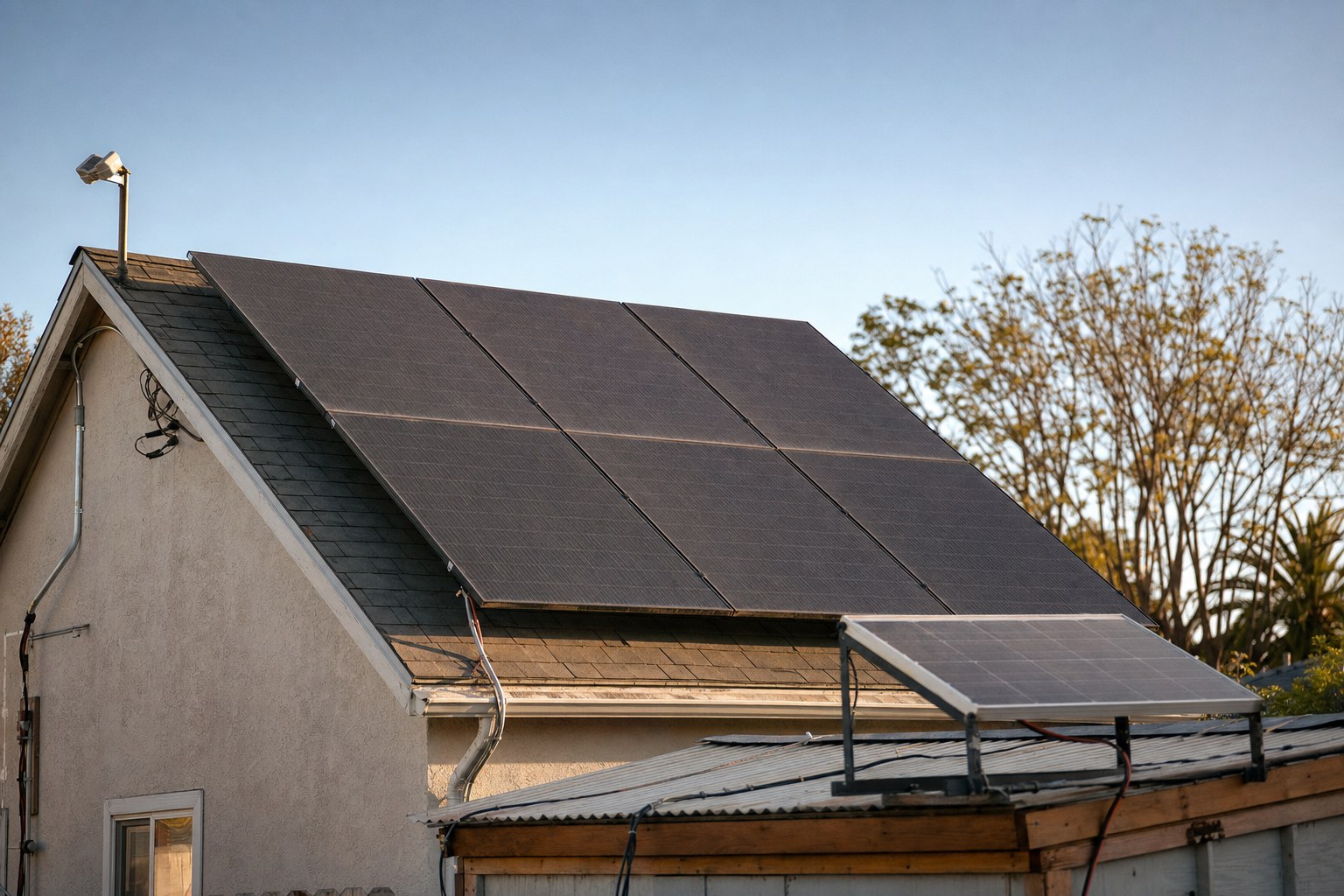
Sticker price is the least useful number on a home solar listing. Our database holds 140 home kits
and not one ships complete, so the figure on the product page is where the bill starts, not where it
ends. Everything below is quoted as real build cost instead: what a kit lists for, plus the parts it
quietly forces you to buy before the thing will run. Apr 2026 pricing puts the catalog floor at a
portable Anker SOLIX plug-in unit, $449, and the ceiling at a 63.4 kW EDGE homestead build,
$103,138. Both get specced in full below.
One decision outside the hardware moves the total just as much: who bolts it down. Doing the work
yourself lands near $1.20-$1.80/W installed, hiring it out near $2.50-$3.30/W. On an
8 kW array that spread is worth $10,400-$12,800, a bigger number than most people attach to a
couple of weekends of labor.
Where the 140 Kits Sit: Brands, Prices, and the Completeness Problem
- Catalog: 140 kits across 12 brands
- Average completeness: 83.5%, and nothing in here scores 100%
- Real build cost: $449 at the low end, $114,732 at the high end, averaging $14,200 (Apr 2026)
- Bus voltage: 134 of the 140 run 48V (95%)
- Chemistry: LiFePO4 in all 140. Lead-acid appears zero times.
| Band | Kits | Finished Cost |
|---|---|---|
| Starter (plug-in/portable) | 18 kits | Under $2K |
| Partial-home | 42 kits | $2K-$8K |
| Whole-home | 61 kits | $8K-$30K |
| Large property | 19 kits | $30K+ |
Read that second bullet twice. 132 kits land at 86% complete, another 8 score below that, and the
number scoring 100% is zero. Which is why every kit page here carries a Completion Gap Receipt: it
names what the box leaves out and prices it, so the figure you carry from one brand to the next is
the finished figure.
See all 140 home kits | Our costing method, in full
Sizing First: Panel Count Is an Arithmetic Problem
A capacity target comes out of a formula, not a sales call: yearly kWh, divided by production ratio,
divided by panel wattage, equals panel count. The average American household burns
900 kWh/month, or 10,791 kWh/yr. Push that through and a full offset asks for roughly
7.2 kW of array.
| Array Size | Floor Area | Unshaded Roof | Panels (430W) | Yearly Draw |
|---|---|---|---|---|
| 4 kW | 1,000 sq ft | ~265 sq ft | 10 panels | 6,000 kWh/yr |
| 8 kW | 2,000 sq ft | ~500 sq ft | 19 panels | 12,000 kWh/yr |
| 12 kW | 3,000 sq ft | ~740 sq ft | 28 panels | 18,000 kWh/yr |
Production ratio does the quiet work here. It counts kWh produced per installed watt per year, a
direct read on local sun hours, and it swings from 1.1 in overcast northern climates to
1.6 in the desert Southwest. Same annual output, more panels in Seattle than in Phoenix.
Wattage is the easier input: 97% of the market rates at 400W+ as of 2025, so full offset for
most homes settles at 16-23 panels.
Two kits in the catalog show those targets as hardware. Sized to the 1,000 sq ft line: the PRIME
4.4kW, carrying 4.4 kW of array. Sized to roughly 1,500 sq ft on 16 panels: the Anker F3800.
Both pair an MPPT charge controller with LiFePO4 storage.
Three Architectures: Grid-Tied, Hybrid, Fully Off-Grid
| System | Battery | Outage Coverage | Install Difficulty | Best Fit | Cost Band |
|---|---|---|---|---|---|
| Grid-Tied | Not required | None | Low | Cheapest bill, no backup | $8,000-$20,000 |
| Hybrid | Required | Critical circuits | Medium | Savings plus ride-through | $12,000-$35,000 |
| Off-Grid | Required (large) | Full home | High | Nowhere to plug in | $25,000-$100,000+ |
Grid-tied buys the most savings for the least hardware: no battery, surplus sold back through net
metering, and a house that goes dark with everyone else's when the line drops. Add a bank and it
becomes a hybrid, carrying the critical circuits through an outage. The PRIME 4.4kW is that
configuration. Go fully off-grid and you take the largest banks and the hardest install in trade for
owing the utility nothing.
The paperwork deserves a line in the budget. Ask homeowners what the worst stretch was and they tend
to name the utility paperwork rather than the roofwork, while net metering rules that shift from one
state and one utility to the next make grid-tied payback hard to model before you commit. Plug-in solar is the
one path that skips the utility conversation outright.
Kits sized for a whole house | Put two kits head to head
Under $1,500: The Plug-In Tier
18 kits sit below $2,000. Two are worth pulling out, for opposite reasons.
<span class="font-mono">Anker SOLIX C1000 Gen2 + 600W Solar</span>
Finished cost $449 (Apr 2026), covering 600W of panel, 1,024Wh of LiFePO4, and
a 2,000W inverter. No kit we track prices a watt lower: $0.75/W. Scores 86% complete,
and being portable, nothing about it counts as an installation.
<span class="font-mono">EcoFlow DELTA 2 Max 2048Wh + 400W Panel</span>
Finished cost $899 (Apr 2026), though it trades at $1,222 today, down from a
$2,999 ATH against an $849 ATL. Specs: 400W of panel, 2,048Wh of
LiFePO4, an inverter rated 2,400W and pure sine, 86% complete. At $0.44/Wh no other
starter banks this much reserve for the money.
Statute sets the ceiling in this tier, not the hardware. Utah HB 340 cleared 1,200W as the
limit for feeding an ordinary wall outlet directly, skipping both the permit desk and the
electrician, and by early 2026 more than 20 states had put comparable rules on their books. What the budget buys is lights, phone charging, a
router, a refrigerator: one appliance, or one critical circuit. Nobody should read this tier as a whole-home
system.
$2,000 to $10,000: Covering Part of the House
42 kits land in this band, and measured against what a contractor charges for the same capacity,
this is where DIY pays its widest margin.
<span class="font-mono">PRIME 4.4kW + 10.2kWh LiFePO4 (IronRidge Roof Mount)</span>
Finished cost $8,189 (Apr 2026) for 4,400W of panel, 10,200Wh of LiFePO4 (EG4
LL-S), and an EG4 6000XP 6kW hybrid inverter, roof racking by IronRidge in the box. Scores
86% complete. Against a ~1,000 sq ft home, 4 kW at a 1.5 production ratio returns roughly
6,000 kWh/yr.
Price that same 4.4 kW through a contractor and the quote reads $11,000-$14,520. The kit is $8,189, so the labor decision by itself is worth
$2,811-$6,331. Being a hybrid, the critical circuits ride through an outage.
On storage, 10,200Wh carries a 2-person household pulling 2-4 kWh/day across 2-3
sunless days. The 14% gap in this band is usually a single item: monitoring hardware. The kit page's
Completion Gap Receipt prices it exactly.
Compare this band | Size the array
$10,000 to $40,000: The Whole-Home Band
61 kits, and with the household target averaging 7.2 kW, this is the band most US homes
resolve to. The two below answer the same problem in opposite ways: one arrives plug-and-play, the
other gets bolted to the roof.
<span class="font-mono">Anker F3800 Smart Home Kit (6.56kW + 7.68kWh)</span>
Finished cost $15,685 (Apr 2026), sitting 28% under its $21,899 ATH and still
trending down. The build: 16 panels rated 410W, which is 6,560W of array, behind
7,680Wh of LiFePO4,
a 6,000W 120V/240V inverter, and the Anker Smart Home Panel. Scores 86% complete, enough to
carry a home of about 1,500 sq ft.
<span class="font-mono">SELECT 15.84kW + 30.72kWh (Ground Mount, Hybrid)</span>
Finished cost $31,989 (Apr 2026) for 15,840W of panel and 30,720Wh of LiFePO4
(EG4 LL-S), run through an EG4 FlexBoss21 16kW inverter plus GridBoss and mounted on SkyRack
HD ground racking. Scores 86% complete, enough to hold a 3,000+ sq ft home at full autonomy.
Run the labor math on each. Contracted, 8 kW bills $20,000-$26,400, putting the Anker kit's
$15,685 ahead by $4,315-$10,715. Contracted, 16 kW bills $39,600-$52,800,
putting the SELECT kit's $31,989 ahead by $7,611-$20,811.
Storage scales with the household: the SELECT's bank runs 3-4 people for roughly 3-4 days off sun,
at a draw of 5-8 kWh/day. Both sit at 86%, and in both cases monitoring hardware is the piece that
is missing.
Whole-house kits | Panels by category
$40,000 and Up: Homesteads and Multi-Structure Properties
19 kits clear $30K. This band exists for one reason, which is total independence.
<span class="font-mono">EDGE 63.4kW + 128kWh (6 x Sol-Ark 18K)</span>
Finished cost $103,138 (Apr 2026). The build: 63,360W of panel, 128,000Wh
(128 kWh) of RENON XCELLENT PLUS LiFePO4, and 6 Sol-Ark 18K inverters totaling 108kW. Scores
86% complete. Annual output at a 1.5 production ratio runs about 95,040 kWh, nearly 9x what
the average US home uses.
That bank will hold a household of five or more for 10+ days with zero solar input, drawing
8-12 kWh/day. Contracted, 63 kW would bill $158,400-$209,088, so building it yourself keeps $55,262-$105,950.
The buyers are working farms, parcels with several structures, shops running welders and
compressors, and land the grid never reached. Budget the calendar honestly: permit research at this
scale runs 1-2 months before anything gets mounted, against 2-3 days of physical work.
Non-UL-listed components have blocked approvals outright in documented cases.
The Six Kits Side by Side
All six score 86% complete, so that column is omitted. Each metric sits next to what it measures.
| Kit | Buyer | Finished Cost | Array | $/W | Storage | $/Wh |
|---|---|---|---|---|---|---|
| Anker SOLIX C1000 | First build, renters, trials | $449 | 600W | $0.75/W | 1,024Wh | $0.44/Wh |
| EcoFlow DELTA 2 Max | Entry kit, storage-heavy | $899 | 400W | $2.25/W | 2,048Wh | $0.44/Wh |
| PRIME 4.4kW | Small-home hybrid | $8,189 | 4,400W | $1.86/W | 10,200Wh | $0.80/Wh |
| Anker Smart Home | Whole home, no racking | $15,685 | 6,560W | $2.39/W | 7,680Wh | $2.04/Wh |
| SELECT 15.84kW | Full offset, large home | $31,989 | 15,840W | $2.02/W | 30,720Wh | $1.04/Wh |
| EDGE 63.4kW | Multi-structure homestead | $103,138 | 63,360W | $1.63/W | 128,000Wh | $0.81/Wh |
Read the $/W column top to bottom and it draws a U: cheapest at the bottom of the catalog, most
expensive through the middle, cheaper again once the build gets big. The $/Wh column draws the same
shape. That middle bulge is the whole-home band charging for the convenience of arriving
pre-integrated, and it is worth sitting with: the tier most families land in is the tier where every
watt and every watt-hour costs the most.
Four Checks Worth Running Before You Order
What the box leaves out. Completeness averages 83.5% here, and nothing reaches 100%. Monitoring
hardware goes missing more often than anything else. Finished pricing folds in whatever is required
and absent, itemized on each kit's Gap Receipt. Read it before you order: it is the difference
between the price you saw and the price you pay.
Whether the roof can take it. Even a small array wants 265 sq ft with nothing shading it,
facing south if possible, pitched somewhere between 15-40 degrees. Ground mount is the answer when the roof
cannot deliver that, which is why SkyRack HD racking ships with the SELECT 15.84kW.
Chemistry, which is already settled. LiFePO4 runs in all 140, and the spec sheet explains the
sweep: $100-$150/kWh, better than 92% round-trip efficiency, a 15-20 year service life, and
6,000+ cycles even when routinely run down to 80% depth of discharge. Lead-acid answers none of
those numbers.
The paperwork, which is not settled. Non-UL-listed parts have both stalled inspections and
disqualified systems from the tax credit, in documented cases. Against 2-3 days of physical work,
budget 1-2 months for research and approvals. A licensed electrician is still mandatory on the final
utility tie-in in some jurisdictions.
Questions We Get About Home Solar
Why is real build cost higher than the listing price?
Because a listing quietly assumes you already own the parts it left out, and finished pricing adds
them back at what they cost to source. Monitoring hardware is the usual omission. Since not one of
these 140 kits arrives at 100%, sticker prices cannot be compared against each other at all.
Finished cost can.
What counts as plug-in solar?
Anything up to 1,200W that feeds an ordinary 120V outlet, clearing the permit desk, the
electrician, and the utility all at once. Utah HB 340 (2025) drafted the template. By early 2026,
20+ states had followed.
How many panels will my house need?
Divide yearly kWh by a production ratio between 1.1-1.6 (your location sets it), then divide by
panel wattage. Run the US average of 10,791 kWh/yr through it and 7.2 kW falls out,
which is 16-23 panels rated 430W. Estimate from your own loads.
Is DIY installation allowed?
Most US states allow it. What the labor is worth: $1.20-$1.80/W installed by you against
$2.50-$3.30/W installed by a contractor, which is a gap of $10,400-$12,800 once the
array reaches 8 kW.
Mounting is 2-3 days of work. The permitting and utility coordination wrapped around it is 1-2
months.
Which parts should a complete kit contain?
Panels, an MPPT charge controller, a LiFePO4 battery, an inverter of the pure sine variety, plus
wiring and mounts. With completeness averaging 83.5%, assume something is absent and pull up the Gap
Receipt before ordering.
Read Next
Explore the Data
Track the prices, not the hype
We track real build costs across 400+ off-grid kits and email the biggest verified price drops every week. See this week’s drops.