Lithium and LiFePO4 Batteries: What 419 Solar Kits Say About Chemistry, Voltage, and $/Wh
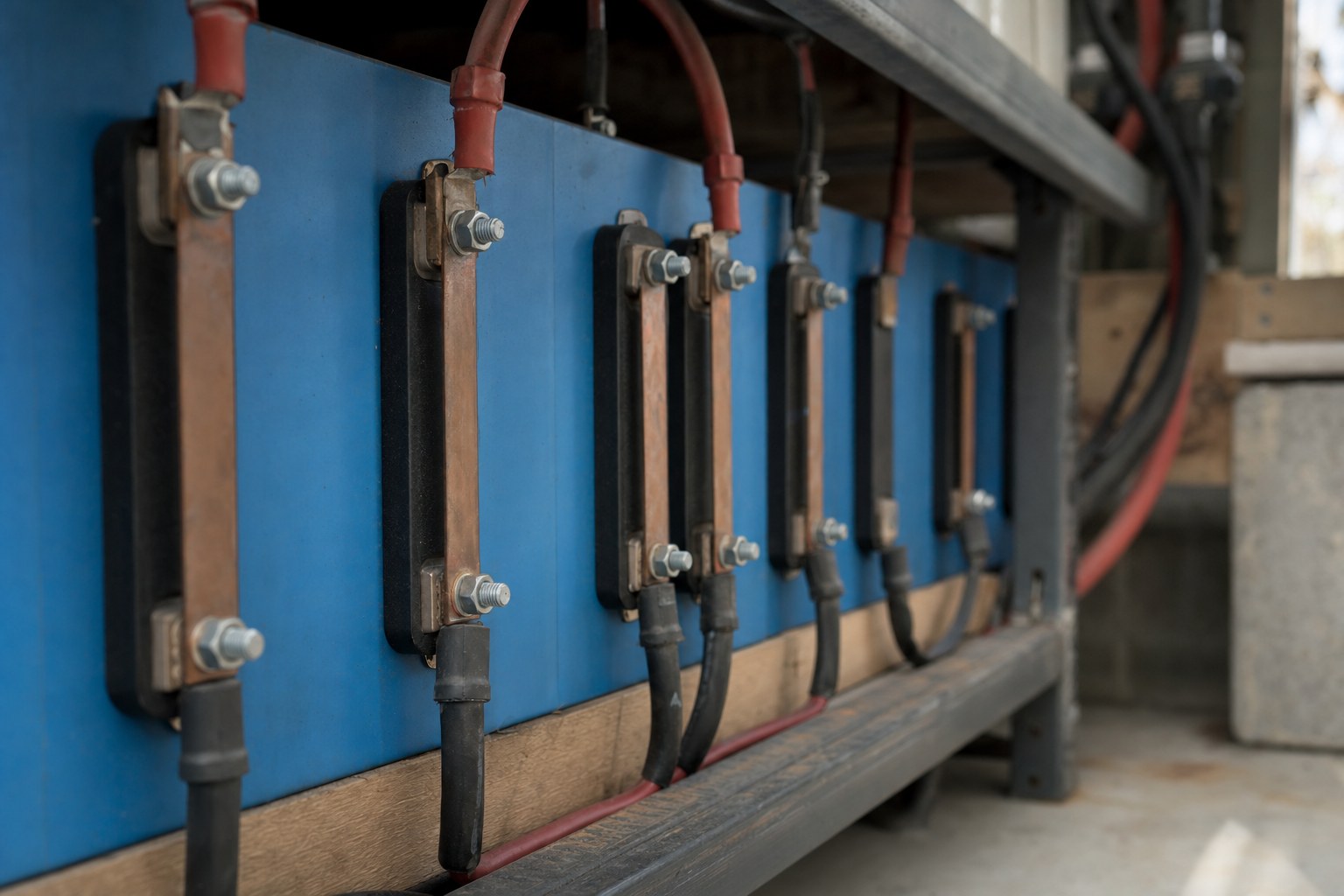
Storage is where a solar kit's sticker price stops being a useful number. Two kits sat in front of us at nearly the same advertised price: one banks 1,800Wh of AGM, the other 5,120Wh of lithium iron phosphate. Priced per watt-hour stored, that is $0.91/Wh against $0.25/Wh. A 3.6x spread, sitting inside listings that look like peers.
The catalog has already voted. Of the 419 kits we track, 384 (92%) ship LFP cells. AGM survives in a shrinking pocket of 12V builds under 2,000Wh.
What the spread does not explain is why buyers still get burned. Two failures do most of the damage. The first is vocabulary: "lithium-ion" and "LiFePO4" get used as synonyms across listings, review videos, and forum threads, and they are not synonyms. The second is arithmetic: rated capacity gets treated as usable capacity, and the system comes up short the first time a cloudy week arrives. Feed an LFP pack a lead-acid charge profile and you can halve its service life without a single warning light.
Below is the honest math on both, drawn from kits spanning 768Wh to 5,120Wh, portable units under $350 through cabin-scale systems past $1,200. Every figure traces to a kit slug and a price we verified.
The Cobalt-Free Cathode Doing All the Work
LiFePO4 is lithium iron phosphate. It lives inside the lithium-ion family, but its cathode carries no cobalt, and nearly everything that makes it the default off-grid chemistry follows from that one substitution.
What the cells deliver:
- Cycle life: 3,000 to 6,000 cycles at 80% depth of discharge, with the spread driven by BMS quality and operating temperature
- Round-trip efficiency: 95-98% of what goes in comes back out
- Discharge temperature range: -20C to 60C
- Charge temperature range: 0C to 55C, extending to -30C on self-heating BMS variants that warm the cells before accepting current
- Thermal runaway threshold: above 500C, against 150-200C for NMC lithium-ion, which can ignite from a puncture alone
Pack voltage is just arithmetic on a 3.2V nominal cell. Four in series make 12.8V and get sold as "12V." Eight make 25.6V ("24V"). Sixteen make 51.2V ("48V"). Those true voltages are not trivia; they are what the charge controller has to be told.
Here is the version of that mistake we see most. A "12V" LFP pack actually rests at 12.8V. A controller still running its lead-acid profile floats at 13.8V. Hold LFP cells at that float and they never stop trickle-charging, which means they never stop making heat. LFP wants 13.5V. The gap is 0.3V, and it decides whether the pack is still working in year 8 or dead in year 4.
Integrated stations sidestep the whole question. The Anker SOLIX C2000 Gen2 ($799, 2,048Wh) runs its own BMS and charge parameters, with nothing for the owner to configure. At $0.39/Wh it lands on the median LFP price in our database.
Three Chemistries, Three Cost Structures
Off-grid kits use three battery chemistries. They fail differently, age differently, and price differently.
| Measure | AGM (Lead-Acid) | NMC (Lithium-Ion) | LiFePO4 (LFP) |
|---|---|---|---|
| Weight per kWh | ~30 kg | ~7 kg | ~12 kg |
| Priced per Wh across tracked kits | $0.91-$1.05 | N/A (rare in kits) | $0.25-$0.58 |
| Depth you can actually use | 50% | 70-80% | 80-100% |
| Energy returned round-trip | 80-85% | 92-95% | 95-98% |
| Rated cycles | 300-500 | 1,000-3,000 | 3,000-6,000 |
| Thermal runaway onset | N/A (vents gas) | ~150-200C | >500C |
Blame the confusion on consumer electronics. In a phone, a laptop, or an EV, "lithium-ion" usually means NMC (nickel manganese cobalt) or NCA: more energy per kilogram, fewer cycles, less tolerance for heat.
Solar storage went the other way. EcoFlow, Bluetti, and Anker SOLIX all build on LFP, not NMC. So when a power station's listing says "lithium-ion battery," LFP is almost certainly what is in the box. Confirm it on the spec sheet, where the cell chemistry line should read "LiFePO4" or "iron phosphate." A listing that says "lithium-ion" and stops there is worth an email to the manufacturer before any money moves, because chemistry sets the charge settings, the cycle-life expectation, and the safety envelope.
Weight decides whether a build is even possible. Five kWh of AGM lands around 150 kg (330 lbs). Five kWh of LFP lands around 60 kg (132 lbs). In a van or an RV, those 90 kg come straight out of payload, fuel economy, and where the bank can legally sit.
The catalog makes the price gap concrete. The WindyNation 400W Mono Kit with 1500W VertaMax Inverter + 300Ah AGM holds 1,800Wh for $1637, or $0.91/Wh. The Bluetti RV5 holds 5,120Wh for $1299, or $0.25/Wh.
Roughly the same money. For it, the LFP kit returns 2.8x the storage, 6-12x the cycles, and 60% more usable energy on every one of them, because it discharges deeper. Efficiency compounds the rest: cycle a 2,000Wh system daily for a year and LFP loses about 40 kWh to internal resistance while AGM loses about 300 kWh. That is 260 kWh of harvested sunlight turned into waste heat, annually.
Pack Voltage Is Really a Copper Budget
Push the same wattage at a higher voltage and current falls. Lower current means less resistive loss and thinner, cheaper cable. That is the entire argument, and the market has already settled it: 270 of our 372 tracked LFP kits (73%) are 48V.
| Pack voltage | Continuous load it suits | Copper on a 10ft run |
|---|---|---|
| 48V | Over 5,000W | 10-12 AWG |
| 24V | 1,500W to 5,000W | 6-8 AWG |
| 12V | Under 1,500W | 4 AWG |
Price the copper and the rule stops being theoretical. A 3,000W load pulls 250A at 12V, which demands 2/0 AWG at $8-12/ft. The same load pulls 62.5A at 48V, served by 6 AWG at $1-2/ft. Over a 15-foot battery-to-inverter run, the wire alone swings $120-$150.
12V, for emergency kits and small mobile builds. The EcoFlow RIVER 2 [MAX] 512Wh / 500W Portable Power Station + Choose Your Custom Bundle | Complete Solar Kit - EcoFlow River 2 Max [Main Unit Only] carries 512Wh for $269 ($0.53/Wh), which covers a shed, a go-bag, or a weekend. The tier scales further than people expect: the ECO-WORTHY 400W 12V Complete Kit Ultra with 40A MPPT + 280Ah LiFePO4 + 2000W Inverter reaches 3,584Wh at $1400 ($0.39/Wh), which is where van and RV builds land when the existing appliances are already 12V. Our price history has it down from $1,600, a 12.5% cut.
24V, the tier nobody stocks. Almost no portable station runs 24V internally. It lives in component builds: a standalone 24V LFP bank, an external MPPT controller, a separate inverter. Between 1,500W and 3,000W it halves the current against 12V while keeping parts cheaper than a 48V build.
48V, for mid-size and up. The EcoFlow DELTA 3 Max – 2,048Wh / 2,400W Portable Power Station + Choose Custom Solar Panel Bundle Option | 5-Year Warranty | Complete Solar Kit - Gray / DELTA 3 MAX [Main Unit Only] holds 2,048Wh at $799 ($0.39/Wh). At the top of the tier, the Bluetti RV5 reaches 5,120Wh at $1299 ($0.25/Wh), the cheapest watt-hour of any complete LFP system we track.
DELTA 3 Max – 2,048Wh / 2,400W + Main Unit Only
One hard constraint: voltages do not mix. A 12V battery cannot sit in parallel with a 48V battery. Every battery in a bank has to share voltage, chemistry, and preferably capacity, or the bank runs unbalanced current, ages its weakest cells fastest, and eventually trips a BMS. Going from 12V to 48V is not an upgrade path, it is a replacement: bank, controller, and inverter all go.
Sizing Against Usable Capacity, Not the Label
The typical build has too many panels and not enough battery. The formula that fixes it:
> (Daily Wh load) x (Days of autonomy) / (Depth of Discharge %) = Required Wh capacity
Autonomy is how many sunless days in a row the system has to carry alone. Two days is the working default. One day suits backup where the grid is still there as a fallback. Three or more is remote-cabin territory, where nothing else is coming.
Four load profiles, sized at two days and 80% DoD:
| Build | Kit capacity to shop | What the formula asks for | Daily draw |
|---|---|---|---|
| Basic cabin | 5,120+ Wh | 5,000-10,000 Wh | 2,000-4,000 Wh/day |
| Full-time boondocking | 3,072-5,120 Wh | 3,750-6,250 Wh | 1,500-2,500 Wh/day |
| Simple RV / van | 2,048-3,072 Wh | 2,000-3,000 Wh | 800-1,200 Wh/day |
| Emergency backup | 768-2,048 Wh | 1,250-2,000 Wh | 500-800 Wh/day |
Run that formula on rated capacity and it lies to you. A 2,000Wh LFP pack at 80% DoD hands over 1,600Wh. A 2,000Wh AGM pack at 50% DoD hands over 1,000Wh. Identical labels, and a system sized off them comes in 20-50% short of what it needed.
Emergency tier. The EcoFlow River 2 Pro holds 768Wh for $339 ($0.44/Wh). At 80% DoD that is 614Wh on the table, which covers a day or two of phones, LED light, a router, and a laptop.
RIVER 2 PRO 768Wh / 800W + Main Unit Only
Boondocking tier. The Anker SOLIX F3000 holds 3,072Wh for $1299 ($0.42/Wh) and takes expansion modules. Its 3,600W inverter covers most RV appliances, a small AC unit included. Size the inverter and the storage separately, though: a 1,500W microwave hits 1,500W for five minutes and walks away with 125Wh, a rounding error against the bank.
SOLIX F3000 3,072Wh/3,600W + Main Unit Only
Cabin tier. The Bluetti RV5 holds 5,120Wh for $1299 ($0.25/Wh) behind a 5,000W inverter. At 80% DoD across two days of autonomy, that funds 2,048 Wh/day with no sun at all: refrigeration, lights, a water pump, and cooking in bursts.
Cold weather takes its cut before any of this applies. LFP loses 10-15% of capacity at 0C and 20-25% at -10C, so a cold-climate build should carry a 20% buffer through the formula. Self-heating packs warm their cells before charging, which solves the charge cutoff but spends stored energy to do it, so the net storage still comes down.
The Ten-Year Receipt
On day one, AGM wins on price. It does not win again after that.
| One 100Ah, 12V battery | AGM | LiFePO4 |
|---|---|---|
| What the unit costs | ~$250 | ~$700 |
| Energy it returns per cycle | 600 Wh (50% DoD) | 960 Wh (80% DoD) |
| Cycles before replacement | 500 | 4,000 |
| Cost per cycle | $0.50 | $0.175 |
Read the last column against the second. LFP asks 2.8x the money up front and returns it at 2.86x lower cost per cycle. Cycling once a day, the lines cross somewhere in year 3-4. Every cycle after that is margin.
The efficiency gap runs underneath the whole comparison. LFP banks 95-98% of what the panels make; AGM banks 80-85%. On a 2,000Wh system cycled daily for a year, that is roughly 40 kWh lost against roughly 300 kWh lost. The 260 kWh difference is about $30-40 worth of panel capacity generating power that no load ever sees.
Depth of discharge widens it again. Rate two batteries at 100Ah and the LFP gives up 80Ah at 80% DoD while the AGM gives up 50Ah at 50%. Same label, 60% more energy.
Then replacements close it out. Cycled daily, AGM is down to 80% of original capacity within 3-5 years. LFP takes 8-16 years to reach the same point. A decade off-grid burns through 2-3 AGM sets against 1 LFP set: $250 per AGM battery across 3 replacements is $750, against one $700 LFP battery that simply stays in service.
The kits say the same thing. The WindyNation 400W Complete Off-Grid Kit is $1149 for 1,200Wh ($1.05/Wh, 500 cycles). The Bluetti RV5 is $1299 for 5,120Wh ($0.25/Wh, 3,500+ cycles). Pay $150 more, store 4.3x the energy, keep it 7x longer.
How we calculate real build cost
Charge Settings That Quietly Cost You Years
More LFP packs die of controller configuration than of anything else. Pair a standalone LFP bank with an external MPPT controller and three parameters need a human to set them.
| Pack | Bulk / absorption | Float | Absorption window |
|---|---|---|---|
| 12V | 14.4V | 13.5V | 30 min per 100Ah |
| 24V | 28.8V | 27.0V | 30 min per 100Ah |
| 48V | 57.6V | 54.0V | 30 min per 100Ah |
That absorption window is short by lead-acid standards for a physical reason: LFP takes current at a nearly flat rate right up to absorption voltage, while lead-acid needs 2-4 hours for its current to taper. Leave a 2-hour absorption on an LFP bank and it burns daylight holding cells at a voltage that is no longer moving any charge into them.
Three defaults to switch off before the first charge:
- Temperature compensation: OFF. Lead-acid needs its voltage trimmed against ambient temperature. LFP does not. Leave compensation running and the pack overcharges in the cold and undercharges in the heat, and both ends shorten cell life. Victron SmartSolar, Renogy Rover, and EPEver Tracer controllers all ship with it enabled.
- Equalization charge: OFF (or 0V). Equalization is a deliberate overcharge that breaks sulfation off lead plates. LFP has no sulfation to break. All the overcharge does is drive cells past their voltage ceiling until the BMS cuts out.
- Float voltage: 13.5V, not 13.8V. Most controllers default to a lead-acid 13.8V float. Those 0.3V hold LFP cells in permanent trickle charge, making heat for no return, and cost 20-40% of cycle life over the pack's service life.
The ECO-WORTHY 400W 12V Complete Kit Ultra ships its controller on lead-acid defaults. The LFP profile is there under "battery type" in the settings menu, and selecting it is step one, before first charge.
None of this applies to sealed stations. EcoFlow, Bluetti, and Anker SOLIX units carry the controller and BMS inside the box and manage every parameter without input. The settings above are strictly for component builds: loose LFP batteries, external MPPT.
The BMS Is What You Are Actually Buying
Every charge and discharge event passes through the Battery Management System. It sets the load ceiling, decides what happens below freezing, and determines how long the cells last. Two packs built on identical cells can behave nothing alike once their BMS boards differ.
The specs that show up in real use:
- Continuous discharge current: 100A entry-level against 200A higher-tier. On a 12V system, a 100A BMS caps continuous output at 1,200W. A 200A BMS doubles that to 2,400W.
- Low-temperature charge cutoff: blocks charge below 0C, where current would plate lithium instead of storing it. Entry-level boards sometimes omit it and let current flow into cells that cannot take it.
- Cell balancing: passive balancing bleeds the excess off as heat; active balancing moves charge between cells. Active adds 15-25% to pack life by keeping the weakest cell from dragging the pack down first.
- Communication protocol: basic boards report nothing. Higher-tier boards speak CAN BUS or RS485, exposing state of charge, per-cell voltage, and temperature live.
Price tracks this closely in our catalog. A $400 standalone LFP battery is generally a 100A board, passive balancing, no comms. The Anker SOLIX C2000 Gen2 at $799 builds in cell monitoring, thermal management, and overload protection.
Certification is a usable shortcut. UL 9540A (energy storage) and UL 1973 (stationary batteries) both mandate specific BMS behavior: thermal cutoff, overcurrent protection, cell-level monitoring. A battery carrying either has had a third party confirm the board does what the listing claims.
Building from components? Check three things before ordering cells: continuous discharge rating, whether a low-temp cutoff exists at all, and what the board can talk to.
Browse battery kits by capacity
Four Builds, Four Kits, Verified Prices
1. Emergency backup and weekend camping
EcoFlow RIVER 2 [PRO] 768Wh / 800W Portable Power Station + Choose Your Custom Bundle | Complete Solar Kit - EcoFlow River 2 Pro [Main Unit Only] at 768Wh / 800W inverter / $339 / $0.44/Wh. It weighs 7.8 kg and scores 71% on completeness, which means panels are a separate purchase. The 614Wh usable at 80% DoD is the emergency tier exactly: a day or two of small loads.
2. Full-time RV boondocking
Anker SOLIX C2000 Gen2 Portable Power Station | 2,048Wh / 2,400W (4,000W Peak) | 58-Min UltraFast Recharge | Expandable to 4kWh | Choose Your Bundle | 5-Year Warranty - C2000 Gen 2 [Main Unit Only] at 2,048Wh / 2,400W inverter / $799 / $0.39/Wh. Our multi-retailer tracking has it flat at $799 since November 2025. 71% completeness. The 2,400W inverter takes most 120V RV appliances without nuisance trips.
3. Off-grid cabin or large RV
BLUETTI RV5 - Modular RV Solar System | 5,000W | 120V | Off-Grid Ready | UL Certified | 5-Year Warranty - RV5 Power Hub [Unit Only] at 5,120Wh / 5,000W inverter / $1299 / $0.25/Wh. Ships with 1,800W of panels and the 5,000W inverter. 86% completeness. Our use-case ratings (RV, cabin, shed, emergency) all score it on load-capacity match.
4. Expandable whole-home
Anker SOLIX F3000 Portable Power Station | 3,072Wh / 3,600W | 2,400W Solar Input | Expandable to 12,288Wh | 5-Year Warranty - F3000 [Main Unit Only] at 3,072Wh base / 3,600W inverter / $1299 / $0.42/Wh. Add-on modules grow the bank later. 86% completeness. Begin at 3,072Wh and scale with the loads, base unit intact.
The overlap in that list is the interesting part. Options 3 and 4 both ask $1,299. The Bluetti RV5 returns 2,048Wh more storage at $0.17/Wh less, behind a bigger 5,000W inverter. The Anker F3000 gives up base storage (3,072Wh) and gives back a 3,600W inverter plus modular expansion, which is the option to add capacity later instead of buying the ceiling now.
So the call comes down to one question about your loads. Known and stable, buy capacity: option 3. Likely to grow, whether that is an AC unit, a second fridge, or power tools, buy the expansion path: option 4. The price is identical either way, so what you are choosing between is storage density today or headroom tomorrow.
Browse RV solar kits | Browse cabin solar kits | Compare kits side-by-side
Questions Buyers Send Us
Is LiFePO4 just another name for lithium-ion?
Not quite. LFP is one chemistry inside the lithium-ion family: every LFP battery is lithium-ion, but the reverse does not hold. LFP runs a cobalt-free iron phosphate cathode; NMC lithium-ion runs nickel manganese cobalt. LFP gives up energy density and gets back cycle life and thermal stability, which is why off-grid solar standardized on it.
How many years should a LiFePO4 battery last?
Figure 3,000 to 6,000 cycles at 80% depth of discharge, depending on cell grade and how well the BMS manages them. Cycled once daily, that is 8-16 years before capacity falls to 80% of original. AGM lead-acid gets 300-500 cycles on the same duty, which is roughly 1-2 years.
Are LiFePO4 batteries a fire risk?
LFP needs to pass 500C to enter thermal runaway, a threshold no electrical fault reaches under normal operation. NMC lithium-ion can get there at 150-200C, which an internal short or a puncture can supply. Among lithium chemistries used in solar storage, LFP is the most thermally stable one available.
12V, 24V, or 48V for my system?
Let the load pick. Under 1,500W continuous, 12V. From 1,500W to 5,000W, 24V or 48V. Above 5,000W, 48V. Voltage up means current down, which means thinner wire and smaller resistive losses. Across our catalog, 73% of LFP kits are 48V.
Does LiFePO4 need its own charger?
It needs its own charge settings. On a 12V system: 14.4V bulk/absorption, 13.5V float, with temperature compensation and equalization both disabled. Nearly every MPPT controller carries an LFP profile; the job is selecting it instead of the AGM/lead-acid default. All-in-one stations do this themselves.
Can I swap AGM out for LiFePO4?
Usually, provided the charge controller gets reprogrammed. The dimensions differ, so mounting may need work. The profile has to move from AGM to LFP: float from 13.8V down to 13.5V, equalization off. What you get for the trouble is 60% more usable capacity from the same amp-hour rating, thanks to deeper discharge, plus 6-12x the cycle life.
Can LiFePO4 and AGM share a bank?
No. The two have different charge profiles, different voltage curves, and different internal resistance. Wire them in parallel and current runs unbalanced: the AGM drains quicker and refills slower, so it lives chronically undercharged while the LFP lives overcharged. Each chemistry needs its own bank and its own controller.
What does LiFePO4 really cost against AGM?
Up front, 2.8x more per 100Ah. Across the system's life, 2.86x less per cycle ($0.175 against $0.50). Over ten years, using our own kit data: the WindyNation 400W Complete Off-Grid Kit at $1.05/Wh needs its batteries replaced 2-3 times, while the Bluetti RV5 at $0.25/Wh finishes the decade on its original cells.
Read Next
Explore the Data
Track the prices, not the hype
We track real build costs across 400+ off-grid kits and email the biggest verified price drops every week. See this week’s drops.