RV and Camper Solar Kits: The Honest Math on 7 Systems
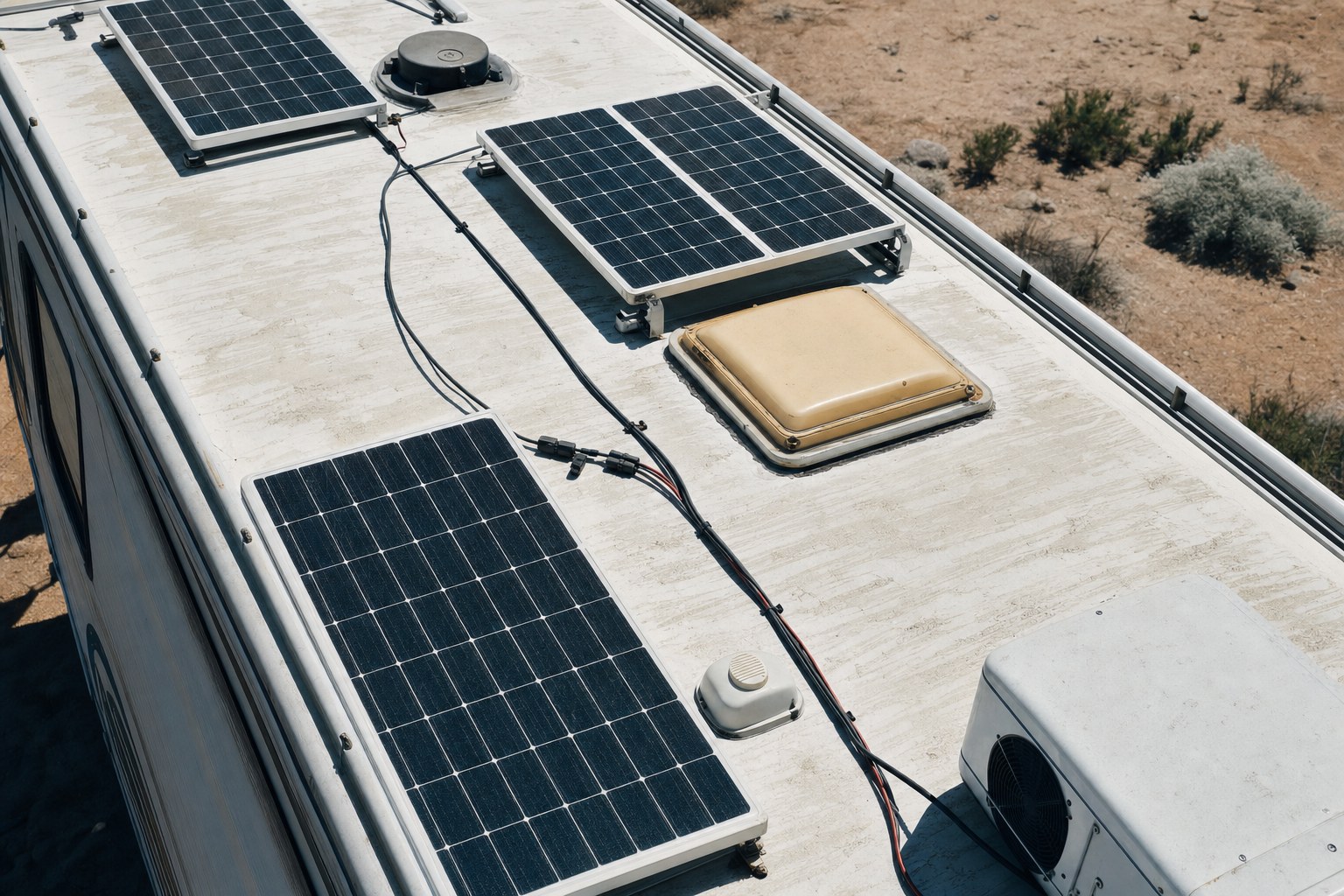
Renogy sells its 100W Starter Kit for $160. Buy it and you own panels, a controller, wire, and brackets. You do not own a battery or an inverter, so nothing in the box will light a bulb. Source the two missing parts and the bill reaches $438. That $278 difference is the hidden watt in RV and camper solar, and it repeats across the category.
We took 7 kits apart into the 7 component roles a working system needs, then priced each role against what filling it actually costs. What follows runs in the order a buyer meets the problem: what the price tag leaves out, how much system the vehicle needs, which chemistry and controller earn their money, and which of the 7 kits survives the arithmetic. Prices checked Apr 2026.
What the Sticker Price Leaves Out
Not one of these kits sold as "complete" is complete. Every one is short at least a part the system cannot run without. Plan on $50--$200 past checkout no matter which one goes in the cart.
Receipt: the Renogy 100W Starter
Walk the Renogy 100W Starter through role by role. Panels: in the box. Controller: in the box. Wiring and mounting: in the box. Battery: absent. Inverter: absent.
Advertised at $160. Real build cost once those two roles are filled: $438. The gap is $278, or 174% on top of the listing.
Where the Kits Land on Completeness
| Kit | Listed | Real Build Cost | Complete | Absent Roles |
|---|---|---|---|---|
| Renogy 100W Starter | $160 | $438 | 50% | Battery, inverter |
| Eco-Worthy 200W Complete | $540 | $575 | 71% | Mounting hardware |
| WindyNation 400W | $1,637 | $1,637 | 86% | Monitoring |
| Renogy 400W LiFePO4 | $1,899 | $1,899 | 100% | Nothing |
One kit of the four carries no gap at all. The role-by-role method behind those figures is documented in how real build cost is calculated.
The Parts Nobody Puts in the Box
A buyer's guide states the pattern plainly: "Solar power kits for RVs include the big stuff, but they don't include everything. You'll still need to source additional wiring, fuse blocks, inline fuses, bus bars, and outlets." Price point does not change it. Brand does not change it.
The 7 roles we score are Panels, Controller, Battery, Inverter, Wiring, Mounting, and Monitoring. Any role a kit omits gets priced at what it currently costs to buy, and real build cost is the listed price plus that total.
Monitoring is the role that disappears even from kits scoring 86% and up. Without it there is no reading of battery state of charge, solar input, or load draw, which is a fuel-gauge problem more than a spec problem. A Bluetooth monitor or shunt runs $50--$150.
Wire gauge is the other quiet one. Kits ship enough wire to prove a panel works on a bench, not enough for a cable run past 10 feet. On a 30A system, runs over 10 feet want 10 AWG. That costs $20--$50 and stops a voltage drop that would otherwise eat output with no symptom to warn you.
Start With Watt-Hours, Not Panel Wattage
Panel wattage is the number on the box. Daily watt-hours is the number that decides whether the system works. One equation ties them together:
Minimum panel wattage = (Daily Wh / Peak Sun Hours) x 1.3--1.5
Five minutes with that formula costs less than replacing an undersized array a year later. Most buyers skip it and shop the marketing claim instead.
What an RV Draws in a Day
| Load | Daily Wh |
|---|---|
| Compressor fridge (12V) | 800 Wh |
| Laptop (3 hours) | 120--180 Wh |
| TV (4 hours) | 100 Wh/night |
| CPAP (with humidifier) | 30--60 Wh/night |
| Lighting, LED | 30--50 Wh/night |
| Two phones charging | 20--30 Wh |
Two adults with a compressor fridge, lights, phones, and a TV land near 2,000 Wh/day. Every number after this one traces back to that figure.
Running the Numbers on 2,000 Wh
The continental US averages 5 peak sun hours. 2,000 Wh / 5 = 400W of panel before losses. Cloud, shade, and system loss take the 1.5x end of the multiplier, which lands at 400W x 1.5 = 600W.
Why the Multiplier Is Not Padding
The 1.3--1.5 factor buys back specific, measurable losses. Controller conversion costs 3--20% depending on whether it is PWM or MPPT. Wiring resistance takes a cut. Panels derate as they heat. And "5 peak sun hours" is an annual mean that drops to 3 hours or less through a northern winter.
Rated output is optimistic on its own. Independent testing of Eco-Worthy panels rated at 400W measured 347W in direct sun, a 13.3% shortfall against the label. At the small end, the ECO-WORTHY 200W 12V Complete Kit with 100Ah Battery + 1100W Inverter yields roughly 800 Wh/day in average conditions. That covers lights, phones, and a laptop. It does not cover a fridge cycling around the clock.
What Overcast Days Do to Output
Cloud cover strips 75--90% off rated output, which turns a 400W array into 40--100W. One owner running 300W against a Dometic CFX35 fridge drained the bank flat after 4 straight rainy days inside a 10-day trip. Battery, not panel, is what bridges that stretch.
How Much Battery to Buy
LiFePO4: hold 1--2 days of consumption, so 2,000--4,000 Wh. AGM: double it. The 50% depth-of-discharge ceiling means 4,000--8,000 Wh of rated capacity to hand over the same usable energy.
Then there is December. Winter production runs about 3:1 below summer, so a bank sized in July comes up short in the dark half of the year. Size against winter for anything that runs year-round.
The Controller Nobody Reads the Spec Sheet For
A PWM controller drags panel voltage down to battery voltage and throws the surplus away as heat. An MPPT controller converts that surplus voltage into current instead. In efficiency terms, that is 94--97% for MPPT against 75--80% for PWM.
Mechanically, PWM ties the panel straight to the battery and clips. A 12V panel sitting at 18V open-circuit gets clipped to 14.4V, and the 3.6V that disappears becomes heat. MPPT runs a DC-to-DC conversion and trades that voltage for amps, so more watts reach the battery off the same glass.
41.1 Amps Against 29.46
Put both on a 600W array. MPPT delivered 41.1A. PWM delivered 29.46A. Same panels, 39% more energy.
Where the Gap Shows Up
The spread widens with array size, and it widens again in cold or overcast weather when panel open-circuit voltage climbs further above battery voltage. Under 200W in a warm climate the two controllers are close enough to ignore. At 400W and up the difference is measurable every day.
This is where two of the kits split. Eco-Worthy's 200W ships a 30A PWM controller. Renogy's 400W ships a 40A MPPT. Set panel wattage aside and the controllers alone open a real output gap between the systems. Anyone who inherited a PWM controller on a budget kit should treat the MPPT swap as the first thing to fix.
What the Upgrade Costs
MPPT runs $80--$150 over a comparable PWM unit. On a 400W array making roughly 1,600 Wh/day, a 20% efficiency gain hands back 320 Wh/day that PWM would have burned off. One summer of steady use pays for it.
Above 200W nothing else on the build returns that much per dollar. Even at 200W the winter months show a gain, because that is when open-circuit voltage spikes and the mismatch between panel and battery widens. Wider mismatch, more energy recovered.
Chemistry: Where the Budget and the Weight Go
Battery chemistry is the largest single line item in an RV build, and the heaviest. The spec sheet does not leave much to argue about.
Spec Sheet, Side by Side
| Metric | LiFePO4 | AGM |
|---|---|---|
| Usable depth of discharge | 95% | 50% |
| Cycle life | 2,000--5,000 cycles | 300--500 cycles |
| Round-trip efficiency | 95--97% | 80--85% |
| Weight per 100Ah | 25--30 lbs | 60--70 lbs |
| Charging in the cold | Stops below 32F | Works in freezing temps |
Rated amp-hours are not delivered amp-hours. 100Ah of LiFePO4 hands over 95 Ah. 100Ah of AGM hands over 50 Ah. Shopping rated capacity means buying nearly twice the AGM to arrive at the same place.
Two Kits, Same Panel Wattage
WindyNation's 400W AGM kit costs $1,637 and carries 300Ah of AGM: 1,800Wh on the label, 900 Wh in hand at 50% depth of discharge. Its controller is PWM.
Renogy's 400W LiFePO4 kit costs $1,899 and carries 200Ah: 2,560Wh on the label, and at 95% usable, 2,432 Wh in hand. Its controller is a 40A MPPT.
$262 separates the two prices. Usable energy separates them by 2.7x. Across a 5-year window the LiFePO4 bank outlives 4--10 rounds of AGM replacement.
Weight, and Why Vans Care
200Ah of AGM weighs 120--140 lbs. 200Ah of LiFePO4 weighs 50--60 lbs. On a Sprinter or Transit build fighting a cargo rating, 60--80 lbs back is real payload. A Class A or fifth wheel with room to spare will care about cycle life and usable energy long before it cares about weight.
The Retrofit Bill
Dropping LiFePO4 into a rig built for AGM is not a swap. RV converters made before 2021 generally will not charge LiFePO4 correctly. The rest of the bill:
- Heavier wiring: $400+
- A converter that speaks LiFePO4: $170--$270
- A monitor to read the bank: ~$200
- An isolator relay: ~$90
Call it $900--$1,000+ before the battery itself. Any AGM-to-LiFePO4 comparison that leaves that out is not a comparison.
The Case AGM Still Wins
Under 30 days of use a year, AGM wins on money out the door and nothing else. Between 30 and 100 days a year, LiFePO4 catches up inside 3--4 years of lifecycle math. Full-time, there is no argument left. Temperature is the real exception: camping below 32F means a heated battery box or a LiFePO4 pack with a heater built in, and that call comes before the chemistry call.
Roof Space and Loads by Vehicle Class
A cargo van and a 40-foot Class A share almost nothing except the search term. Roof area and daily load both move by a wide factor across the classes.
What Each Class Needs
| Class | Roof Capacity | Daily Load | Panel Floor | Battery Floor |
|---|---|---|---|---|
| Class A (31--40+ ft) | 600W+ | 3,000--5,000 Wh | 600--1,200W | 400Ah+ LiFePO4 |
| Class C (24--31 ft) | 400--600W | 2,000--3,000 Wh | 400--600W | 200--300Ah LiFePO4 |
| Travel trailer / fifth wheel | 400--600W | 1,500--3,000 Wh | 400--600W | 200--300Ah LiFePO4 |
| Class B (Sprinter 170, Transit) | 400--600W | 1,500--2,000 Wh | 400W | 200Ah LiFePO4 |
| Cargo van / Sprinter 144 | 300--525W | 1,000--1,500 Wh | 300--400W | 100Ah LiFePO4 |
Usable Roof Is Smaller Than Measured Roof
The tape measure says one thing; the AC unit, vents, skylights, and antennas say another. Between them they eat 30--50% of the theoretical figure. Roof area of 200+ square feet on a Class A can leave 100 square feet that a panel will actually sit on. One 400W rigid panel needs roughly 74 x 41 inches and adds about 50 lbs. Measure what is actually left, and verify the roof load rating, before anything ships.
Towables carry a constraint motorhomes do not: nothing charges the bank while the trailer is behind a truck. There is no alternator contribution on drive days, so the array has to cover 100% of daily consumption by itself. Sizing carries more weight on a travel trailer or fifth wheel than on a Class C.
Vans Hit the Ceiling First
Class B and cargo van builds are the tightest. A Sprinter 144 carrying one roof vent and fan fits about 300W of rigid panel. Flexible panels can get past 500W in the same footprint, at the cost of efficiency and service life. On a van the electrical system also competes with everything else for payload.
Matching Kits to Classes
Eco-Worthy's 200W at $540 is a van and weekend-use system. Renogy's 400W Complete at $1,899 reaches across Class B and Class C. A full-time Class A is past what any single kit here holds, and belongs on component-level selection.
One van lifer ran 400W into winter and found it short, rationing power to stay ahead of the shortened days. After moving up to 600W: "It's SO nice not to have to worry about rationing electricity." That is the 3:1 winter-to-summer production ratio showing up in somebody's actual week.
Kits ranked for your vehicle class
Box in a Cabinet, or Panels on the Roof
A $449 power station and a $1,899 wired kit look like two prices for one job. They are two different jobs.
What an All-in-One Buys
A power station puts the battery, inverter, and charge controller in one case. Panels plug into one side, devices into the other, and installation is over.
The Anker SOLIX C1000 Gen2 at $449 carries 1,024Wh of LiFePO4 behind a 2,000W inverter. Nothing gets drilled, nothing gets wired, and it moves to another vehicle whenever you do. For renters and weekend trips, that is the whole argument.
The same idea comes smaller and larger. The Bluetti AC70P at $499 holds 864Wh behind a 1,000W inverter for lighter loads. The EcoFlow DELTA 2 Max at $899 holds 2,048Wh behind a 2,400W inverter, roughly the top of the class.
Where All-in-Ones Stop
Capacity ceilings out at 3,000--5,000 Wh. Solar input is capped as well (600W on the Anker), and input voltage tolerances rule out roof arrays above 800W. Rooftop AC is off the table entirely: the compressor's startup surge pulls 2,500W+, which folds a 2,000W inverter on the spot. And there is no expansion path. Growing the system means buying a different one.
What a Wired Build Buys
A wired system is separate panels, controller, battery bank, and inverter, spliced into the RV's electrical system permanently.
The Renogy 400W 12V Complete Solar Kit with 200Ah LiFePO4 at $1,899 brings 400W of panel, 2,560Wh of LiFePO4, a 2,000W pure sine wave inverter, and a 40A MPPT controller. It is the only kit in this set at 100% completeness.
What that money buys is headroom. Panels can be added, batteries can be added, the roof gets used fully, the MPPT controller keeps the harvest, and AC, a microwave, and heavy loads come into range once the system is sized for them. What it costs is roof penetrations best left to an installer, a system that stays with the vehicle when it sells, and more cash up front.
Storage Cost, Compared
The Anker SOLIX C1000 holds energy at $0.44 per Wh. The Renogy 400W Complete holds it at $0.74 per Wh. Renogy costs more per Wh because a standalone MPPT controller, a pure sine wave inverter, and mounting hardware are inside that price. The premium buys expandability and room to grow capacity, which the Anker does not offer at any price.
Picking Between Them
| How You Camp | What to Build |
|---|---|
| Weekend trips to state parks | Portable power station |
| 3--5 day boondocking, no AC | Either works |
| 1--2 week boondocking | Wired system |
| Full-time RV living | Wired system mandatory |
| Running rooftop AC | Wired, 1,400W+ solar, 600Ah+ battery |
Three Builds, Sorted by How You Camp
Use pattern picks the system. Three of them cover most buyers.
The Weekend Build
Hookups most nights, a night or two off-grid now and then, no AC in the plan.
Spend: $449--$899
Form factor: Portable power station
Panels: 200--400W, portable folding
Storage: Built-in LiFePO4, 1,024--2,048 Wh
Lights, devices, and a 12V fridge run 1--2 nights on the Anker SOLIX C1000 at $449. Storage doubles to 2,048Wh on the EcoFlow DELTA 2 Max at $899, which stretches the same loads into a long weekend.
The Two-Week Build
Off-grid for 1--2 weeks. Fridge, lights, electronics, no rooftop AC.
Spend: $575--$1,899
Form factor: Wired, roof-mounted
Panels: 200--400W, rigid
Storage: 100--200Ah LiFePO4, MPPT controller in front of it
Entry is the Eco-Worthy 200W at $575 real build cost, with the PWM controller as the asterisk: add panels later and it caps what they harvest. The Renogy 400W Complete LiFePO4 at $1,899 fills every component role and puts an MPPT controller in front of whatever gets added next.
Storage cost tells the rest of it. The Eco-Worthy 200W holds energy at $0.45 per Wh, the Renogy 400W at $0.74 per Wh. That gap is the MPPT controller, the LiFePO4 chemistry, and a bill of materials with nothing left on it after checkout.
The Full-Time and AC Build
Living in it, or running the rooftop air conditioner.
Spend: $2,500+
Form factor: Wired, built from components
Panels: 600W+, rigid
Storage: 400Ah+ LiFePO4 bank
Inversion: 3,000W+ pure sine wave
Nothing sold as a kit covers this. Panels, controller, battery bank, and inverter get chosen separately, one at a time. The Renogy 400W Complete is a defensible first block to build on, with panels and batteries added over time.
What to Walk Away From
- A kit called "complete" with no battery in it
- A PWM controller sitting in front of 400W+ of panels
- A system sized for July with no December margin
- An advertised price quoted without its real build cost
Across a decade of ownership, the cheapest system out there is whichever one got sized right on the first attempt.
Every RV kit, ranked by what it really costs
Next Steps
Three tools, in the order they are useful:
[The sizing calculator](/calculator) takes appliances, location, and usage pattern, then returns a panel, battery, and inverter target built from Wh arithmetic instead of a marketing claim.
[RV and van kit rankings](/best-for/rv) holds the RV-rated catalog in real-build-cost order, each entry carrying its Completion Gap Receipt. Filters cover vehicle class, spend, and system size.
[Kit-vs-kit comparison](/compare) stacks two kits in a single view: what each really costs to build, how complete it is, what a Wh costs, and where the specs diverge. It earns its keep when a portable and a wired option price out close together.
A Completion Gap Receipt sits on every kit we track: what it advertises, what it still needs, what it truly costs. Size first, then shortlist only the kits that reach the number.
Also useful: Batteries | Panels | Inverters
Common Questions
Is rooftop air conditioning possible on RV solar?
Only on a large wired system. An AC compressor's startup surge pulls 2,500W+, past what any portable power station's inverter will hold. Pure sine wave inversion at 3,000W+, LiFePO4 at 600Ah+, panel at 1,400W+. The floor is $3,000+.
What panel wattage will my roof actually hold?
That depends on the class and on what is already bolted up there. Class A: 600W+. Class C: 400--600W. Sprinter 144: 300--525W. Take 30--50% off theoretical area for AC units, vents, skylights, and antennas.
Is PWM good enough, or does the build need MPPT?
Under 200W in a warm climate, PWM is adequate. At 400W and up, MPPT recovers 20--39% more from identical panels. For $80--$150 it is the best return per dollar anywhere on the build.
How much do panels make when it is overcast?
They keep working, at 10--25% of rated output. A 400W array can fall to 40--100W. Carry 1--2 days of battery autonomy and the weather passes without a generator.
What is a "complete kit" actually complete with?
Anywhere from 50% to 100% of a working system, judging by the kits in this database. A listing can say complete while shipping panels and a controller alone, leaving the battery, inverter, and wiring still to buy. Read the real build cost and the Completion Gap Receipt rather than the advertised price. Run your own numbers
Does LiFePO4 justify its price against AGM?
At 30+ days a year, yes. Per amp-hour it hands over 2.7x the usable energy, it lasts 4--10x as many cycles, and it weighs half as much per 100Ah. Lifecycle cost crosses over inside 3--4 years of regular use. The one exception is cold: below 32F it needs a heated compartment or a battery with an internal heater.
Is this a DIY job?
A portable power station needs no installation at all. A wired roof-mounted system needs basic electrical knowledge, a tolerance for sealant and wire routing, and $50--$200 of hardware (fuse blocks, bus bars, wiring) that no kit includes.
Explore the Data
Track the prices, not the hype
We track real build costs across 400+ off-grid kits and email the biggest verified price drops every week. See this week’s drops.