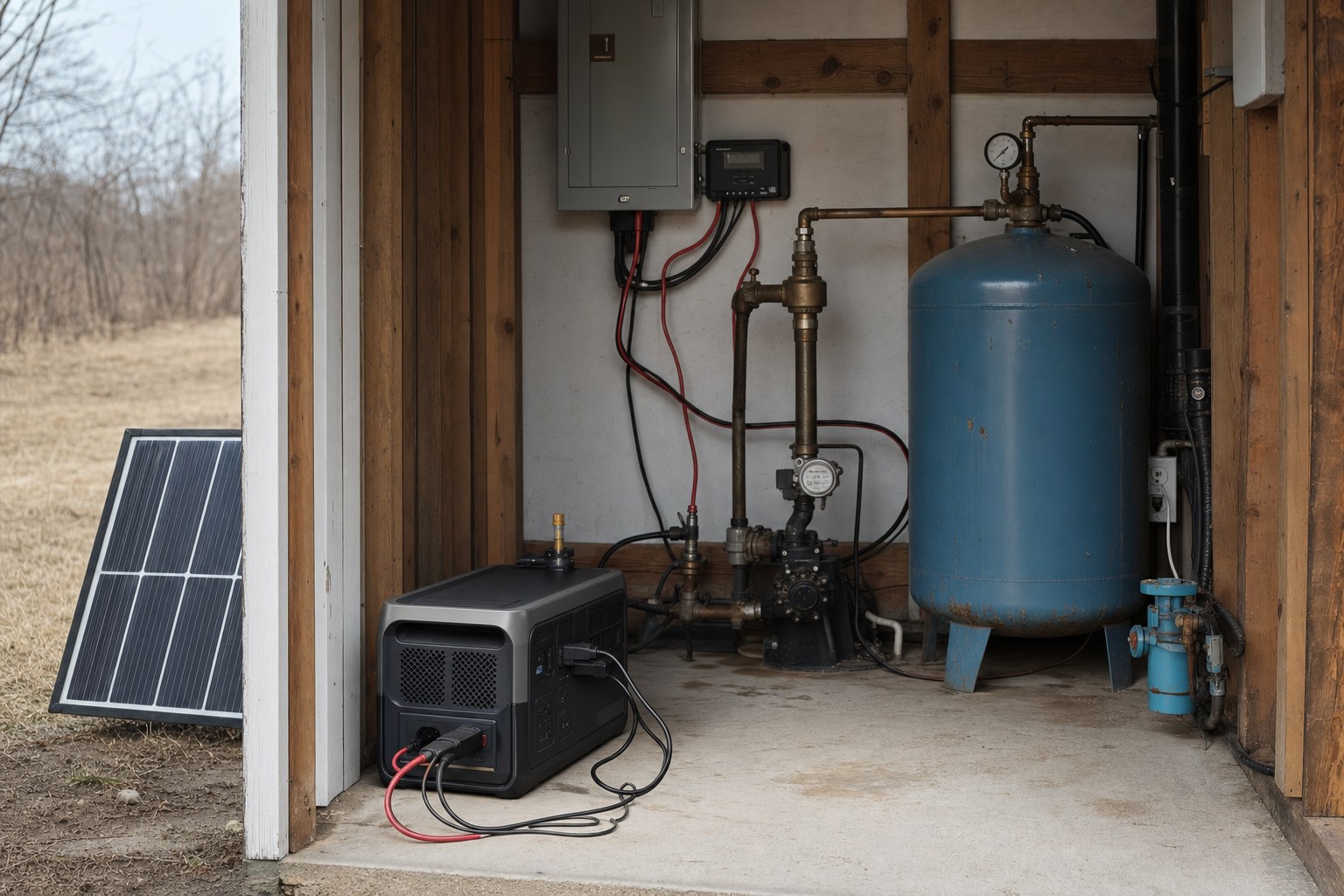
Solar Generator for a Well Pump: The Startup Spike That Kills Most Kits (and the 123 It Doesn't)
The short answer
The failure is almost always the same. A "3,000W" solar generator reads fine against a pump's running watts, then shuts off the instant the motor's locked-rotor spike hits 2,000–3,500W. What actually runs a pump is a pure-sine LiFePO4 unit carrying genuine surge reserve, plus, on a 240V submersible, a 120/240V split-phase inverter rather than a 120V power station. Starting from 439 kits, 123 clear the LiFePO4 and ≥3,000W bar. Five of those hold enough reserve to absorb the inrush. Below are those five, with specs, price, and the pump-tie-in BOM no kit ships with.
The load profile: what a well pump actually pulls
A well pump misleads a buyer the same way a refrigerator does, except here the thing on the line is your water supply. A ½ HP submersible settles at roughly 750W once it's turning, but the motor pulls 3–5× that for a split second on every start, a 2,000–3,500W locked-rotor inrush. A 2,000W inverter can handle the 750W running number all day and still shut down on that spike. (Note one wrinkle: our load calculator lists the pump conservatively at 750W run / 1,500W surge, which is a running-surge figure. The locked-rotor inrush the verdict engine defends against is the larger 2,000–3,500W number.)
Three buyers land on this page. (a) Grid-down well backup, meaning the pump plus a fridge for outages. (b) Off-grid homestead, where the pump is one of many all-day loads. (c) 240V deep submersible, a 1–1.5 HP pump that requires a 120/240V split-phase inverter and not merely a 120V power station.
Duty cycle sets the sizing rule. A well pump works in 1–3 minute bursts, so the surge sizes the inverter while the cycling, plus everything else sharing the system, sizes the battery. Run your own combination (pump, fridge, freezer, Starlink) through the load calculator, and read the low-frequency vs high-frequency explainer in inverters & power conversion.
The verdict: a pump can trip an inverter sized for its running watts
Our 14-pattern failure engine fires a blocker on this load:
> A ½ HP pump runs at ~750W but its motor draws 3–5× that for a split second on every start (locked-rotor inrush), a 2,000–3,500W spike. Plenty of 2,000W inverters shut down on it even though the running number looks fine.
The engine's fix, verbatim: use a low-frequency (transformer-based) inverter rated 3,000W+, or fit the pump with a soft starter / CSCR control box. Pure sine only. That sentence is the entire thesis of this page, and it's a sourced engine fact, not something a generic "yes, with enough watts" post can invent. Background sits in how the methodology works and how real build cost is calculated.
A pump almost never runs by itself, either. Three secondary warnings drive the storage sizing: - Fridge + freezer — both surge 3–5× as well, and both cycle 24/7, which is what dominates daily watt-hours. - Sump pump — inrush roughly doubles its running watts, and the storms that call it into service are precisely the days with no sun for recharging. Budget real surge headroom and 2–3 days of autonomy. - Starlink — a rural well tends to come with rural internet, drawing ~1.8–2.4 kWh/day, continuously. That load is why the bigger banks (#2/#4) hold their spots.
A submersible well pump can trip an inverter that's sized for its running watts
A ½ HP pump runs at ~750W but its motor draws 3–5× that for a split second on every start (locked-rotor inrush) — a 2,000–3,500W spike. Plenty of 2,000W inverters shut down on it even though the running number looks fine.
Fix: Use a low-frequency (transformer-based) inverter rated 3,000W+, or fit the pump with a soft starter / CSCR control box. Pure sine only.
Fridges and freezers surge hard and never turn off
Compressors pull 3–5× their running watts to start, and because they cycle 24/7 they quietly dominate your daily watt-hours — especially in summer heat. Modified-sine power makes them buzz and shortens compressor life.
Fix: Pure-sine inverter, and size the battery for the all-day cycling load. In hot climates add ~30% to the fridge's estimated draw.
A sump pump is critical and surges — don't run it on the edge
Motor inrush roughly doubles the running watts, and the times you need it most (storms) are exactly when there's no sun to recharge.
Fix: Give it real inverter surge headroom and 2–3 days of battery autonomy so a multi-day storm doesn't outlast the bank.
Always-on Starlink is often the single biggest line item
At ~75–100W running 24/7, that's ~1.8–2.4 kWh every day — and in low-sun winter it's frequently the load that drains the battery first.
Fix: Size the battery for 2–3 cloudy days, or put Starlink on a scheduled/idle power cut overnight. It's a continuous load, not a peak one.
The 5 kits that win
Each of the five picks is a LiFePO4, pure-sine integrated system clearing the surge bar with margin: #1 at 7,500W continuous and the remaining four at 6,000W, all of them comfortably past a 3,500W inrush. Ranking runs on surge headroom first, then cost-per-watt-hour. The page's single buy link rides on the #1 pick, and every kit name opens its full audit.
Voltage deserves a hard opinion. Running a 240V deep submersible? Skip the single Anker F3800 (#3), which is 120V unless you hub it, and take the split-phase EG4 WallMount (#2) or the dual-hub Anker (#4) instead. Running a 120V jet or shallow pump, or building grid-down backup? The F3800 is the cheapest unit here that clears the inrush. Put any of them head-to-head, or look through more 240V-capable whole-home systems.
#1 · Best surge headroom
PRO 3.2kW — Rich Solar 6K, 10kWh LiFePO4Startup is the whole problem, and this is the tidiest solution to it. A 7,500W continuous inverter takes a 3,500W locked-rotor spike with better than 2× to spare, so a pump start never comes near the ceiling. Behind it, 10,000Wh of LiFePO4 covers the pump's daily duty cycle plus the fridge and freezer that almost always share the circuit. Price sits mid-pack at $0.60/Wh, which buys far more inverter than the rest of the field offers. One box, no tripping.
#2 · Best value / native 240V
$0.51/WhThe EG4 6000XP underneath is a 6,000W 120/240V split-phase inverter, which means a 240V deep submersible connects directly, with no hub and no workaround. It also carries the largest bank on this board (14,300Wh), sized for a homestead where the pump is one load among many, and $0.51/Wh makes it the best value here. Hardwired 240V pump, start at this line.
#3 · Cheapest that clears the inrush
$0.57/WhLowest sticker on the page that still beats the spike. The F3800's 6,000W surge absorbs a 3,500W locked-rotor inrush with margin, and it delivers 120V and 240V both. That makes $2,199 the entry point for grid-down well backup. Read the 3,840Wh bank honestly, though: it covers outages, not whole-house autonomy, and one F3800 on its own needs the Double Voltage Hub before it can serve a true 240V well.
#4 · Portable 240V, bigger bank
$0.62/WhPair two F3800 units on the Double Voltage Hub and you get real split-phase 240V alongside 7,680Wh, a 240V well backup that plugs together without an electrician touching the unit itself. The 6,000W inverter handles the inrush, and $0.62/Wh makes this the practical route to 240V when hardwiring a wall-mount is off the table. For a 240V submersible, buy this rather than the single F3800 at #3.
#5 · Hardwire, mid bank
$0.64/WhSame EG4 6000XP split-phase platform as #2, sized down to a 10,200Wh bank for households that will never touch the full 14kWh. The 6,000W native-240V inverter still drives a submersible directly. At $0.64/Wh it is a reasonable alternate to the WallMount if the battery format suits you better. Timing caveat: it is sitting near its 6-month high right now, so check the buy/wait note first.
The receipt: what your money actually buys
The receipt on this cohort is short. All five picks are component-complete integrated systems, which means missing-parts cost is $0 and no hidden BOM surcharge stands between the box and a working kit. The receipt on this page, then, isn't padding in the price. It's runtime (how many pump-and-fridge hours the money buys) plus the single item no kit ships with: the pump tie-in. On a hardwired 240V submersible that means a manual transfer switch or generator interlock (≈$150–$400, electrician install) and appropriately-rated cable, itemized in the gap-closing BOM below. The kit price is complete and real. The pump-connection parts are the gap.
| Kit | Listed | Storage | Fridge runtime, no sun | Days autonomy |
|---|---|---|---|---|
| PRO 3.2kW — Rich Solar 6K, 10kWh LiFePO4 | $5,989 | 10.0 kWh | ~13 hrs | ~0.6 |
| PLUS 4.4kW — EG4 6000XP, 14.3kWh LiFePO4 | $7,309 | 14.3 kWh | ~19 hrs | ~0.8 |
| F3800 PLUS - 3,840Wh / 6,000W + Main Unit | $2,199 | 3.8 kWh | ~5 hrs | ~0.2 |
| F3800 PLUS Dual Kits - 7,680Wh / 6,000W/6,000W | $4,797 | 7.7 kWh | ~10 hrs | ~0.4 |
| PLUS 4.4kW — EG4 6000XP, 10.2kWh LiFePO4 | $6,489 | 10.2 kWh | ~14 hrs | ~0.6 |
Runtime ≈ usable storage ÷ ~750W effective fridge draw (running watts + inverter overhead, before summer derate). A real receipt for integrated stations is hours of runtime, not missing parts.
Gap-closing BOM: what you still need to actually run your well
Panel, battery, inverter, controller, cabling: all of it rides in the box on these kits, so no missing-parts surcharge applies (how we calculate that). What you genuinely still have to buy is the pump tie-in, which no power station includes:
- ◈120V power station path — a 120V pump and 120V pressure-control need nothing extra. Verify the pump voltage before anything else.
- ◈240V submersible path — confirm the inverter is 120/240V split-phase (#2 and #4 are; a single F3800 is 120V unless hubbed), then budget a manual transfer switch or generator interlock kit (~$150–$400, electrician install) plus appropriately-rated cable (an L14-30 path, for instance, on portables).
- ◈Soft-start option — sticking with a smaller inverter? A CSCR control box / soft starter on the pump (~$80–$250) knocks the inrush down. That comes straight out of the verdict note's fix.
The wiring walkthrough lives in solar installation & DIY. Re-run your numbers in the calculator once the pump and its companion loads are in. Kit prices come from multi-retailer tracking, documented in data sources.
Buy now or wait?
| Kit | Current | 6-mo low | Above low | Signal |
|---|---|---|---|---|
| PRO 3.2kW — Rich Solar 6K, 10kWh LiFePO4 | $5,989 | $5,989 | at low | Buy now |
| PLUS 4.4kW — EG4 6000XP, 14.3kWh LiFePO4 | $7,309 | $6,549 | +12% | Wait |
| F3800 PLUS - 3,840Wh / 6,000W + Main Unit | $2,199 | $2,199 | at low | Buy now |
| F3800 PLUS Dual Kits - 7,680Wh / 6,000W/6,000W | $4,797 | $4,797 | at low | Buy now |
| PLUS 4.4kW — EG4 6000XP, 10.2kWh LiFePO4 | $6,489 | $5,749 | +13% | Wait |
6-month price history — PRO 3.2kW — Rich Solar 6K, 10kWh LiFePO4
Price History
— AT AVERAGELast observed at retailer: Jun 20, 2026. Days between observations carry the most recent known price — not new data.
Why these won — and why others failed
Why these won
- ✓Every podium kit takes a 3,500W locked-rotor inrush with genuine reserve left over: the #1 sits at 7,500W continuous, the other four at 6,000W. All are pure-sine LiFePO4, so the motor runs clean rather than hot.
- ✓Surge headroom is abundant in the data. Within the 123-kit cohort, 102 carry inverters ≥4,000W and 81 reach ≥6,000W. We took the residential sweet spot instead of the oversized whole-home stacks.
- ✓Two of the five output native 120/240V split-phase, driving a deep submersible with no adapter in between. Every spec and price traces to live data, not to a single-brand blog promoting its own box.
Why others failed
- ✕The most common buyer mistake: a sub-3,000W power station reads fine against 750W of running load, then trips on the 2,000–3,500W locked-rotor inrush.
- ✕Modified-sine inverters leave pump and compressor motors buzzing, running hot, and dying early. On a well, pure sine isn't optional.
- ✕A 120V-only power station won't turn a 240V submersible at all. We also dropped mis-parsed whole-home records (fused inverter kW) and 20kW+ stacks, which are overkill for a well.
Frequently asked
Can a solar generator power a well pump?
Yes, on one condition: the inverter has to clear the pump's startup surge, not merely its running watts. A ½ HP submersible settles at ~750W but spikes 2,000–3,500W on every start, which calls for a pure-sine LiFePO4 unit rated 3,000W+ (a low-frequency inverter or a pump soft-starter makes it easier). Pumps running on 240V additionally need a 120/240V split-phase inverter rather than a 120V power station.
How many watts do I need to run a well pump on a solar generator?
Size against the surge, not the run. A ½ HP submersible sits near 750W while running but pulls a 2,000–3,500W locked-rotor inrush at startup, so the target is a pure-sine inverter rated 3,000W continuous at minimum. The podium picks here run 6,000–7,500W to clear that with margin. Step up to a 1–1.5 HP pump and you need both more surge headroom and a 240V split-phase inverter.
Will a portable power station run my 240V submersible well pump?
Only when it puts out true 120/240V split-phase. One Anker F3800 is 120V until you pair two of them on a Double Voltage Hub, whereas the EG4 6000XP-based kits are natively 240V. A hardwired 240V pump also needs a manual transfer switch or generator interlock, about $150–$400 installed. That's the one piece no kit brings with it.
Methodology, freshness & corrections
Cohort: the surge-clearing floor: LiFePO4 chemistry behind a pure-sine inverter ≥ 3,000W → 123 kits clear the bar; the podium is drawn from the 40 clean, complete primaries left after dropping variants and incomplete listings. Prices auto-refresh from multiple retailers every 6 hours; this page last refreshed 2026-07-03.
See how real build cost is calculated, our methodology, data sources, and editorial policy. Found an error? Tell us — we correct fast.
Different use case? See the best off-grid solar generator for every load.