Off-Grid / Boondocking RV Solar Kits: The 5 That Power a Coach, and the Parts the Box Leaves Out
The short answer
Four parts make a boondocking RV kit: panels, a LiFePO4 battery, a pure-sine inverter, a charge controller. For most coaches the band that works is 1,000–2,560Wh of storage behind 1,800–2,400W of inverter. From there the road forks. A plug-and-play power station arrives finished, with nothing left on the shopping list. A hardwired component kit wires permanently into the coach, but drags along install-side parts its own BOM never lists. We put 65 RV-rated kits in that storage band through the screen. 91% run LiFePO4, and the median sticker lands near $1,299. The 5 that genuinely power a coach are below, along with the unwelcome truth about air conditioning.
The load a boondock day actually puts on the bank
These kits are built for a 12V coach. A house is a different question entirely. Sketch the real day and it looks like this: lights, roof and cabin fans, a DC fridge cycling around the clock, a water pump, Starlink plus devices, and a microwave firing in bursts off the inverter. Three storage tiers in this cohort answer that profile:
- ◈~1,024Wh (Anker C1000). Weekender territory. Lights, fans, charging, microwave bursts, and not much sustained AC draw on top.
- ◈~1,440–2,048Wh (Bluetti, EcoFlow, big Anker). The same list, all day, with margin left over.
- ◈2,560Wh (Renogy hardwired). Maximum all-day headroom, wired permanently into the coach.
Your coach is not the average coach, so run the numbers through the load calculator, and pick up the category background in RV and camper solar. One limit holds across all five picks: they run the coach, none of them run rooftop air conditioning off-grid. The next section shows why.
Read this first: the microwave and the A/C verdict
Watt arithmetic misses two things that this load profile drags into the open:
- ◈A microwave lies on its own door. The "1,000W" printed there is cooking output, not what leaves the battery, and the real pull is closer to ~1,500–1,700W the instant it starts. Every pick on this shortlist runs 1,800W+ pure-sine, so a microwave is genuinely fine in bursts. The budget Anker is where the caveat bites: 1,024Wh will *run* the microwave and *sustain* almost nothing beside it.
- ◈Air conditioning is off the table for this cohort. Startup surge on a compressor is roughly 3×, meaning a 500W window unit spikes near 1,500W on every cycle. Even 2,560Wh of Renogy will not push a rooftop A/C through an afternoon without a soft-start kit *and* a far larger bank. So the answer is the unglamorous one: run the A/C on shore power or a generator. What these kits do is power the coach, meaning lights, fans, a DC fridge, devices, the water pump, and microwave bursts.
The derivation behind both verdicts sits in our methodology.
Air conditioner compressors surge ~3× on startup
A 500W window unit spikes near 1,500W the instant the compressor kicks in, and it does that every cycle. On a modified-sine inverter the compressor buzzes, runs hot, and fails early.
Fix: Run AC only on a pure-sine inverter with real surge headroom, or add a soft-start kit. Plan battery for the cycling draw, not the nameplate watts.
Fridges and freezers surge hard and never turn off
Compressors pull 3–5× their running watts to start, and because they cycle 24/7 they quietly dominate your daily watt-hours — especially in summer heat. Modified-sine power makes them buzz and shortens compressor life.
Fix: Pure-sine inverter, and size the battery for the all-day cycling load. In hot climates add ~30% to the fridge's estimated draw.
A "1,000W" microwave actually pulls ~1,500–1,700W from the battery
The wattage on the door is cooking output, not input draw. The real load on your inverter is 40–70% higher, and it hits instantly.
Fix: Size the inverter to the input draw (2,000W+ pure sine), and keep run times short — microwaves are fine off-grid in bursts, not for long cooks.
Always-on Starlink is often the single biggest line item
At ~75–100W running 24/7, that's ~1.8–2.4 kWh every day — and in low-sun winter it's frequently the load that drains the battery first.
Fix: Size the battery for 2–3 cloudy days, or put Starlink on a scheduled/idle power cut overnight. It's a continuous load, not a peak one.
One day of battery autonomy is thin for the critical loads you listed
You have loads that can't simply wait for sun — fridge/freezer, a pump, medical gear, or always-on connectivity. A single overcast stretch can take the bank to empty before noon.
Fix: Plan 2–3 days of autonomy for critical setups. Bump the "days of autonomy" input and re-check the battery size.
The 5 kits, and the buyer each one is built for
The hardwired pick takes the top slot, because permanent coach power is its own category, and the plug-and-play stations rank below it. Two different buyers, so the table names them rather than blurring them together:
- ◈#1 Renogy 400W. The cohort's one complete hardwired LiFePO4 kit. The pick when power belongs wired into the coach for good.
- ◈#2 EcoFlow Delta 2 Max. Lowest cost-per-Wh among the complete picks at $0.44/Wh, which makes it the plug-and-play value anchor.
- ◈#3 Bluetti AC180P double-kit. Mid-coach, with panel wattage to spare when the parking spot is shaded.
- ◈#4 Anker C1000. Cheapest door in. Our data flags it panel-included at 600W, so confirm the array on the listing before ordering.
- ◈#5 Anker C2000. The plug-and-play inverter-headroom leader, sized for a bigger coach.
Every kit name opens its full audit, and the one buy link on this page rides on the #1 pick. For the wider field, browse RV-rated solar kits.
#1 · True off-grid pick (hardwired)
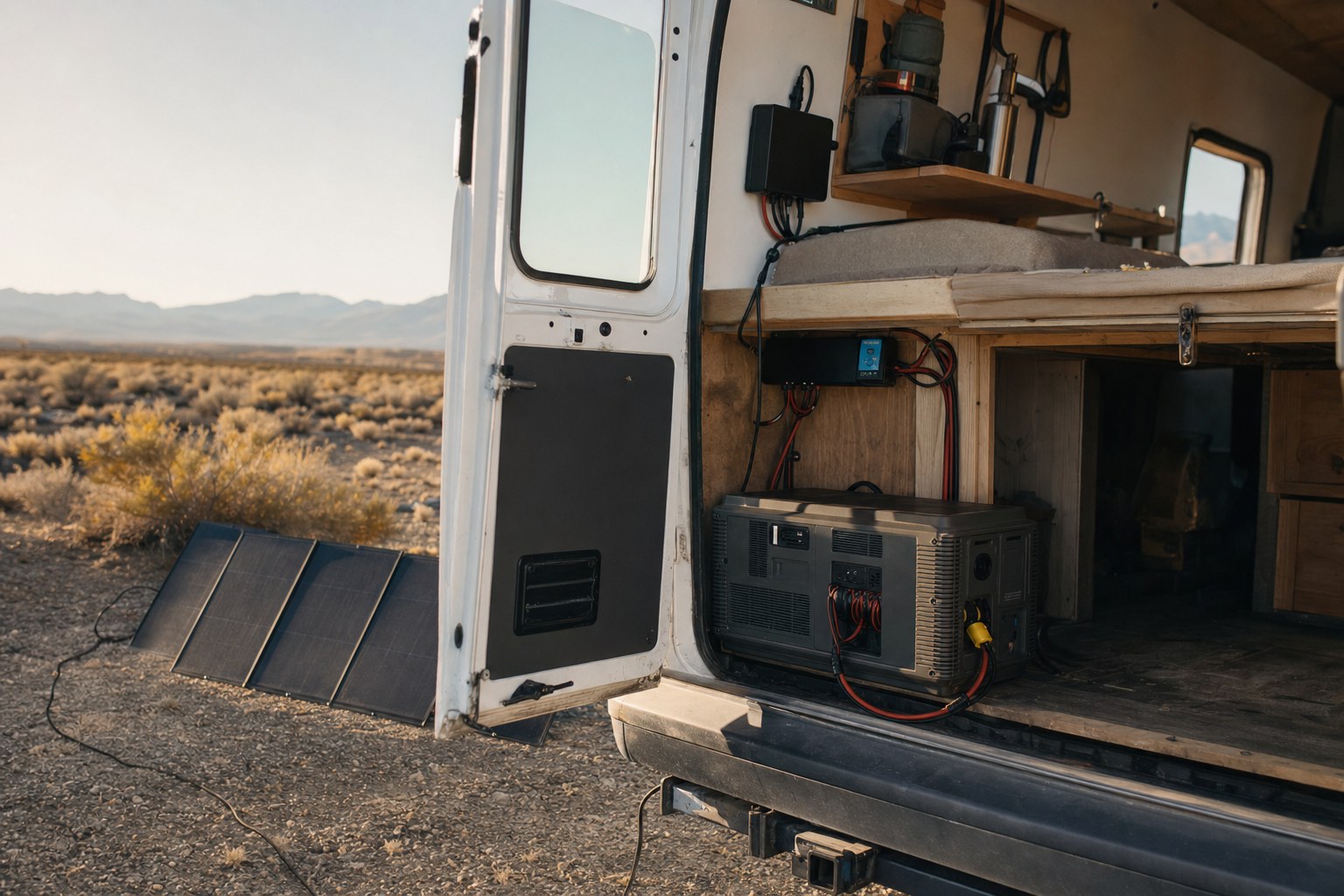
400W 12V — 200Ah LiFePO4One kit in this cohort is both *hardwired* and complete, and this is it. If the goal is power built into the coach rather than parked on the floor, start here. Nothing in the BOM is left blank: 400W of panels, a Rover 40A MPPT controller, a 200Ah 12V LiFePO4 battery, a 2,000W pure-sine inverter, MC4 and battery cables, Z-bracket mounts, a BT-2 Bluetooth monitor. That is a 100/100 completeness score at $1,899 ($0.74/Wh). The hidden cost sits elsewhere. Kit parts are all present, but a permanent coach hardwire still wants mounts, a Class-T fuse, and a transfer switch, which is the receipt further down this page.
#2 · Plug-and-play value anchor
$0.44/WhCost per watt-hour is the whole argument here. At $0.44/Wh nothing else in the complete cohort comes in lower. A microwave's startup draw passes through the 2,400W pure-sine inverter in bursts, and the 2,048Wh LiFePO4 bank covers a full boondock day of 12V loads. Missing-parts cost is $0, since it ships finished. What you give up is permanent integration; what you get back is plugging it in and being done. The price reads fair today, though it has been cut hard in the past, so a drop is worth waiting for.
#3 · Mid-coach plug-and-play
$0.67/WhBalance is the point of this one. 500W of rigid panels feed a 1,440Wh LiFePO4 station running an 1,800W pure-sine inverter, finished out of the box at $969 ($0.67/Wh). Panel wattage runs ahead of the storage tier, so it refills quicker than the spec sheet suggests, which matters for a coach that spends its afternoons in part shade. Lights, fans, a DC fridge, devices, microwave bursts: all covered. Air conditioning: not covered.
#4 · Cheapest door in (weekender)
$0.44/WhThe budget entry, stated plainly, at $449. Read the '600W' carefully: that figure is solar-input capacity, not an array in the box. The C1000 main unit arrives with no panel at all, so panels are a separate purchase before this is an off-grid machine. The 2,000W pure-sine inverter handles a microwave in bursts, but with only 1,024Wh behind it, little else survives alongside. This suits a weekender chasing the lowest viable sticker who accepts a second order for panels. One timing note: it currently sits at its 6-month price high, and it has sold for less.
#5 · Big-coach plug-and-play
$0.56/WhHeadroom leader among the plug-and-play group: 2,400W of pure-sine inverter, 2,048Wh of LiFePO4, a 400W panel, finished at $1,149 ($0.56/Wh). The larger inverter plus an expandable platform is what a bigger coach wants once a microwave starts stacking on top of the routine DC loads. Nothing to add after the box opens, and the price is holding in a fair, narrow range.
The receipt: what your money actually buys
The honest math splits in two directions here. Take the plug-and-play picks (EcoFlow, Bluetti, Anker) at their word: missing-parts cost is $0, because the panel, battery, inverter, and cables all ride in the box, and that is the entire reason they exist. The hardwired #1 earns 100/100 on *kit* completeness, yet a permanent coach install still reaches for parts no kit BOM carries. Roof mounts or tilt brackets run about $30–$120. A Class-T or ANL fuse with its holder on the inverter cable, roughly $25–$60. A DC fuse block or bus bars, $40–$90. A battery shunt, when it isn't bundled, $30–$200. A transfer switch or shore-power inlet, $60–$200. Cable upgrades, lugs, and an entry gland, $30–$80. Add it up and integration parts run roughly $250–$600 beyond the kit. Two other kits in the cohort carry a *modeled* gap of their own: WindyNation 400W at +$170 and Eco-Worthy 200W at +$125, both cheap on the sticker and incomplete in the box.
The receipt: finished in the box vs still on the list
Nobody else prints this part. On the plug-and-play picks, real build cost and listed price are the same number. Missing-parts cost is $0, since the panel, battery, inverter, and cables are all in the box, and that completeness is the product.
The hardwired path reads differently. On paper the Renogy kit is finished (100/100: panels, MPPT controller, battery, pure-sine inverter, cables, mounts, BT-2 monitor). A permanent install then reaches past the BOM for parts the kit never modeled:
- ◈Roof mounts / tilt brackets: ~$30–$120
- ◈Class-T or ANL fuse + holder on the inverter cable (safety-critical): ~$25–$60
- ◈DC fuse block / bus bars: ~$40–$90
- ◈Battery monitor / shunt if not bundled: ~$30–$200
- ◈Transfer switch or shore-power inlet to tie into the coach AC panel: ~$60–$200
- ◈Cable upgrades / lugs / entry gland: ~$30–$80
Plan on roughly $250–$600 in integration parts riding on top of any hardwired kit. Our engine already prices gaps like these elsewhere in the cohort: WindyNation 400W carries a modeled +$170, Eco-Worthy 200W a modeled +$125. Cheap sticker, unfinished kit. The full derivation is in how real build cost is calculated, and the wiring itself is covered in the DIY install guide.
Buy now or wait?
| Kit | Current | 6-mo low | Above low | Signal |
|---|---|---|---|---|
| 400W 12V — 200Ah LiFePO4 | $1,899 | $1,899 | at low | Buy now |
| DELTA 2 Max 2048Wh + 400W Panel | $899 | $849 | +6% | Fair price |
| Premium 150 AC180P + 2×200W Rigid Panels | $969 | $969 | at low | Buy now |
| SOLIX C1000 Gen2 1,024Wh/2,000W + Main Unit Only | $449 | $399 | +13% | Fair price |
| SOLIX C2000 Gen2 2,048Wh/2,400W | $1,149 | $1,099 | +5% | Fair price |
6-month price history — 400W 12V — 200Ah LiFePO4
Price History
Tracking since 2026-03-23
Chart appears after more observations
Last observed at retailer: Mar 23, 2026. Days between observations carry the most recent known price — not new data.
Why these won — and why others failed
Why these won
- ✓1,800W+ pure-sine inverters across the whole podium, which is what lets a microwave fire in bursts without tripping the unit or buzzing a compressor.
- ✓LiFePO4 in all five, matching the 91% of the viable RV cohort that runs it: daily deep cycling, charge held between trips, and none of the compromises of the 2 legacy AGM kits we left off.
- ✓Ranking comes from real specs and cost-per-Wh ($0.44/Wh–$0.74/Wh), and the plug-and-play vs hardwired split stays intact rather than collapsing into one brand's favorite box.
Why others failed
- ✕Both AGM kits in the cohort dropped out on the same arithmetic: roughly 50% usable depth and a shorter life make them a worse buy per real watt-hour than any LiFePO4 pick.
- ✕Kits pairing a PWM controller with a modified-sine inverter, WindyNation 400W among them (modeled gap of +$170), buzz compressors on microwave and A/C surges and give up charge-controller efficiency on top.
- ✕Rooftop air conditioning off-grid is beyond every kit in this 1–3kWh band, the 2,560Wh Renogy included, since it would still need a soft-start kit and a far bigger bank. We print that rather than imply otherwise.
Frequently asked
Can I run my RV air conditioner off a solar kit?
No kit in this 1,000–3,000Wh cohort will do it. Startup surge on a rooftop A/C compressor runs about 3×, so a 500W unit spikes near 1,500W on every cycle, and even 2,560Wh of Renogy falls short of an afternoon without both a soft-start kit and a much larger battery bank. Shore power or a generator is the answer for A/C. What these kits cover is the coach itself: lights, fans, a DC fridge, devices, the water pump, and a microwave in bursts.
What do I still need to buy beyond the kit?
With the plug-and-play stations (EcoFlow, Bluetti, Anker), essentially nothing. They arrive complete, carrying $0 in missing parts. A hardwired install like the Renogy 400W is different. Every component is in the kit, but bolting it permanently into a coach pulls in install-side parts: roof mounts, a Class-T or ANL fuse on the inverter cable, a DC fuse block or bus bars, a battery shunt when it isn't bundled, a transfer switch or shore-power inlet, and cable upgrades. That runs roughly $250–$600 in total.
How big a solar kit do I need for boondocking?
Most coaches land at 1,000–2,560Wh of LiFePO4 storage behind an 1,800–2,400W pure-sine inverter. The tiers break down cleanly. Around 1,024Wh fits a weekender on lights, fans, charging, and microwave bursts. Between 1,440Wh and 2,048Wh buys a full boondock day with margin left. At 2,560Wh you get the most headroom, and that tier is what a permanent hardwired install wants. Your own loads decide which one, so run them through the load calculator.
Methodology, freshness & corrections
Cohort: RV-rated (good or better) with 1,000–3,000Wh of storage: the band that survives a boondock → 65 kits clear the bar; the podium is drawn from the 5 clean, complete primaries left after dropping variants and incomplete listings. Prices auto-refresh from multiple retailers every 6 hours; this page last refreshed 2026-06-19.
See how real build cost is calculated, our methodology, data sources, and editorial policy. Found an error? Tell us — we correct fast.
Different use case? See the best off-grid solar generator for every load.