Deep Cycle Battery Types Compared: The Cost-Per-Cycle Math Behind 314 Solar Kits
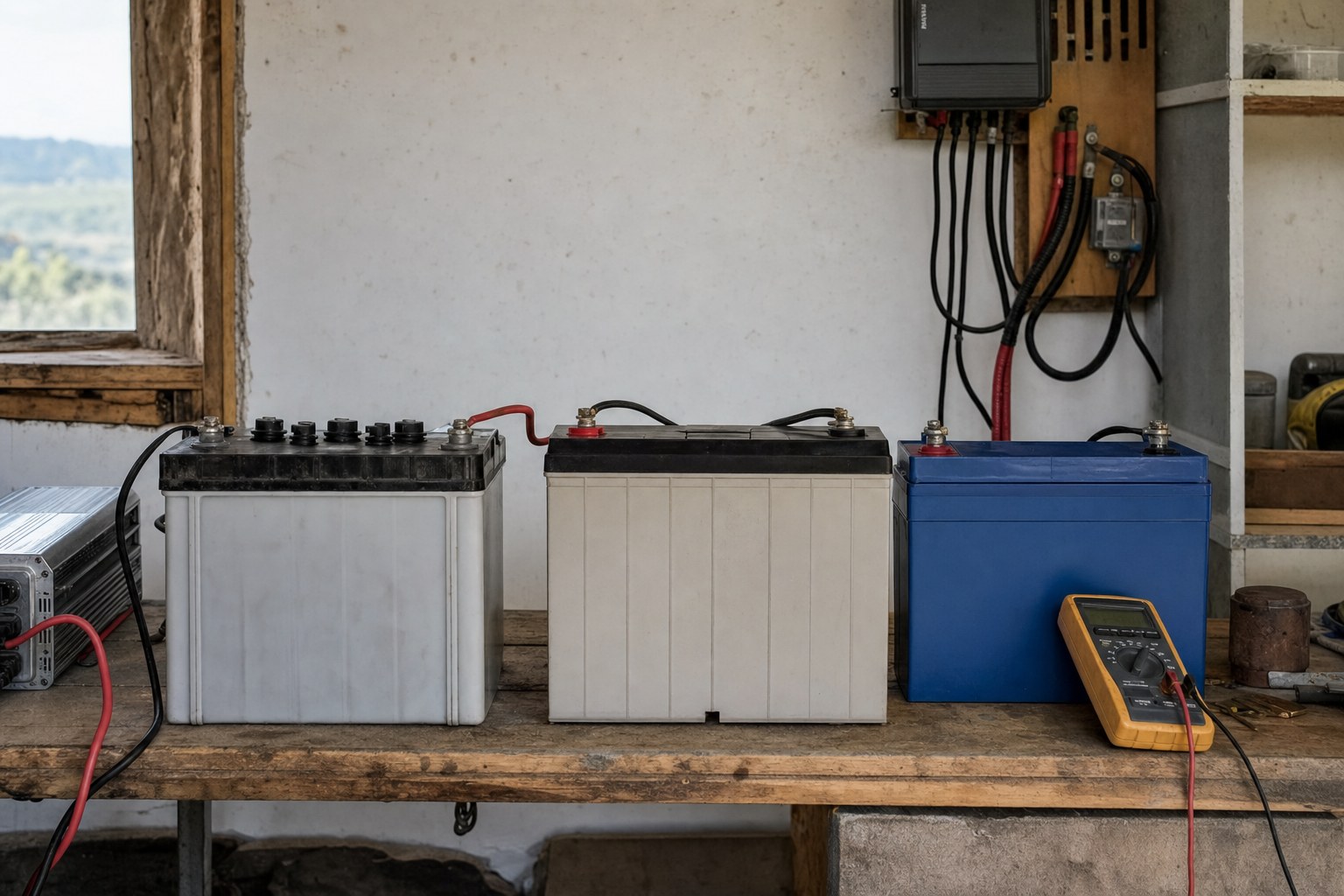
Three chemistries compete for the storage slot in an off-grid system, and the shopping decision usually gets made on sticker price. That is the wrong input. Sticker price tells you what leaves your account on day one. It says nothing about what the battery costs to actually operate, which is where the money hides.
We priced and audited 314 battery-equipped kits across 16 brands. LiFePO4 appears in 311 of them. AGM appears in two. A single kit runs conventional Li-ion. Flooded lead acid appears in none. Manufacturers converged there for reasons that are entirely arithmetic, and this page walks the arithmetic.
Most pages ranking for battery types and deep cycle are 350-500 word overviews that name the three chemistries and stop. They skip cycle counts. They skip depth-of-discharge percentages. They skip cost per usable watt-hour. They skip the temperature window inside which lithium will accept a charge. Those four numbers decide the purchase, so those four numbers are what we lead with, sourced from manufacturer spec sheets, third-party bench data, and kit prices we verified ourselves.
The order here runs backward from the usual guide. We settle the cost question first, since it frames everything downstream. Then the one spec that drives cost (depth of discharge), then each chemistry in order of how often it actually ships, then wiring voltage and controller setup, then a use-case table. Eight common questions close it out.
Every figure below traces to a real kit or a published spec, from the WindyNation 400W Complete Off-Grid Kit at $1,149 to the ECO-WORTHY 200W 12V Complete Kit at $540. No rankings, no favorites, no hype. Just the honest math.
Start With Cost Per Cycle, Not Cost Per Battery
Here is the number the category is built to obscure: $4.20 per usable cycle per kWh for AGM, against $0.22 for LiFePO4. A battery is not a thing you buy once. It is a thing that delivers a finite number of discharges before it stops being useful, so the defensible unit of comparison is dollars divided by cycles divided by the energy each cycle actually releases.
Two Real Kits, Run Through the Formula
WindyNation AGM kit (WindyNation 400W Complete Off-Grid Kit):
- Real build cost: $1,259
- Nameplate capacity: 1,200Wh
- Usable at 50% DoD: 600Wh (0.6 kWh)
- Cycle life: 500 cycles
- Cost per usable cycle per kWh: $1,259 / (500 x 0.6) = $4.20/cycle-kWh
Eco-Worthy LiFePO4 kit (ECO-WORTHY 200W 12V Complete Kit):
- Real build cost: $575
- Nameplate capacity: 1,280Wh
- Usable at 80% DoD: 1,024Wh (1.024 kWh)
- Cycle life: 2,500 cycles
- Cost per usable cycle per kWh: $575 / (2,500 x 1.024) = $0.22/cycle-kWh
The spread is 19x against AGM. The cheaper battery to buy is the more expensive battery by a factor of nineteen once you price what it does rather than what it weighs on the invoice.
The Watts That Turn Into Heat Instead of Work
Round-trip efficiency is a second tax, invisible on any product page. AGM returns 80-85% of what the array puts in, so 15-20% of every harvested watt becomes waste heat inside the case before it ever reaches a load. LiFePO4 returns 95-99%. Over a few thousand discharges the difference in delivered energy adds up to hundreds of dollars of production the AGM system paid for and never used.
How Many Times You Buy It Again
Cycle counts convert directly into replacement intervals once you assume one discharge per day. AGM's 500 cycles works out to 1.4 years in service. LiFePO4's 2,500 cycles stretches to 6.8 years. Project both across a decade and the compounding becomes obvious: AGM needs 7 replacements x $1,259 = $8,813, while LiFePO4 needs 1.5 replacements x $575 = $862.
Greentech Renewables reached the same ordering independently in a published 48V system analysis, putting FLA at $4.59/cycle, AGM at $5.27/cycle, and LiFePO4 at $1.35/cycle.
Lead Acid Shrinks When You Pull Hard
FLA and AGM both carry the Peukert Effect, a capacity penalty tied to discharge rate. Drain a 100Ah lead-acid battery slowly across 20 hours and you get close to the rated 100Ah. Drain the same battery in 1 hour and it yields only 50-60Ah. Anything with a motor or a heating element (microwaves, circular saws, air conditioners) pulls at exactly the rates that trigger it. LiFePO4 delivers its rating whatever the draw.
What This Does to a Budget
Budgeting from day-one spend inverts the decision. A shopper holding $1,200 can pick the WindyNation AGM build that grows into $8,813 across 10 years, or the Eco-Worthy LiFePO4 build that totals $862 across the same window. The lithium option is cheaper on the first day and roughly 10x cheaper by the last one.
LiFePO4 costs the least to own. AGM costs the least to buy.
The DoD Spec Is What Drives All of It
Depth of discharge is the specification underneath the cost figures above, and it accounts for 80% of the battery failures that show up in off-grid systems. The phrase "deep cycle" gets read as "you can run it flat." It does not mean that. It describes a cell built to hand back a controlled portion of its stored energy, repeatedly, without permanent injury. DoD names that portion: the share of rated capacity you consume before recharging.
Cycle life tracks DoD almost to the exclusion of everything else. Himax Battery's published LiFePO4 test data lays out the relationship:
- 100% DoD = 600 cycles
- 80% DoD = 900 cycles
- 40% DoD = 3,000 cycles
- 20% DoD = 9,000 cycles
Notice the curve. Halving the depth does not double the life, it more than triples it. Which makes rated DoD a heavier spec than the amp-hour number printed on the label.
Rated Amp-Hours Versus Amp-Hours You Can Spend
Run the two chemistries against each other and the label stops being informative. A 200Ah AGM cell held to 50% DoD hands you exactly as much energy per cycle as a 100Ah LiFePO4 cell taken to 100% DoD. Nameplate multiplied by rated DoD is the only figure worth sizing against.
Across the three chemistries the split is stark: AGM gives you 50% of nameplate, FLA is best held to 50%, and LiFePO4 delivers 80-100%. Two of the three forfeit half of what they advertise. The third forfeits 0-20%. Calendar aging erodes capacity too, independent of use, but on a bank that cycles every day the DoD-driven wear dominates.
Which is why cost per Wh on this site is always computed against usable capacity, never nameplate. That single correction rewrites the ranking of every kit we carry.
The Dual-Purpose Marine Label Is a Trap
A recurring mistake is grabbing a marine "starting/deep cycle" hybrid for a solar bank. Those cells are engineered around cranking amps, which means thin plates with lots of surface area. Thin plates degrade fast under the daily partial-discharge duty a solar system imposes. Real deep cycle construction uses thick plates that tolerate that duty without accelerating wear.
The contrast lives in our own catalog. WindyNation's 400W Complete Off-Grid Kit runs AGM deep cycle cells rated to 50% DoD, so its 1,200Wh nameplate yields 600Wh per cycle. The ECO-WORTHY 200W 12V Complete Kit runs LiFePO4 at 80% DoD, turning 1,280Wh nameplate into 1,024Wh usable. Same shelf, same category, and a 70% gap in what you can actually spend.
LiFePO4: The Chemistry in 99% of Shipping Kits
311 of 314 battery-equipped kits in our catalog run lithium iron phosphate. Spread across 16 brands, that is 99.04% of the market picking one chemistry. Manufacturers do not agree that completely out of habit. They agree because cycle life, efficiency, and ownership cost all point the same direction and none of the three is close.
The Spec Sheet
- DoD: 80-100%
- Cycle life: 2,500-6,000 cycles at 80% DoD (EG4 LL 48V is rated 7,000 cycles)
- Round-trip efficiency: 95-99% (Fire Mountain Solar)
- Self-discharge: 1-3% per month
- Weight: 25-30 lbs per 100Ah (versus 60-70 lbs for AGM)
- Cost per cycle: $1.35 (Greentech Renewables)
At 95-99% round-trip, essentially the whole harvest reaches the load. AGM's 15-20% heat loss, multiplied by 2,500 discharges, is a recoverable sum with a dollar value attached.
The BMS Ships Inside the Battery
Nothing labeled LiFePO4 arrives without a Battery Management System. It watches for discharge below minimum cell voltage, charge above maximum cell voltage, drift between cells, short-circuit current, and temperatures outside the allowed band. Treat the BMS as part of the cell's operating envelope rather than as a bolt-on feature, because the chemistry's published ratings assume it is present and working.
Cathode Chemistry and the Heat Ceiling
Iron phosphate cathodes hold together to roughly 270°C before decomposition begins. NMC (nickel-manganese-cobalt) lithium-ion starts around 210°C. That 60°C of headroom takes thermal runaway off the table under any normal operating condition, which matters when the bank sits in a shed nobody visits for weeks.
What a Kilowatt-Hour Costs This Year
Market pricing has collapsed. LiFePO4 averaged $400/kWh in 2020 and sits near $240/kWh in 2026. Buy at rack scale and it drops further: the EG4 48V 5.12kWh battery trades between $650-$750, which pencils out to $127-$146/kWh. Warranties followed the confidence, running 5-10 year terms tied to rated cycle life where AGM typically offers 1-2 year coverage.
What It Looks Like on Real Kits
- EcoFlow RIVER 2 Max: LiFePO4, 12V, 512Wh, advertised price $269 = $0.53/Wh
- Anker SOLIX C1000 Gen2: LiFePO4, 48V, 1,024Wh, advertised price $650 = $0.63/Wh
- ECO-WORTHY 200W 12V Complete Kit: LiFePO4, 12V, 1,280Wh, advertised price $540 = $0.45/Wh
RIVER 2 MAX 512Wh / 500W + Main Unit Only
SOLIX C1000 Gen2 1,024Wh/2,000W
Freezing Is the One Hard Stop
The chemistry has exactly one real weakness. Charging is permitted only between 32°F and 122°F (LiTime). Push current in below 32°F and lithium plates onto the anode, stripping capacity permanently at the cell level (REDARC Electronics), so the BMS refuses the charge instead. Discharge is unaffected all the way down to -4°F.
Both fixes are cheap and well understood. Wrap the bank in a heated enclosure, generally $50-$100, or buy a self-heating LiFePO4 model that warms its own cells before it will accept current. Self-heating versions run $50-$80 above a standard cell of equal capacity.
Pounds You Get Back
100Ah of LiFePO4 weighs 25-30 lbs. The same 100Ah in AGM weighs 60-70 lbs. On anything that moves (an RV, a van, a boat, a case you carry), that is a 40-60% reduction. Spec a 400Ah bank in lithium instead of AGM and 120-160 lbs never gets loaded.
The EcoFlow RIVER 3 shows how far that scales down: 245Wh at $199, with inverter, BMS, and MPPT controller all inside a package under 8 lbs.
[TOOL_CTA:/learn/lithium-and-lifepo4-batteries:LiFePO4 battery guide] | [TOOL_CTA:/categories/batteries:Browse battery kits]
AGM: What the Sealed Compromise Actually Buys
AGM took the maintenance out of lead acid by locking the electrolyte into fiberglass mats compressed between the plates. Nothing sloshes, nothing spills, nothing needs topping up. That was a genuine advance over flooded cells, and it is why AGM still holds two slots in our catalog.
It also costs more per cycle than the chemistry it replaced.
The Spec Sheet, AGM
- DoD: 50% maximum recommended
- Cycle life: 300-500 cycles at 50% DoD (premium AGM such as Concorde Lifeline reaches 2,050 cycles)
- Round-trip efficiency: 80-85%
- Self-discharge: 3-5% per month
- Cost per cycle: $5.27 (Greentech Renewables), the highest of the three chemistries reviewed here
- Absorption voltage: 14.4-15.0V (BatteryStuff)
Two Kits on the Same Bench
Set the two AGM and LiFePO4 kits from our catalog next to each other and the comparison resolves quickly.
WindyNation's 400W Complete Off-Grid Kit carries 2x AGM batteries for 1,200Wh nameplate, advertised at $1,149 with a real build cost of $1,259 and a cost per Wh of $1.05/Wh. Held to 50% DoD, you spend 600Wh per cycle. At 60-70 lbs per 100Ah, a 300Ah bank arrives somewhere around 180-210 lbs.
The ECO-WORTHY 200W 12V Complete Kit carries 1,280Wh nameplate, advertised at $540 with a real build cost of $575 and a cost per Wh of $0.45/Wh. At 80% DoD you spend 1,024Wh per cycle, out of a bank that weighs less than half as much at 25-30 lbs per 100Ah.
That is 70% more usable energy for 54% less money. The Peukert penalty then widens it further, since a 100Ah AGM pulled at its 1-hour rate returns something closer to 50-60Ah rather than the 100Ah on the label.
400W Complete Off-Grid Kit
200W 12V Complete Kit — 100Ah Battery + 1100W Inverter
Scaling the AGM side up does not close the gap. The WindyNation 400W Mono Kit with 1500W VertaMax Inverter + 300Ah AGM lifts storage to 1,800Wh nameplate (900Wh usable at 50% DoD) and advertises at $1,637. On nameplate that is $0.91/Wh, already more than double the Eco-Worthy LiFePO4's $0.45/Wh, and the 50% DoD ceiling halves the real storage from there.
Four Places AGM Still Earns the Slot
The chemistry is not obsolete. It wins on four specific counts:
- Cold charging below <data>32°F</data>: LiFePO4 BMS units lock out charging at or below freezing (LiTime data). AGM charges normally in sub-freezing conditions without modification.
- Engine starting: AGM tolerates the brief high-current bursts that cranking applications require.
- Low-cycle installations: Systems that will not reach 300 total lifetime cycles may never exhaust AGM's rated life.
- Vibration tolerance: The sealed, compressed mat construction handles the mechanical stress of boats, trailers, and vehicles on rough roads better than most alternatives.
One caveat on the marketing term. "Maintenance-free" describes water, and only water. AGM still wants a correct charge profile, temperature-aware voltage regulation, and a controller that knows what it is charging. Feed it the wrong program and it dies faster than the flooded cells it was built to replace.
Below 300 lifetime cycles in a reliably cold location, AGM is a rational choice. Outside that box, the numbers do not support it.
Flooded Lead Acid: Cheapest to Buy, Priciest to Keep
FLA is the original: lead plates fully submerged in liquid sulfuric acid, a design old enough that nothing about it is uncertain. At $80-$120 for a 100Ah cell it undercuts everything, with a comparable Renogy AGM 100Ah listing at $189.99. That gap is the entire reason FLA held off-grid installations for decades.
The Spec Sheet, FLA
- DoD: 80% possible, 50% optimal
- Cycle life: 300-700 cycles at 50% DoD
- Round-trip efficiency: 70-80% (Fire Mountain Solar)
- Self-discharge: 10-15% per month
- Cost per cycle: $4.59 (Greentech Renewables, 48V system analysis)
Read the efficiency line carefully. At 70-80%, somewhere between 20-30% of everything the array collects turns into heat inside the battery instead of work at the load. Compound that across a year of daily cycling and a meaningful slice of the panels you paid for was never doing anything.
The Hydrometer Tax
Trojan Battery's own specifications spell out the labor. Electrolyte levels get checked every 2-4 weeks with a hydrometer. Distilled water gets added as needed, and only distilled, since tap water carries minerals that attack the plates. Equalization charges get run every 30-90 days at 15.5V on a 12V bank. Specific gravity should read 1.265 after a full charge, and 1.225 is the number that means intervene now.
Miss the equalization schedule and cells drift apart, quietly shrinking the bank's working capacity. Miss the water checks and plates break the surface, sulfate, and never come back. The maintenance is not optional care. It is the term of the discount.
The Narrow Case That Survives
Two situations still justify it. A seasonal cabin used 30-60 days a year may never reach 300 cycles inside the battery's calendar life, so cycle count stops being the binding constraint. And on very large banks above 10kWh, FLA's low cost per Ah can save several thousand dollars at build time, provided the owner genuinely intends to keep the schedule.
Seasonal owners have a second problem. At 10-15% self-discharge per month, a bank left alone sheds 30-45% of its charge over 3 months. Without a maintenance charger running through the off-season, sulfation takes a permanent bite out of capacity.
Which brings us back to the catalog. Zero of 314 battery-equipped kits, across all 16 brands, ship with FLA. WindyNation's builds use AGM instead, paying more at purchase to delete the maintenance schedule entirely. FLA costs the least to buy and the most to own.
Wiring Voltage and Controller Settings by Chemistry
Chemistry is only half the specification. System voltage is the other half, and our catalog leans hard in one direction: 248 of 314 battery-equipped kits run 48V, 45 run 24V, and just 21 run 12V. The reason is Ohm's law. Same power at higher voltage means lower current, and lower current means thinner copper and less energy burned in the cable run.
Copper Cost Falls as Voltage Rises
Off Grid Authority priced the same 10-foot, 3,000W run at each voltage:
- 12V: requires 4/0 AWG copper, $80-$120
- 24V: requires 2 AWG copper, $30-$50
- 48V: requires 6 AWG copper, $12-$20
Installers compress that into a rule of thumb: under 1kW, stay at 12V; between 1-3kW, step up to 24V; above 3kW, run 48V.
Controller Profiles That Won't Kill the Bank
Each chemistry wants a different charging program, and the mismatches are destructive rather than merely inefficient.
LiFePO4: Requires an MPPT charge controller configured with a LiFePO4 profile. Required settings: bulk/absorb voltage 14.4V (12V systems), float voltage 13.5V. Temperature compensation must be turned off. Equalization mode must be turned off. Both are standard features on lead-acid profiles; both will damage LiFePO4 cells if left active.
AGM: Nearly every MPPT and PWM controller ships an AGM preset already. It sets bulk/absorb to 14.7V and float to 13.8V. Leave temperature compensation enabled here, since AGM wants a lower charge voltage as ambient heat climbs.
FLA: Equalization mode must be active and run every 30-90 days to keep cells balanced. Standard lead-acid profile otherwise.
Why PWM and LiFePO4 Do Not Pair
PWM is fine on lead acid. The chemistry shrugs off a 14.7V absorption voltage and a slow tapering current, so the simpler controller does no harm. LiFePO4 has a flat discharge curve and a narrow voltage window, and a PWM controller can drive cells past their 14.6V ceiling. MPPT is the correct pairing.
Sealed Stations Skip the Question
Integrated units from EcoFlow, Bluetti, and Anker settle all of this at the factory. The EcoFlow RIVER 3 and units like it house the MPPT controller, inverter, and BMS in the same enclosure, so there is no controller to select and no profile to configure.
RIVER 3 300W / 245Wh + Main Unit Only
Picking 48V Effectively Picks Lithium
The two decisions are coupled. All 248 of our 48V kits specify LiFePO4, and the reason is structural. A 48V AGM bank means four 12V batteries in series, which multiplies both the maintenance workload and the odds of cells drifting out of balance with nobody watching. LiFePO4's onboard BMS balances the string itself, which makes long series configurations practical without external monitoring hardware.
At 12V, both chemistries work as single-battery builds. The 21 12V kits in the catalog include WindyNation's AGM systems alongside compact compact LiFePO4 units such as the EcoFlow RIVER 2 Max.
Settle voltage first. Chemistry follows from it. The controller follows from both.
[TOOL_CTA:/calculator:Use the solar calculator] | [TOOL_CTA:/categories/batteries:Browse battery kits]
Matching a Chemistry to the Job
The specs resolve cleanly once you name the duty cycle. Five common builds:
Weekend RV or Van
LiFePO4 12V, 500-1,500Wh. Weight is an operating cost the moment the system moves, and lithium saves 30-40 lbs per 100Ah against AGM. The EcoFlow RIVER 2 Max (512Wh, $269) covers phones, LED lighting, and a fan. The ECO-WORTHY 200W 12V Complete Kit (1,280Wh, $540) adds a 12V fridge and a laptop to that list.
Full-Time Off-Grid Cabin
LiFePO4 48V, 5,000-10,000Wh. Cycling every day is the duty that punishes cycle life and efficiency hardest, which is why every one of our 248 48V kits runs lithium. At 2,500-6,000 cycles, a properly sized bank covers 7-16 years of daily use. A cabin pulling 3,000Wh/day needs at minimum 3,750Wh of LiFePO4 at 80% DoD, or 6,000Wh of AGM at 50% DoD to deliver the identical energy: twice the nameplate and 2-3x the weight. Across 10 years the earlier math lands here directly, at $862 versus $8,813.
Emergency Backup
LiFePO4 at any voltage, 1,000-3,000Wh. What matters in standby is 1-3%/month self-discharge, which keeps the bank ready through months of neglect. The Anker SOLIX C1000 Gen2 (1,024Wh, $650) carries critical loads for 24-48 hours.
Cold Climate Cabin, Regularly Below 32F
AGM 12V is the simple answer. The WindyNation 400W Complete Off-Grid Kit ($1,149 AGM) takes a charge below freezing with nothing added. The lithium route needs a heated enclosure ($50-$100) or a self-heating cell at $50-$80 per battery. Solve the charging problem and lithium's 19x cost-per-cycle edge is still intact, at a slightly higher entry price.
Starter System Under $300
One Renogy AGM 100Ah ($189.99) and a PWM controller fits the budget. Plan the LiFePO4 replacement for roughly 2 years out, when the AGM reaches its cycle ceiling.
400W Mono Kit — 1500W VertaMax Inverter + 300Ah AGM
The Table Version
| Use Case | Chemistry | Voltage | Capacity | Budget Range | Cycle Demand |
|---|---|---|---|---|---|
| Weekend RV | LiFePO4 | 12V | 500-1,500Wh | $269-$575 | 100-200/yr |
| Full-time cabin | LiFePO4 | 48V | 5,000-10,000Wh | $1,500-$4,000 | 365/yr |
| Emergency backup | LiFePO4 | Any | 1,000-3,000Wh | $400-$1,200 | 10-50/yr |
| Cold climate | AGM or heated LiFePO4 | 12V/48V | 1,200-5,000Wh | $500-$2,000 | 200-365/yr |
| Budget starter | AGM | 12V | 1,200Wh | Under $300 | Under 300 total |
Buying on price alone, with no reference to duty cycle, is the costliest habit in off-grid design. Daily cycling defaults to LiFePO4. AGM holds up in sub-freezing charging and at the hard bottom of a first budget, and the cost-per-cycle figures above apply to every row here.
[TOOL_CTA:/compare:Compare solar kits] | [TOOL_CTA:/calculator:Use the solar calculator] | [TOOL_CTA:/categories/batteries:Browse battery kits]
Questions We Get Asked
How is a deep cycle battery different from a starting battery?
Plate thickness. Deep cycle cells use thick plates engineered for repeated partial discharge and recharge. Starting cells use thin plates tuned for short high-current bursts. Put a starting battery on a solar cycling duty and it is finished inside 50-100 cycles. Deep cycle designs run 300-6,000+ cycles depending on chemistry and how hard they get drained.
Does LiFePO4 count as lithium-ion?
Not quite. Lithium iron phosphate is one member of the lithium-ion family. The standard Li-ion in laptops and EVs (NMC/NCA) uses nickel-manganese-cobalt or nickel-cobalt-aluminum cathodes. LiFePO4 trades away energy density and gets thermal stability back, and it does not go into thermal runaway. Exactly 1 of the 314 battery kits we catalog uses a lithium-ion chemistry other than LiFePO4.
How many years will a deep cycle battery last?
Cycled once daily, AGM at 50% DoD runs about 1.4 years (500 cycles) and LiFePO4 at 80% DoD runs about 6.8 years (2,500 cycles). At the top of the range, the EG4 LL's 7,000 cycles projects to 19+ years on a one-cycle-per-day schedule.
Will a marine battery work in a solar bank?
A purpose-built deep cycle marine cell is fine. A dual-purpose "starting/deep cycle" marine battery does not hold up to daily cycling. Ask for the manufacturer spec sheet and look for two things: a DoD rating and a cycle count. Missing either one usually means it is a starting cell wearing a dual-purpose sticker.
What is depth of discharge, in plain terms?
It is the share of capacity you use before recharging. A 100Ah battery sitting at 50Ah is at 50% DoD. Hold AGM to 50% DoD as a routine ceiling. LiFePO4 runs safely at 80-100% DoD. Shallower discharges buy cycle life at a non-linear rate, which is why the Himax curve triples life when depth halves.
Will LiFePO4 take a charge in freezing temperatures?
They discharge to -4°F without complaint, but charging is restricted to the 32°F to 122°F band (LiTime). Below 32°F, incoming current plates lithium onto the anode, and that damage is permanent and irreversible at the cell level (REDARC Electronics). The BMS refuses the charge rather than allow it. Two fixes: a heated enclosure at $50-$100, or a self-heating model.
Does LiFePO4 need its own charge controller?
Yes: MPPT, running a LiFePO4 profile. Four settings decide it, with bulk/absorb at 14.4V, float at 13.5V, temperature compensation off, and equalization off. Leave the controller on an AGM or FLA profile and it can drive cells past 14.6V, which either trips the BMS into shutdown or damages the cells outright.
Which deep cycle chemistry is cheapest per cycle?
LiFePO4, at $1.35/cycle against FLA's $4.59/cycle and AGM's $5.27/cycle (Greentech Renewables). Measured per usable cycle per kWh the margin widens, because lithium spends 80-100% of nameplate each cycle while AGM spends 50%. Add the Peukert Effect discount that lead acid takes under heavy draw and it widens again. There is no metric on which LiFePO4 loses this one.
[TOOL_CTA:/categories/batteries:Browse battery kits] | [TOOL_CTA:/learn/lithium-and-lifepo4-batteries:LiFePO4 battery guide]
Kit prices checked Apr 5, 2026. Prices fluctuate. Verify current pricing before purchase.
Track the prices, not the hype
We track real build costs across 400+ off-grid kits and email the biggest verified price drops every week. See this week’s drops.