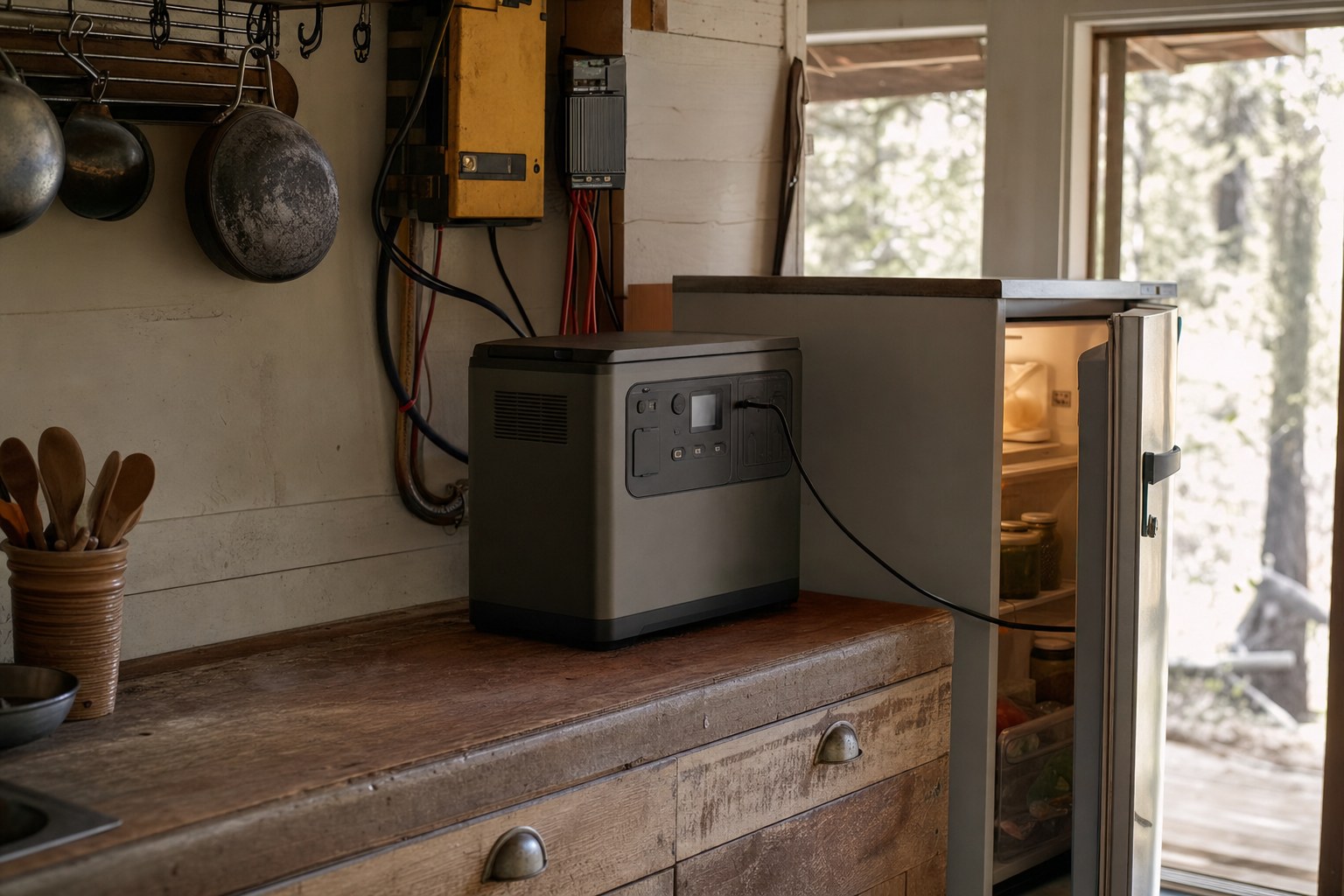
Will a Solar Generator Run a Refrigerator? We Bench-Tested the Surge Math Across 160 Kits
The short answer
Short version: yes, but only when two conditions hold. The inverter has to swallow the compressor's startup surge (2,000W or more, pure-sine), and the battery has to be sized for a full day of cycling rather than the fridge's ~150W nameplate. We put 160 solar-generator kits against that floor. Of those, 78 (49%) arrive with their own panels and clear it. The three lowest-cost winners are below, along with the surge math the rule rests on: a compressor's locked-rotor draw runs 3–5× its steady running watts.
The load profile: what a fridge really draws
A refrigerator misleads you on two fronts. The first: that ~150W on the nameplate is only its *running* draw, while the compressor demands 3–5× that at startup (its *locked-rotor amperage*, or LRA), a ~1,200–1,800W spike lasting a fraction of a second every time it cycles on. The second: it never truly shuts off. It runs roughly a third of every day, around the clock.
Run the honest figures. A 150W fridge cycling about ⅓ of the day works out to 1.2–1.5 kWh per day. Pile on summer heat and you add ~30%, so call it 1.8 kWh/day. That gap is why a "1000W solar generator" with a 1,000W inverter keeps failing on a fridge it's nominally "rated" for. Either the inverter trips on the surge, or the battery was sized to the nameplate and drains overnight.
Match the spec to *your* fridge with the load calculator and the battery sizing calculator. The floor, though, holds for everyone: beat the surge, and store for the cycling load, not the nameplate.
The verdict: yes, once it clears two bars
The verdict block below trips the fridge-and-freezer failure note, the field reality that raw watt arithmetic glosses over. Two bars a kit has to clear:
- ◈Surge-clearing inverter — 2,000W minimum, pure-sine. Modified-sine units leave compressors buzzing, running hot, and failing early, while undersized 1,000–1,500W inverters just trip on the startup spike.
- ◈Cycling-sized battery — matched to the all-day watt-hours (≈1.5–1.8 kWh/day for a fridge), not the 150W running number.
That two-part gate is precisely why we screened to inverter ≥ 2,000W and storage ≥ 2 kWh. Anything under it is a "reads rated, dies in the field" trap. For why the failure note earns its trust, see how we calculate real build cost and our methodology.
Fridges and freezers surge hard and never turn off
Compressors pull 3–5× their running watts to start, and because they cycle 24/7 they quietly dominate your daily watt-hours — especially in summer heat. Modified-sine power makes them buzz and shortens compressor life.
Fix: Pure-sine inverter, and size the battery for the all-day cycling load. In hot climates add ~30% to the fridge's estimated draw.
One day of battery autonomy is thin for the critical loads you listed
You have loads that can't simply wait for sun — fridge/freezer, a pump, medical gear, or always-on connectivity. A single overcast stretch can take the bank to empty before noon.
Fix: Plan 2–3 days of autonomy for critical setups. Bump the "days of autonomy" input and re-check the battery size.
The 3 kits that win
Every one of the five picks below is a LiFePO4, pure-sine integrated station, so they clear the chemistry and surge-headroom rules without a fight. The best-value pick leads the podium, and the page's single buy link rides on it. Each kit name opens its full audit.
#1 · Best value
DELTA 2 Max 2048Wh + 400W PanelThis is the plain answer to the question. Its 2,400W pure-sine inverter absorbs a fridge's ~1,200–1,800W startup surge with room to spare, the 2,048Wh battery carries a typical 150W-cycling fridge roughly 24–36 hours through a sunless stretch, and at $899 it is the cheapest complete, panel-included kit that beats the surge floor, with nothing left to add. The #2 pick banks more storage per dollar, but when the goal is a covered fridge at the lowest sticker price, this is where you start.
#2 · Most autonomy per dollar
$0.25/WhRuntime per dollar is where this one lands first: $0.25/Wh, 5,120Wh of storage, and 1,800W of panels to top it back up. Reach for it when the job is "fridge, plus a freezer, plus a couple of cloudy days." The 5,000W inverter has so much reserve that no fridge surge will come close to bothering it.
#3 · Surge-headroom pick
$0.42/WhPick this one when loads will stack up. The 3,600W inverter keeps reserve for a microwave, a well pump, or an older fridge with a stiff compressor running alongside the main fridge, so the inverter never edges toward its ceiling every time a compressor kicks on.
#4 · Budget pick
$0.37/WhThe cheapest way onto the podium at $749: 2.05kWh of LiFePO4 sitting behind a 2,400W pure-sine inverter, carrying $0 in hidden parts. At $0.37/Wh it runs one modern fridge without drama. Choose it when the priority is a covered fridge for the smallest outlay rather than the longest runtime. It ships as the main unit only, so panels get added separately to recharge off-grid.
#5 · Alt — smallest viable
$0.47/WhThe smallest build we'll still sign off as a yes: 2,048Wh and a 2,400W pure-sine inverter clear the floor, paired with just one 200W panel for slow off-grid top-ups. Right for a single fridge in a cabin you drop in on, not a homestead freezer farm.
The receipt: what your money actually buys
Now the honest math. Every kit in this cohort is an all-in-one power station bundled with its own panels, which means missing-parts cost is $0: nothing else has to be bought to run a fridge. For this class the real receipt isn't hidden hardware, it's runtime. What your dollars buy here is fridge-hours. (Roughly 29 of the 439 kits in our catalog *do* bury required parts, component kits such as a panel-and-controller starter shipped with no battery, and those carry a real Completion Gap Receipt. The ones on this page don't.)
| Kit | Listed | Storage | Fridge runtime, no sun | Days autonomy |
|---|---|---|---|---|
| DELTA 2 Max 2048Wh + 400W Panel | $899 | 2.0 kWh | ~27 hrs | ~1.1 |
| RV5 - /5,000W + Unit Only | $1,299 | 5.1 kWh | ~68 hrs | ~2.8 |
| SOLIX F3000 3,072Wh/3,600W + Main Unit Only | $1,299 | 3.1 kWh | ~41 hrs | ~1.7 |
| SOLIX C2000 Gen2 2,048Wh/2,400W + Main Unit Only | $749 | 2.0 kWh | ~27 hrs | ~1.1 |
| SOLIX C2000 Gen2 2,048Wh/2,400W | $969 | 2.0 kWh | ~27 hrs | ~1.1 |
Runtime ≈ usable storage ÷ ~75W effective fridge draw (running watts + inverter overhead, before summer derate). A real receipt for integrated stations is hours of runtime, not missing parts.
Gap-closing BOM: what's still left to buy
With these integrated stations, the gap to *run a fridge* is basically nothing. The panel, battery, inverter, and cables all ride in the box. The add-ons people genuinely reach for are optional, never required:
- ◈A second panel or expansion battery for multi-day autonomy through a long cloudy stretch.
- ◈A heavy-gauge outdoor extension cord to reach the fridge without dropping voltage on the run.
- ◈A manual transfer switch, and only if you're hard-wiring into a panel instead of plugging straight in.
Want the next size up, or a side-by-side look? Browse the 2,000W solar kits or run a head-to-head compare.
Buy now or wait?
| Kit | Current | 6-mo low | Above low | Signal |
|---|---|---|---|---|
| DELTA 2 Max 2048Wh + 400W Panel | $899 | $849 | +6% | Fair price |
| RV5 - /5,000W + Unit Only | $1,299 | $1,299 | at low | Buy now |
| SOLIX F3000 3,072Wh/3,600W + Main Unit Only | $1,299 | $1,199 | +8% | Fair price |
| SOLIX C2000 Gen2 2,048Wh/2,400W + Main Unit Only | $749 | $699 | +7% | Fair price |
| SOLIX C2000 Gen2 2,048Wh/2,400W | $969 | $919 | +5% | Fair price |
6-month price history — DELTA 2 Max 2048Wh + 400W Panel
Price History
▼ 40% BELOW AVGLast observed at retailer: Jun 20, 2026. Days between observations carry the most recent known price — not new data.
Why these won — and why others failed
Why these won
- ✓Every podium kit beats the 2,000W pure-sine surge bar with genuine reserve: the #1 sits at 2,400W, the autonomy pick at 5,000W.
- ✓All run LiFePO4 (holds a charge for months, deep-cycles daily) and arrive with their own panels, so they can truly recharge off-grid.
- ✓Each is priced and spec'd from live data and ranked by cost-per-watt-hour, not a single-brand blog talking up its own box.
Why others failed
- ✕Sub-2,000W "solar generators" trip on the compressor's startup surge even when their running watts read just fine.
- ✕Modified-sine units punish compressors: they buzz, run hot, and cut fridge life short.
- ✕Main-unit-only listings look cheap per Wh but ship with no panel, so they can't charge off-grid at all, which is why we kept them out of the paneled shortlist.
Frequently asked
Will a solar generator run a refrigerator?
Yes, provided the inverter beats the compressor's startup surge (2,000W or more, pure-sine) and the battery is sized for all-day cycling, roughly 1.5–1.8 kWh/day for a typical fridge, instead of the ~150W running nameplate. Kits under that bar tend to trip on the surge or run flat overnight.
What size solar generator do I need for a fridge?
For one modern refrigerator, aim for a 2,000W+ pure-sine inverter and at least 2 kWh of LiFePO4 storage, which buys about a day of runtime with no sun. Add a freezer or plan for a couple of cloudy days and you'll want to step up to 5 kWh of storage plus panels to refill it.
Can a solar generator run a fridge and a freezer together?
Yes, as long as you plan for the combined cycling load (often 2.5–3.5 kWh/day) and the overlapping surges. A kit with ~5 kWh of storage, a 3,000W+ inverter, and 1,000W+ of panels, like our autonomy pick, carries both with ease. A 2,000W single-fridge unit will be marginal.
Methodology, freshness & corrections
Cohort: the surge-clearing floor: inverter ≥ 2,000W paired with storage ≥ 2 kWh → 160 kits clear the bar; the podium is drawn from the 78 clean, complete primaries left after dropping variants and incomplete listings. Prices auto-refresh from multiple retailers every 6 hours; this page last refreshed 2026-06-19.
See how real build cost is calculated, our methodology, data sources, and editorial policy. Found an error? Tell us — we correct fast.
Different use case? See the best off-grid solar generator for every load.