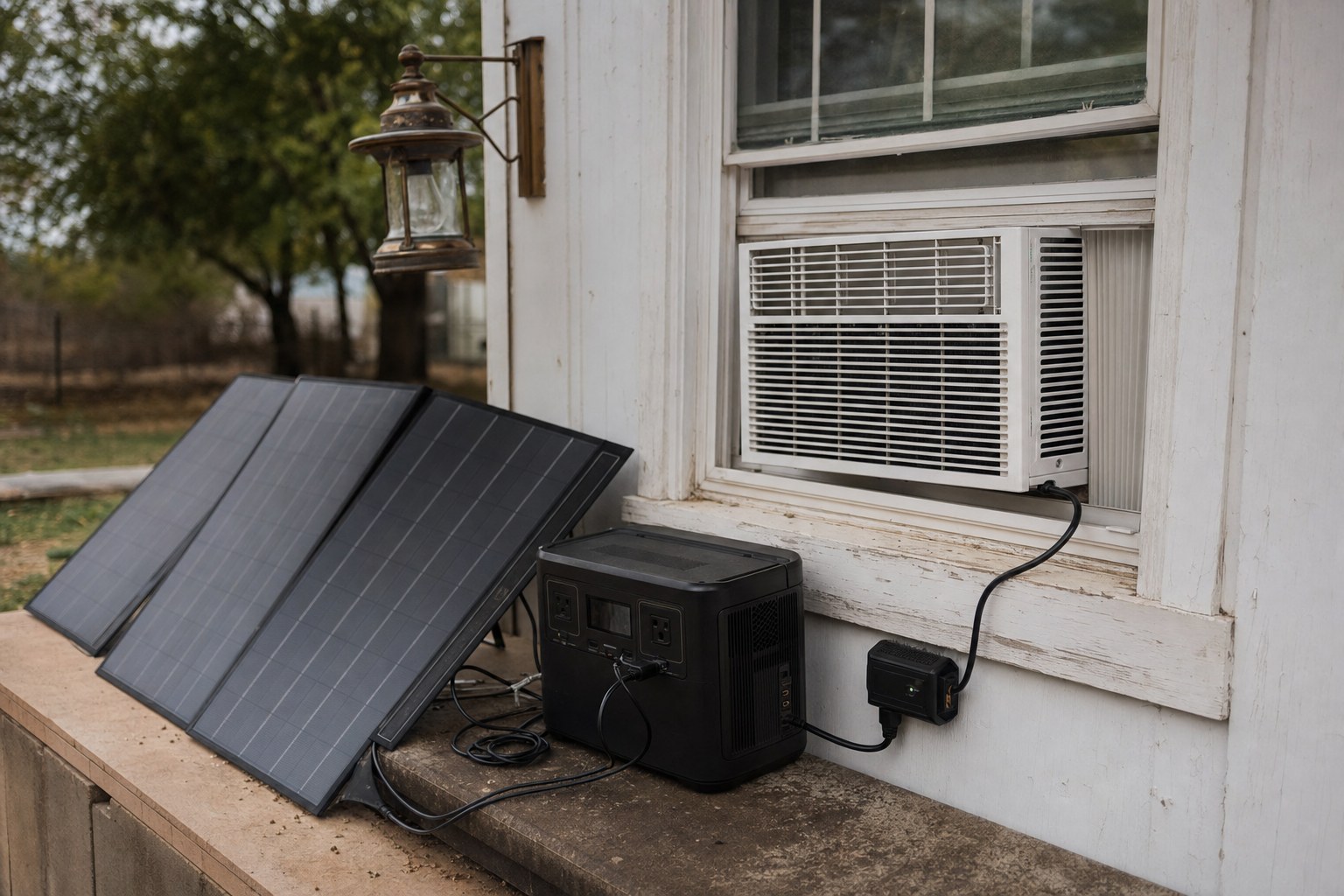
What a Solar Kit Still Needs to Run a Window AC: Soft-Start, Inverter, and Battery Math
The short answer
Two separate things break a solar kit under a window air conditioner. The compressor pulls about 3× its running watts at every start, and once it settles in it runs for hours and works straight through the bank. Three gaps close that. A soft-start kit trims the startup surge ~65%. A pure-sine inverter keeps the motor from buzzing and overheating, which modified-sine power will do to it. Battery capacity buys the hours. Below: the parts that close each gap on a kit you already own, and the 3 LiFePO4 systems out of the 135 AC-capable ones that clear the bar with nothing added.
Load profile: one spike, then hours of grind
A window air conditioner attacks a solar kit from two directions at once:
- ◈The startup spike. Every time the compressor motor kicks on, it pulls roughly 3× its running watts for a fraction of a second. Running draw on a 5,000 BTU unit sits near 450–550W, and the spike clears 1,500W. Step up to a 12,000 BTU unit and the running figure is 1,100–1,300W, with spikes past 3,500W. Size the inverter off the running number and it trips on that spike.
- ◈The grind. A well pump cycles and it's gone. An AC runs for hours, so clearing the surge only earns the right to watch the battery drain: runtime is nothing more than battery watt-hours ÷ running watts. Against a 500W window unit, a 2kWh bank lasts ~3–4 hours, a 3.6kWh bank ~6–7.
Put your own numbers (BTU, run hours, room size) through the load calculator before any parts get ordered.
The verdict: kill the surge, clean the waveform, buy the hours
A window AC trips a blocker in our failure engine:
> Startup pulls ~3× the compressor's running watts, so an inverter sized to the running figure trips the moment it kicks on. Cut the inrush with a soft-start kit, run pure sine, and size the battery to the hours the unit actually spends running.
Each clause of that blocker is one row in the table above. Soft-start flattens the surge so a smaller inverter copes. Pure sine protects the compressor motor. More battery buys runtime. Start with the soft-start, since it's the cheapest path from a kit that *almost* runs your AC to one that does. Our methodology explains how the call gets made, and the inverters & power conversion explainer covers why motors and modified-sine power don't mix.
Air conditioner compressors surge ~3× on startup
A 500W window unit spikes near 1,500W the instant the compressor kicks in, and it does that every cycle. On a modified-sine inverter the compressor buzzes, runs hot, and fails early.
Fix: Run AC only on a pure-sine inverter with real surge headroom, or add a soft-start kit. Plan battery for the cycling draw, not the nameplate watts.
Skip the retrofit: 3 kits that clear the surge as shipped
Three LiFePO4 kits handle a window AC with nothing bolted on. Ranking here is value measured against runtime: the $0.42/Wh Anker takes the top spot, the 3,600Wh EcoFlow holds the most for a bigger unit, and the $899 EcoFlow is the lowest price that still runs a small one. The page's one buy link rides on the #1 pick. Every kit name opens its full audit, real build cost and 6-month price history included.
A soft-start still earns its keep even on these, letting a smaller unit drive a bigger AC while cutting wear. Run a head-to-head compare, or browse the wider portable power pool.
#1 · Best value, no retrofit needed
SOLIX F3000 3,072Wh/3,600W + Main Unit OnlyA 3,600W inverter takes the startup spike of a 5,000–10,000 BTU window unit straight on, no soft-start required. Storage of 3,072Wh at $0.42/Wh (the lowest cost-per-watt-hour on this page) covers several hours of running. A 12V DC output is on board, and the bank expands past 12kWh when the hours matter more than the sticker. Buying new rather than upgrading, this is the first stop.
#2 · Longest run on a bigger unit
$0.47/Wh3,600Wh, the largest bank in this shortlist, sitting behind a 3,600W inverter. That pairing absorbs a larger window unit's surge and keeps the compressor fed well past the point smaller banks quit, buying hours before the sun returns. It lands at $0.47/Wh and arrives bundled with a 400W panel. Right choice when the AC is the load the whole system exists for.
#3 · Lowest sticker that still cools a room
$0.44/Wh$899 is the lowest price here, and it buys 2,048Wh behind a 2,400W inverter, enough for a 5,000–6,000 BTU window unit and more comfortably still with a soft-start fitted. The bigger banks outlast it, no argument. For one small room, or a nap-length cool-down, this is the cheapest entry that survives the honest math.
What to add to close the gap
| Part to add | Why it closes the gap | Est. cost | Shop |
|---|---|---|---|
| Soft-start kit (e.g. Micro-Air EasyStart, SoftStartRV) | Takes ~65% off the compressor's startup inrush, which is usually all it takes to stop a marginal 2,000W inverter from tripping. No other add-on moves the needle this far per dollar. | $250–$350 | Find on Amazon → |
| Pure-sine inverter upgrade (only if your kit is modified-sine) | A compressor fed modified-sine power buzzes, runs hot, and dies young. Confirm the waveform on the kit you own, and if it isn't pure sine, replace the inverter before any motor load goes near it. | $150–$500 | Find on Amazon → |
| Expansion battery / extra LiFePO4 storage | Hours, not minutes: that is what a window AC asks of a bank. Since runtime resolves to battery watt-hours ÷ running watts, capacity is the only lever that extends the gap between charges. | $400–$1,200 | Find on Amazon → |
| Plug-in watt meter (e.g. Kill A Watt) | Nameplate BTU and watts are a claim, not a measurement. Read your own unit's real running and startup draw before the system depends on it, because the surge is the number that trips the inverter. | $20–$40 | Find on Amazon → |
The receipt: what your money actually buys
The receipt on this page is the add-on table above, the parts a near-fit kit still needs, rather than a cost buried inside the three picks (those ship complete, missing-parts cost is $0). Ranked by leverage, the soft-start wins outright at roughly $250–$350: it pulls the surge down far enough that a 2,000W inverter you already own will run an AC it currently trips on. Autonomy figures below run on the AC's continuous draw. Soft-start plus battery is what stretches them.
| Kit | Listed | Storage | Fridge runtime, no sun | Days autonomy |
|---|---|---|---|---|
| SOLIX F3000 3,072Wh/3,600W + Main Unit Only | $1,299 | 3.1 kWh | ~6 hrs | ~0.2 |
| DELTA Pro + 400W Panel | $1,699 | 3.6 kWh | ~7 hrs | ~0.3 |
| DELTA 2 Max 2048Wh + 400W Panel | $899 | 2.0 kWh | ~4 hrs | ~0.2 |
Runtime ≈ usable storage ÷ ~550W effective fridge draw (running watts + inverter overhead, before summer derate). A real receipt for integrated stations is hours of runtime, not missing parts.
Running the numbers on a kit you already own
Two calculations settle whether your current system can carry your AC:
- ◈Surge check. Multiply the AC's running watts by 3 to approximate the startup spike, or measure it with a watt meter. Land above your inverter's surge rating and a soft-start kit, worth ~65% off the inrush, will typically bring it back under. Worked through: a 500W unit spiking ~1,500W falls to ~500–600W, territory almost any 2,000W inverter handles.
- ◈Runtime check. Hours = battery watt-hours ÷ AC running watts. More hours means expansion storage, because solar rarely matches an AC's draw in real time. The battery is what carries the load.
Turn up a modified sine inverter and that gets fixed before anything else, since no amount of battery makes that waveform safe for a compressor. Re-run your own figures in the calculator, and see data sources for where kit pricing comes from.
Buy now or wait?
| Kit | Current | 6-mo low | Above low | Signal |
|---|---|---|---|---|
| SOLIX F3000 3,072Wh/3,600W + Main Unit Only | $1,299 | $1,199 | +8% | Fair price |
| DELTA Pro + 400W Panel | $1,699 | $1,399 | +21% | Fair price |
| DELTA 2 Max 2048Wh + 400W Panel | $899 | $849 | +6% | Fair price |
6-month price history — SOLIX F3000 3,072Wh/3,600W + Main Unit Only
Price History
— AT AVERAGELast observed at retailer: Jun 20, 2026. Days between observations carry the most recent known price — not new data.
Why these won — and why others failed
Why these won
- ✓Nothing else on the list buys as much per dollar as the soft-start: ~65% off the startup surge means the 2,000W inverter already sitting in your garage runs a unit it currently trips on, at a fraction of what a new system costs.
- ✓All three shortlist kits are pure-sine LiFePO4 carrying genuine surge headroom, which is why a window AC runs on them with no retrofit. They're ranked on runtime-per-dollar off live data.
- ✓Each add-on traces back to a sourced failure-note: compressor surge, modified-sine motor damage, marathon runtime. Those are computable gaps, not the hand-waving a generic 'can solar run AC?' article settles for.
Why others failed
- ✕Sizing the inverter to the AC's running watts and ignoring the ~3× startup surge. This is the number-one reason a kit that 'should' run an AC quits the instant the compressor engages.
- ✕Feeding a compressor from a modified-sine inverter. It buzzes, it overheats, and the motor's life gets cut short. Pure sine isn't optional on an AC.
- ✕Budgeting for the surge and forgetting the grind. An AC keeps pulling from the bank for hours, so undersized storage empties long before the heat lets up.
Frequently asked
What do I need to add to a solar generator to run a window AC?
Three parts, in this order. A soft-start kit, to pull the compressor's ~3× startup surge down until your inverter stops tripping. A pure-sine inverter, if the kit you own isn't already pure sine, because modified sine damages compressor motors. Then battery capacity to cover the hours the AC actually runs. Cheapest and most decisive of the three is the soft-start, which alone often converts a near-fit kit into a working one.
Will a soft-start kit let a small inverter run an air conditioner?
Usually. Roughly 65% comes off the compressor's inrush, so a 500W window unit spiking ~1,500W at startup instead asks for ~500–600W, which most 2,000W inverters reach without complaint. Running watts don't budge, meaning battery capacity still decides runtime. What the soft-start does is get a smaller system through the startup surge.
How long will a solar battery run a window air conditioner?
Divide battery watt-hours by the AC's running watts. Against a ~500W (5,000 BTU) window AC, a 2,000Wh unit gives about 3–4 hours and a 3,600Wh unit about 6–7. Panels rarely match an AC's draw in real time, which leaves battery size as the figure that sets how long the unit runs between recharges.
Methodology, freshness & corrections
Cohort: window-AC-capable LiFePO4 systems: inverter 2,000W+, storage 2 kWh+, soft-start assumed on the marginal ones → 135 kits clear the bar; the podium is drawn from the 111 clean, complete primaries left after dropping variants and incomplete listings. Prices auto-refresh from multiple retailers every 6 hours; this page last refreshed 2026-07-03.
See how real build cost is calculated, our methodology, data sources, and editorial policy. Found an error? Tell us — we correct fast.
Different use case? See the best off-grid solar generator for every load.