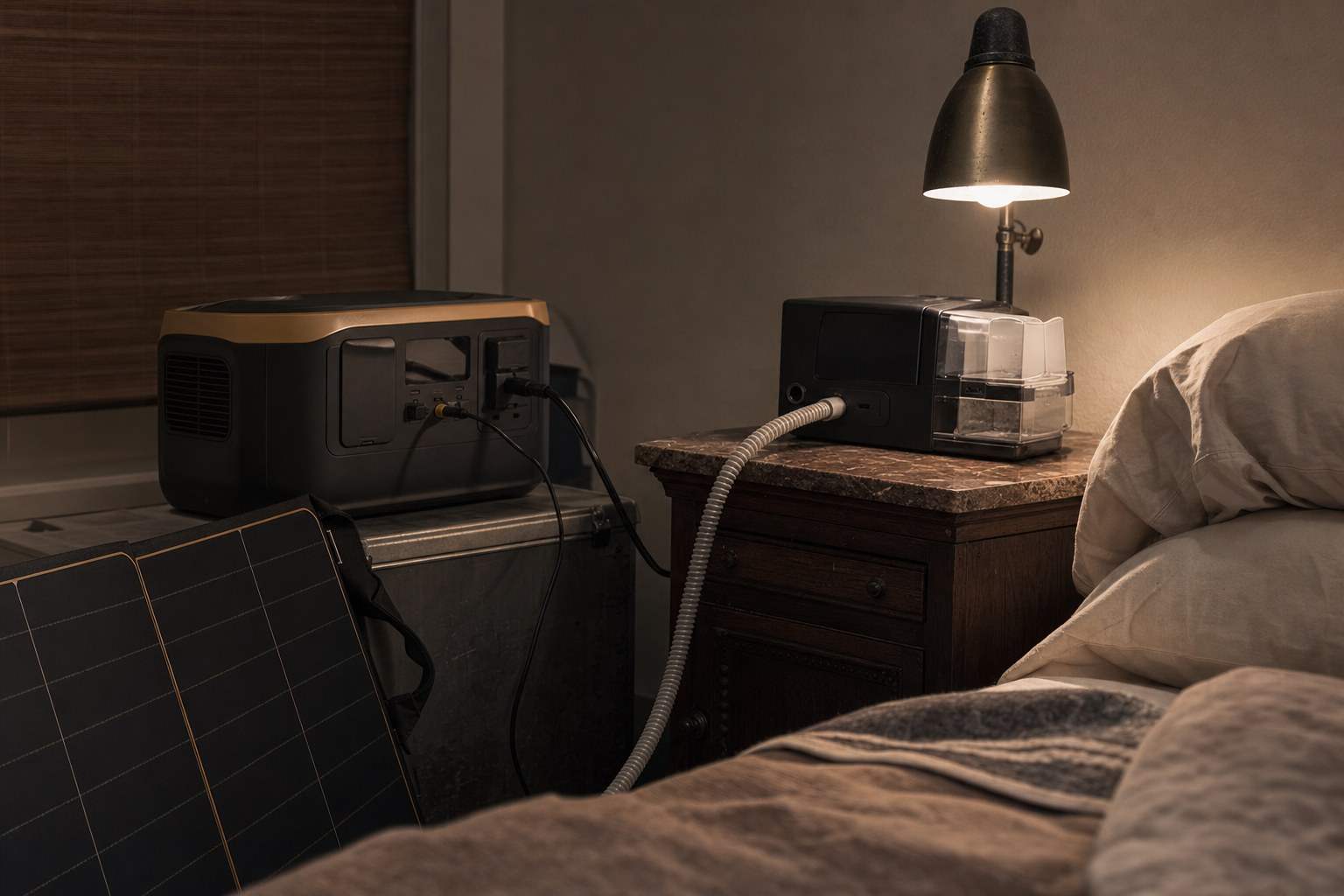
Off-Grid Power for a CPAP: Ranked by Nights of Runtime, Not Watts
The short answer
Watts are not the constraint here. A CPAP draws roughly 30–60W, which every inverter in this cohort handles without noticing. The constraint is nights: how many times you sleep through before the bank is flat. Budget about 400–500Wh per night with the heated humidifier running (it roughly doubles the draw), or about 250Wh with it off, then divide your storage by that figure. We started with 81 LiFePO4 power stations carrying real storage, kept the 38 rated for emergency use, and ranked the 5 best on runtime per dollar. Also below: the trick (12V DC, humidifier off) that turns two nights into three.
The load profile: nights, not watts
A CPAP is the unusual off-grid load where the wattage is irrelevant. Running draw sits at 30–60W, and every station on this page inverts that without effort. The number that decides the purchase is nights per charge, and the heated humidifier swings it hardest: switch it on and consumption roughly doubles, from about 250Wh a night to ~400–500Wh across a typical 8-hour sleep. (Our load calculator carries the CPAP at 60W with humidification. Without it, figure closer to 30W.)
One line of arithmetic is the entire decision: battery watt-hours ÷ nightly watt-hours = nights of runtime. 2,048Wh buys roughly four humidified nights. 4,085Wh buys roughly eight. Size against the longest gap between recharges you expect, not the typical one. On medical equipment, the worst case is the case that counts.
The verdict: run it on DC, and size for the bad week
Our failure-note engine tags a CPAP as a plan-conservatively load. Not because powering it is difficult, but because of what rides on it:
> Running a CPAP through an AC inverter wastes power on overhead, and the heated humidifier roughly doubles the draw. A single cloudy night can't be allowed to cut therapy.
The engine's fix, word for word: power it from 12V DC where possible, turn off the heated humidifier to cut draw ~50%, and size 2+ days of autonomy. Three picks below (both F3000-based Anker kits, plus the EcoFlow DELTA Pro) carry a 12V DC output, which lets a DC-compatible CPAP sidestep the conversion loss completely. The reasoning sits in how we run the numbers and the inverters and power conversion explainer.
CPAP is life-support-adjacent — plan it conservatively
Running a CPAP through an AC inverter wastes power on overhead, and the heated humidifier roughly doubles the draw. A single cloudy night can't be allowed to cut therapy.
Fix: Power it from 12V DC where possible, turn off the heated humidifier to cut draw ~50%, and size 2+ days of autonomy.
The 5 winners, ranked on runtime per dollar
LiFePO4 and pure sine describes all five, which is non-negotiable for the sensitive electronics in a CPAP, and our data rates every one of them for emergency use. Ranking runs on nights of runtime against price: the $0.42/Wh value pick takes the top slot, the 4,085Wh Jackery holds the most nights, and the $899 EcoFlow is the cheapest door in. The page's single buy link sits on the #1 pick. Every kit name opens its full audit, real build cost and 6-month price history included.
Be honest about the night count you actually need. A week of autonomy is wasted on a weekend camper, and it is exactly what a homebound medical user should not trim. Put any two of these head-to-head, or work through the full portable power pool.
#1 · Best nights per dollar
SOLIX F3000 3,072Wh/3,600W + Main Unit OnlyValue on this board is settled here. 3,072Wh of LiFePO4 at $0.42/Wh, the lowest cost-per-watt-hour of anything on the podium, covers roughly six humidified nights per charge and stretches past a week once the humidifier goes off. A 12V DC output lets you bypass the inverter entirely (covered below), storage expands past 12kWh later, and the warranty runs 5 years. For most buyers the search ends here.
#2 · Longest runtime, panels in the box
$0.48/WhNobody in this group carries more nights. 4,085Wh covers roughly eight humidified sleeps, and the two 200W panels in the box mean a sunny afternoon rebuilds the bank mid-outage. $0.48/Wh is not the cheapest per watt-hour on the page, but the largest bank plus bundled solar is what you buy when a cloudy stretch cannot be allowed to interrupt therapy.
#3 · Lowest entry price, panel included
$0.44/Wh$899 is the smallest ticket on this page, and a 400W panel still comes with it. 2,048Wh works out to about four humidified nights, or six-plus with the humidifier off, which covers weekend trips and short outages. Autonomy you will never use is money spent for nothing. Start here if a week of reserve is not the requirement.
#4 · For humidifier-on sleepers
$0.47/Wh3,600Wh at $0.47/Wh, bundled with a 400W panel, works out to roughly seven humidified nights with room left over. This is the pick when turning the heated humidifier off is off the table. A 12V car output supports DC-direct running, and the inverter has enough capacity to carry a medication fridge alongside the CPAP.
#5 · Travel and camping build
$0.61/WhSame 3,072Wh F3000 core as the value pick, packaged instead with two folding 200W panels that lie flat in a truck bed or a tent vestibule. $0.61/Wh is a premium over the main-unit-only build, and folding solar is what the premium buys. Worth paying if the CPAP travels rather than sitting in a closet.
The receipt: what your money actually buys
No missing-parts surcharge applies to this cohort. These are integrated power stations, so required missing-parts cost is $0. The one accessory the box may not carry is a 12V DC output cable for your machine (≈$15–$30), and running the CPAP on DC skips the inverter's AC-conversion overhead, worth 10–20% more runtime. So the receipt below counts nights of autonomy rather than hidden hardware: what the money buys is sleep, measured in nights.
| Kit | Listed | Storage | Fridge runtime, no sun | Days autonomy |
|---|---|---|---|---|
| SOLIX F3000 3,072Wh/3,600W + Main Unit Only | $1,299 | 3.1 kWh | ~56 hrs | ~2.3 |
| 2000 Plus + PackPlus E2000 Battery + 2x 200W Panels (4085Wh) | $1,979 | 4.1 kWh | ~74 hrs | ~3.1 |
| DELTA 2 Max 2048Wh + 400W Panel | $899 | 2.0 kWh | ~37 hrs | ~1.6 |
| DELTA Pro + 400W Panel | $1,699 | 3.6 kWh | ~65 hrs | ~2.7 |
| SOLIX F3000 3,072Wh/3,600W + 2×200W Folding Panels | $1,889 | 3.1 kWh | ~56 hrs | ~2.3 |
Runtime ≈ usable storage ÷ ~55W effective fridge draw (running watts + inverter overhead, before summer derate). A real receipt for integrated stations is hours of runtime, not missing parts.
Two levers that turn two nights into three
Whether a given battery covers two nights or three comes down to two adjustments:
- ◈The heated humidifier dominates the load. Shutting it off (or swapping to a heat-and-moisture-exchange filter) cuts nightly watt-hours by ~50%, the fastest night you will ever add during an outage. Run it while there is sun to spare, drop it when there isn't.
- ◈12V DC direct. Feeding the CPAP from the station's DC output skips the inverter's AC-conversion overhead (typically a 10–20% loss), so the identical battery goes measurably further. That takes the correct 12V DC cable for your machine (≈$15–$30), the one accessory worth ordering up front. Check that your CPAP model accepts DC input before you buy.
Once your pressure, humidifier setting, and nightly hours are locked in, re-run your exact runtime through the load calculator. Kit pricing provenance is documented under data sources.
Buy now or wait?
| Kit | Current | 6-mo low | Above low | Signal |
|---|---|---|---|---|
| SOLIX F3000 3,072Wh/3,600W + Main Unit Only | $1,299 | $1,199 | +8% | Fair price |
| 2000 Plus + PackPlus E2000 Battery + 2x 200W Panels (4085Wh) | $1,979 | $1,979 | at low | Buy now |
| DELTA 2 Max 2048Wh + 400W Panel | $899 | $849 | +6% | Fair price |
| DELTA Pro + 400W Panel | $1,699 | $1,399 | +21% | Fair price |
| SOLIX F3000 3,072Wh/3,600W + 2×200W Folding Panels | $1,889 | $1,889 | at low | Buy now |
6-month price history — SOLIX F3000 3,072Wh/3,600W + Main Unit Only
Price History
— AT AVERAGELast observed at retailer: Jun 20, 2026. Days between observations carry the most recent known price — not new data.
Why these won — and why others failed
Why these won
- ✓Every pick is pure-sine LiFePO4 rated for emergency use, and the weakest of them still clears four humidified nights of CPAP runtime on a full charge, which is the only metric a medical backup is judged on.
- ✓Three of the five (both F3000 kits and the DELTA Pro) carry a 12V DC output, so a DC-compatible CPAP runs with no inverter conversion loss. That is the verdict engine's own fix, and it shows up as real watt-hours.
- ✓Runtime, price, and 6-month price history all come out of live data, not a single-brand blog reciting its own spec sheet.
Why others failed
- ✕Stations under ~1kWh read fine on watts and go flat before night two. Buying for the running number instead of the night count is the #1 CPAP mistake.
- ✕Modified-sine inverters can leave sensitive CPAP electronics buzzing or misreading, so pure sine stays non-negotiable on medical equipment.
- ✕Out went the DC-only battery boxes with no AC inverter, along with the oversized whole-home stacks whose surge headroom a 60W machine will never touch. Both are the wrong tool at a bedside.
Frequently asked
How much power does a CPAP use overnight?
Figure about 250Wh a night with the heated humidifier off, and 400–500Wh with it on, based on a typical 8-hour sleep at mid-range pressure. Nights of runtime is your battery's watt-hours divided by that: a 2,000Wh unit lands near four humidified nights, a 4,000Wh unit near eight.
Can a solar generator run my CPAP through the night?
Yes. At 30–60W a CPAP is trivial for any LiFePO4 power station here to invert. Nights between recharges is the harder question. If your machine accepts DC, run it from the unit's 12V output to skip inverter loss, and switching the heated humidifier off will roughly double the nights you get.
Does a CPAP need a pure sine wave inverter?
Yes. A CPAP's electronics and blower motor can buzz, run hot, or misread when fed modified sine. Every pick on this page is pure sine and LiFePO4, the safe pairing for nightly medical use.
Methodology, freshness & corrections
Cohort: the CPAP runtime band: LiFePO4 power stations with an AC inverter and 1–5 kWh of storage → 81 kits clear the bar; the podium is drawn from the 38 clean, complete primaries left after dropping variants and incomplete listings. Prices auto-refresh from multiple retailers every 6 hours; this page last refreshed 2026-07-03.
See how real build cost is calculated, our methodology, data sources, and editorial policy. Found an error? Tell us — we correct fast.
Different use case? See the best off-grid solar generator for every load.