Solar Kit for a Shed or Workshop: We Priced 26 Kits by Real Build Cost, Not Sticker
The short answer
Sticker price is the wrong number to shop on here, because plenty of "kits" quote a figure that leaves out mounting and monitoring. A $640 panel kit turns into a $775 working system once the omitted parts go in the cart. So we ranked 26 shed-rated kits under $1,500 (the $269–$1,499 band) by real build cost. The cheapest complete setup that still survives shop-tool surges is the Anker SOLIX C1000 bundle at $449: a 2,000W pure-sine inverter, 1,024Wh of LiFePO4, 600W of panels, and $0 in hidden parts.
The load profile: what a shed or workshop actually pulls
Sheds sort into three load tiers, and the tier you land in sets the price band before any brand does:
- ◈Tier 1, lights + electronics + the odd tool. LED work lights, a phone or laptop charger, a drill sitting on its charger. A few hundred watt-hours a day, covered by roughly a $500 unit.
- ◈Tier 2, add a shop fridge or long tool sessions. A beer fridge never really stops, cycling around the clock and quietly taking over the daily watt-hour total, and an hour on the tools stacks on top. The battery has to grow, which puts you in the $700 tier.
- ◈Tier 3, a genuine workshop. Table saw, pancake compressor, window AC. Here the surge outranks the running watts as the deciding spec, and the band moves to $900+.
Two loads rewrite the whole plan. An air compressor spikes on every single restart, and electric heat of any kind can outdraw the rest of the system by itself. Put your actual loads through the shed solar calculator first, then come back to the shortlist.
The verdict: two loads will break a cheap kit
The verdict block below fires on the two loads that decide whether a budget kit lives or dies in a workshop:
- ◈Air compressor (the blocker). Restart inrush on a 1,500W compressor runs past 3,000W, which stalls small inverters mid-cut. That is why the shortlist floors the inverter at 2,000W (the Anker) and steps to 2,400W (the EcoFlow) for real shop duty. Pair a $300 pancake compressor with the DELTA 2 Max tier, not the entry unit.
- ◈Electric heat (don't size for it). Resistance heat blows out more off-grid systems than anything else on the list. One shop heater can beat every other load put together. Heat with propane, and treat an electric heater as spot backup rather than a sized load.
A shop fridge is the same lesson at lower volume: pure-sine only, sized to the around-the-clock cycling instead of the nameplate. The inverter side is unpacked in inverters and power conversion.
Air compressors have brutal startup inrush
A 1,500W compressor can spike past 3,000W when the motor unloads and restarts. Pancake and twin-stack units routinely stall small inverters mid-task.
Fix: Run shop tools on a 3,000W+ low-frequency inverter, or add a soft-start / larger run capacitor. Don't size to the running watts.
Fridges and freezers surge hard and never turn off
Compressors pull 3–5× their running watts to start, and because they cycle 24/7 they quietly dominate your daily watt-hours — especially in summer heat. Modified-sine power makes them buzz and shortens compressor life.
Fix: Pure-sine inverter, and size the battery for the all-day cycling load. In hot climates add ~30% to the fridge's estimated draw.
One day of battery autonomy is thin for the critical loads you listed
You have loads that can't simply wait for sun — fridge/freezer, a pump, medical gear, or always-on connectivity. A single overcast stretch can take the bank to empty before noon.
Fix: Plan 2–3 days of autonomy for critical setups. Bump the "days of autonomy" input and re-check the battery size.
The shortlist: five kits that clear the bar
All five picks are LiFePO4 and pure-sine, shed-rated, and under $1,500. The podium is ordered from the cheapest complete setup to the largest battery, and the page's single buy link rides on the #1 value pick.
- ◈#1 Anker SOLIX C1000, $449. The cheapest complete, surge-ready floor: 2,000W inverter, 1,024Wh, $0 hidden.
- ◈#2 Bluetti AC180P, $699. 1,440Wh at $0.49/Wh, the storage step-up once a shop fridge is involved.
- ◈#3 EcoFlow DELTA 2 Max, $899. A 2,400W inverter at $0.44/Wh, the workshop-grade choice.
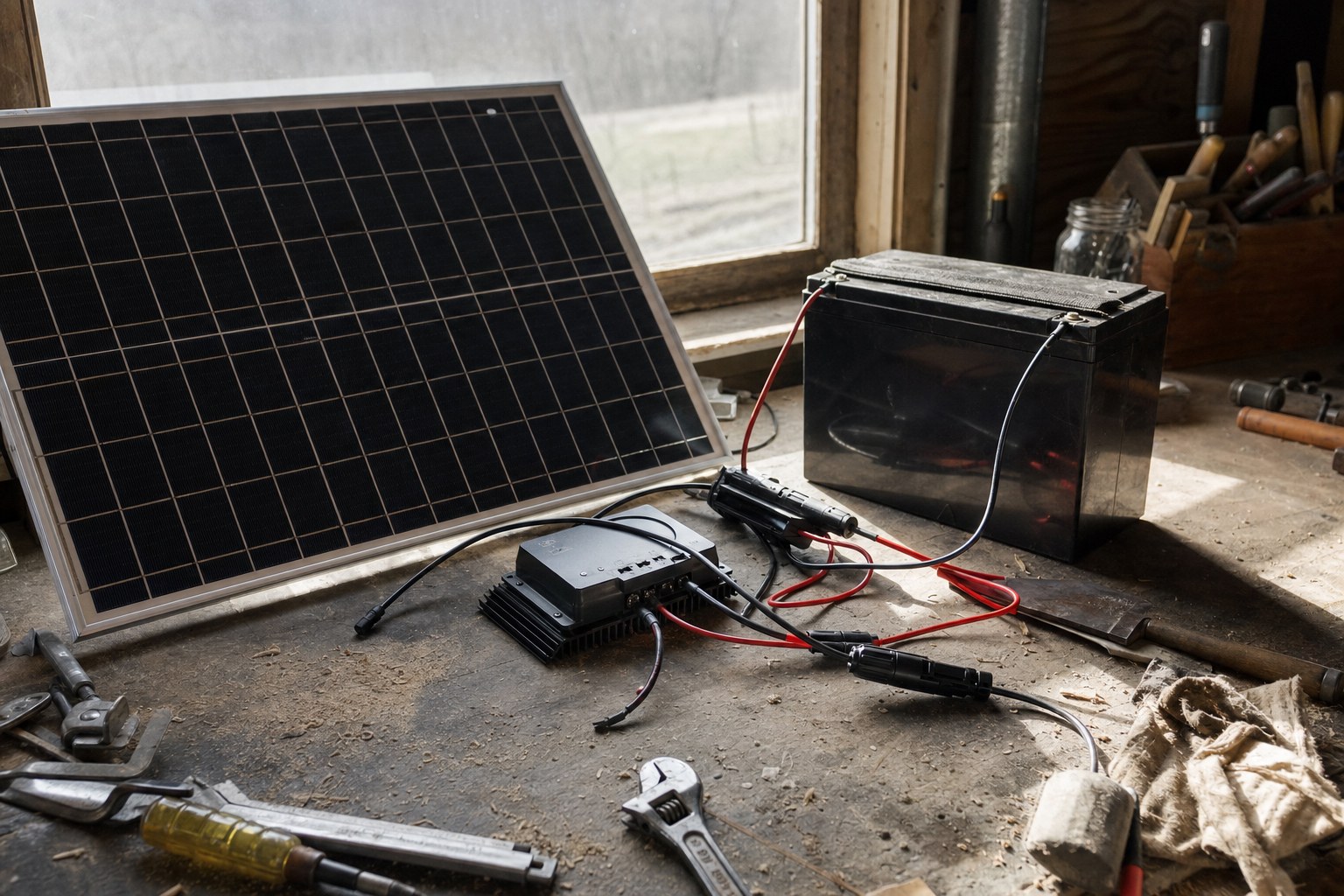
- ◈#4 Eco-Worthy 200W Complete, $640 sticker against $775 real. The DIY budget entry. The receipt below explains the spread.
- ◈#5 Bluetti RV5 Power Hub, $1,299. 5,120Wh at $0.25/Wh behind a 5,000W inverter, the all-day ceiling.
Every kit name opens its full audit. For the entire shed-rated pool, browse best solar kits for a shed or run a side-by-side compare.
#1 · Best value
SOLIX C1000 Gen2 1,024Wh/2,000W + Main Unit OnlyStart here if the shed job is lights, electronics, and a tool now and then. The 2,000W pure-sine inverter handles real shop tools, the 1,024Wh LiFePO4 battery carries work lights, a laptop, and intermittent drilling across a work day, and 600W of solar input puts the charge back. Nothing else has to go in the cart: $449, $0 in hidden parts, $0.44/Wh. That combination makes it the cheapest complete, surge-ready build in the cohort.
#2 · More storage per dollar
$0.49/WhStorage is what this one buys. 1,440Wh of LiFePO4, roughly 40% more battery than the Anker, sitting behind an 1,800W pure-sine inverter for $699 with no hidden parts. The cost per watt-hour ($0.49/Wh) lands a hair above the Anker's $0.44/Wh, which is a small premium for the extra bank. Reach for it when a beer fridge cycles in the shed around the clock, or tool sessions run in hours rather than minutes.
#3 · Workshop-grade inverter
$0.44/WhWhen the "workshop" half of the question is literal, this is the answer. A table saw or a pancake compressor needs surge headroom, and the 2,400W pure-sine inverter supplies it, with 2,048Wh of battery behind it to cover a full shop session. $0.44/Wh is strong value at that inverter class. On timing: $899 today sits within roughly 6% of the 6-month low, close enough to lock in.
#4 · DIY budget — read the receipt
$0.61/WhThe cheapest way into a 12V hard-wired shed, and the clearest lesson in what a sticker hides. The listing says $640. The real build cost is $775, because mounting hardware comes back "Not included" and no battery monitor ships with it (the data names a Victron SmartShunt as the gap, about +$135). The 1,280Wh of LiFePO4 is genuine. The $640 is not, and that arithmetic is precisely how a $449 integrated unit ends up cheaper.
#5 · Big-bank ceiling pick
$0.25/WhThis is the "fridge plus tools, all day" ceiling under $1,500. 5,120Wh of LiFePO4 works out to the cheapest real storage in the cohort at $0.25/Wh, and the 5,000W pure-sine inverter is the most surge headroom on the shortlist. Panels, mounting, and monitoring are already in the box ($0 hidden). Pricing has been flat for six months at $1,299, so there is no dip worth waiting on. Nothing else here delivers this much battery, or this much inverter, per dollar.
The receipt: what your money actually buys
Start with the receipt. The top three picks are integrated power-station bundles, which puts their missing-parts cost at $0: nothing else has to be bought to power a shed. For this class the receipt worth reading isn't hidden hardware, it's runtime, meaning hours of lights, tools, and a fridge before the battery wants sun again. The hidden cost surfaces on the DIY "kits" instead. The Eco-Worthy 200W advertises $640 but builds to $775 once the mounting and the battery monitor it omits go in. That $135 gap is the entire reason a $449 integrated unit outruns a $640 kit on price.
| Kit | Listed | Storage | Fridge runtime, no sun | Days autonomy |
|---|---|---|---|---|
| SOLIX C1000 Gen2 1,024Wh/2,000W + Main Unit Only | $449 | 1.0 kWh | ~8 hrs | ~0.3 |
| Premium 150 AC180P + Main Unit Only | $699 | 1.4 kWh | ~11 hrs | ~0.5 |
| DELTA 2 Max 2048Wh + 400W Panel | $899 | 2.0 kWh | ~16 hrs | ~0.7 |
| 200W 12V Complete Kit — 100Ah Battery + 1100W Inverter | $640 | 1.3 kWh | ~10 hrs | ~0.4 |
| RV5 - /5,000W + Unit Only | $1,299 | 5.1 kWh | ~39 hrs | ~1.6 |
Runtime ≈ usable storage ÷ ~130W effective fridge draw (running watts + inverter overhead, before summer derate). A real receipt for integrated stations is hours of runtime, not missing parts.
The receipt and the gap: sticker price vs real build cost
Panel, battery, inverter, and cables all ship inside the box on the top three picks, because they are integrated power stations. The gap to actually power a shed is nothing, and that $0 of hidden cost is why a $449 unit undercuts a $640 "kit."
The DIY end of the shortlist runs the opposite way. The Eco-Worthy 200W advertises $640 but builds to $775, because mounting hardware comes back "Not included" and no battery monitor is in the box (a Victron SmartShunt, roughly +$135). Going DIY means budgeting that gap list on day one: Z-bracket roof or wall mounts (about $25–40), a battery monitor, plus a correctly rated breaker or fuse for anything hard-wired into shed lights. "Main unit only" listings deserve the same suspicion. A per-watt-hour price that looks too good usually means no panel shipped at all.
The full arithmetic is in how real build cost is calculated and our methodology.
Buy now or wait?
| Kit | Current | 6-mo low | Above low | Signal |
|---|---|---|---|---|
| SOLIX C1000 Gen2 1,024Wh/2,000W + Main Unit Only | $449 | $399 | +13% | Fair price |
| Premium 150 AC180P + Main Unit Only | $699 | $699 | at low | Buy now |
| DELTA 2 Max 2048Wh + 400W Panel | $899 | $849 | +6% | Fair price |
| 200W 12V Complete Kit — 100Ah Battery + 1100W Inverter | $640 | $400 | +60% | Wait |
| RV5 - /5,000W + Unit Only | $1,299 | $1,299 | at low | Buy now |
6-month price history — SOLIX C1000 Gen2 1,024Wh/2,000W + Main Unit Only
Price History
▼ 2% BELOW AVGLast observed at retailer: Jun 20, 2026. Days between observations carry the most recent known price — not new data.
Why these won — and why others failed
Why these won
- ✓Every podium kit runs LiFePO4 and pure-sine behind an inverter of 2,000W or better, sized to clear real shop-tool surges rather than just the running watts.
- ✓The top three are integrated stations carrying $0 in hidden parts, which makes a $449 unit an honest $449 working system with nothing left to buy.
- ✓All five are priced and ranked from live data on real build cost and cost-per-watt-hour, spanning the $449 floor to the $0.25/Wh storage ceiling.
Why others failed
- ✕A $300 pancake compressor and a sub-2,000W kit are a bad pairing: restart inrush past 3,000W trips small inverters mid-task.
- ✕Modified-sine "kits" leave compressors and shop fridges buzzing, running hot, and failing early, so the shortlist stayed pure-sine only.
- ✕Panel-only and "main unit only" listings post cheap per-watt-hour numbers while shipping with no battery or no panel, meaning a second payment before the shed has power.
Frequently asked
Can a compact solar kit run shop tools?
Within limits, yes. The 2,000W pure-sine inverter on the $449 Anker SOLIX C1000 handles a drill, a circular saw, lights, and a laptop. Where it stops is a 1,500W air compressor, whose restart spike passes 3,000W. That job wants a 2,400W kit such as the EcoFlow DELTA 2 Max, or a soft-start on the compressor.
Why is the "kit" more expensive than the advertised price?
Because plenty of DIY kits quote a sticker with the mounting hardware and battery monitor left out of it. The Eco-Worthy 200W lists at $640 and reaches $775 in real build cost once the omitted parts go in. Integrated power stations (Anker, Bluetti, EcoFlow) carry $0 hidden cost: mounting is N/A and monitoring is already built in.
LiFePO4 or AGM for a shed?
LiFePO4, on cycle-life math. It delivers roughly twice the cycles of AGM at a comparable price, holds its charge for months between visits, and takes deep daily discharge without damage. That is why every pick here is LiFePO4 and why AGM kits like the WindyNation 400W never made the shortlist.
Methodology, freshness & corrections
Cohort: complete, shed-rated, and under $1,500 on real build cost (panel + battery + inverter all in) → 26 kits clear the bar; the podium is drawn from the 5 clean, complete primaries left after dropping variants and incomplete listings. Prices auto-refresh from multiple retailers every 6 hours; this page last refreshed 2026-06-19.
See how real build cost is calculated, our methodology, data sources, and editorial policy. Found an error? Tell us — we correct fast.
Different use case? See the best off-grid solar generator for every load.