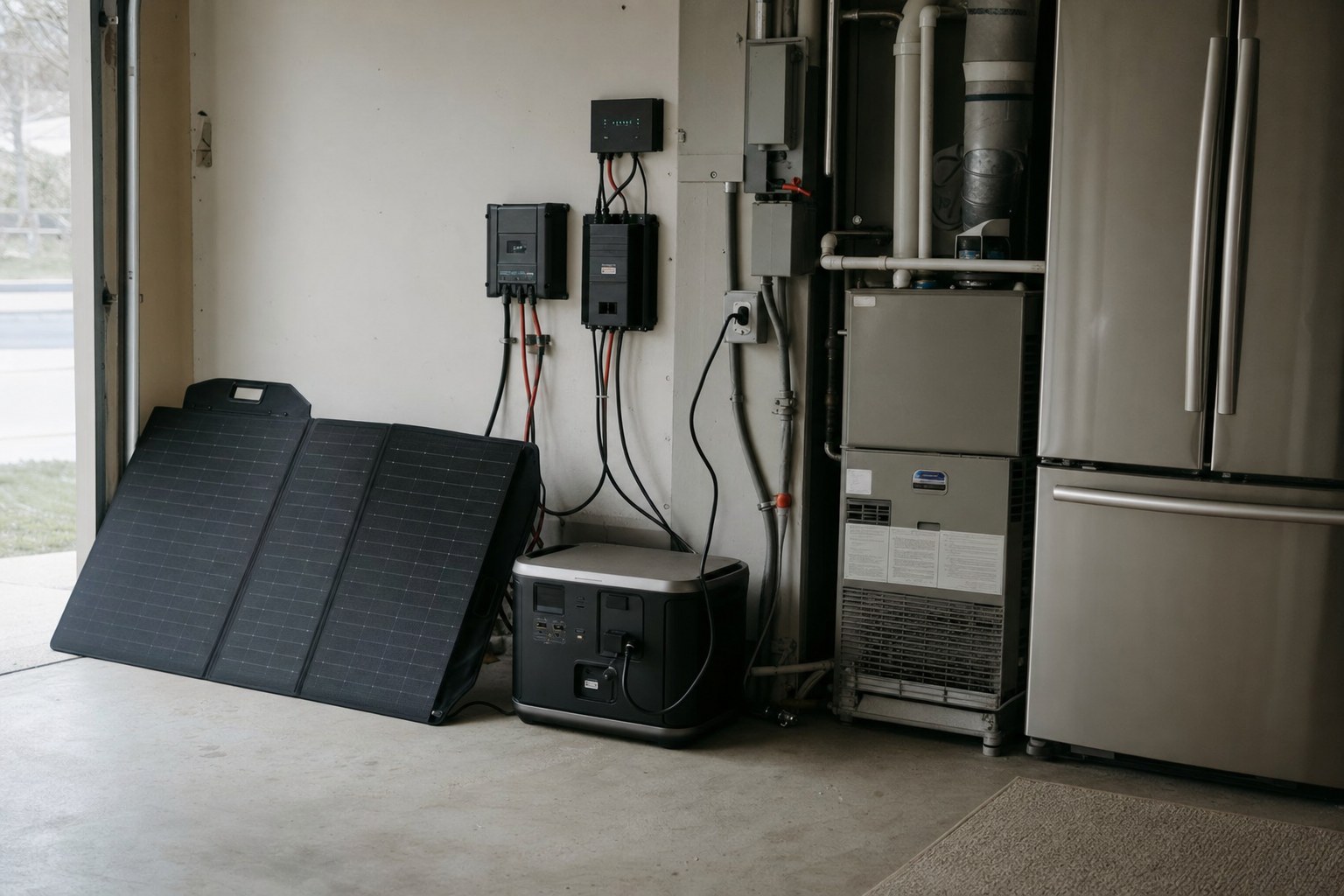
Portable Power Stations for Home Backup: The 108-Kit Screen for Fridge, Furnace Fan, and Sump Pump
The short answer
Running watts are the wrong number to shop on. A fridge and a sump pump each pull 2–5× their steady draw at the instant they start, and the storm that floods a basement is the same storm that leaves nothing for the panels to harvest. That puts the bar at a genuine pure-sine inverter near 3,000W and roughly 2.7 kWh of LiFePO4, enough to cover two days. We ran 108 all-in-one power stations against that load profile. Five clear both bars, ranked below on measured specs and true cost.
Load profile: three motors that lie on their nameplates
Three loads decide a home outage, and every one of them understates itself on the label. A fridge sits at around ~150W while running, surges 3–5× to spin its compressor up, and never truly stops, cycling around the clock. A furnace blower is an inductive ~½ HP motor: ~400–800W steady, with 2–3× inrush each time the burner calls for heat. A sump pump draws ~800–1,050W with ~2× inrush, and the days it earns its keep are multi-day storms, precisely the days the panels harvest nothing.
Stack the three and the daily total lands near 2–4 kWh depending on how hard they cycle. That is why ~2.7 kWh of LiFePO4 reads as a floor rather than a target. The running-watt figures look harmless. Surge and the all-day total are what the purchase actually turns on.
Run *your* own loads through the load calculator before buying. And if a gas generator is still on the table, that fork is worth settling first.
The verdict: surge and autonomy decide it, not running watts
The verdict block below fires two field failure notes that plain watt arithmetic never surfaces: the fridge-and-freezer note (compressors surge hard and never switch off) and the sump-pump note (a critical motor that surges, wanted exactly when the sun is gone). Between them they set two hard gates:
- ◈Surge gate — a genuine pure-sine inverter around 3,000W. Modified-sine leaves motors buzzing, running hot, and failing early, while anything well under 3,000W trips the moment two motors start together.
- ◈Autonomy gate — ~2.7 kWh of LiFePO4 at minimum, sized across 2–3 days, since the flood storm and the no-sun storm are the same storm.
Two popular options die right there: anything modified-sine, and anything below ~3,000W / ~2.7 kWh. The podium is screened to clear both. For the reasoning behind pure-sine and LiFePO4, read how we calculate real build cost and our methodology.
Fridges and freezers surge hard and never turn off
Compressors pull 3–5× their running watts to start, and because they cycle 24/7 they quietly dominate your daily watt-hours — especially in summer heat. Modified-sine power makes them buzz and shortens compressor life.
Fix: Pure-sine inverter, and size the battery for the all-day cycling load. In hot climates add ~30% to the fridge's estimated draw.
A sump pump is critical and surges — don't run it on the edge
Motor inrush roughly doubles the running watts, and the times you need it most (storms) are exactly when there's no sun to recharge.
Fix: Give it real inverter surge headroom and 2–3 days of battery autonomy so a multi-day storm doesn't outlast the bank.
The 5 kits that clear both gates
LiFePO4 has effectively won this category, and the cohort says so out loud: 103 of 108 run it. All five picks below are LiFePO4 pure-sine integrated stations, ordered by how cleanly they pass the surge and autonomy gates. The one buy link on this page rides on the #1 Bluetti AC300, whose 2,764Wh and true 3,000W inverter carry the fridge, furnace fan, and sump pump with margin left over.
Every kit name opens its full audit over on portable power, and any two can be run side by side on compare. If one station is not enough, whole-home systems are a separate class. Start from portable power and scale up from there.
#1 · Best overall
AC300 + B300K + 350W Panel BundleTop of the podium because nothing on this page manages to load it up. The true 3,000W pure-sine inverter takes the fridge, furnace-blower, and sump-pump inrush in stride, and 2,764Wh of LiFePO4 covers the cycling load across a long outage. It is modular as well, so a B300 expansion battery bolts on later for multi-day storm autonomy. The premium shows up at $0.83/Wh. What that money buys is surge headroom plus room to grow.
#2 · Longest runtime
$0.48/WhThe runtime value play among the complete, panel-included units. 4,085Wh at $0.48/Wh is the deepest raw storage of the three complete picks, and the 3,000W pure-sine inverter clears the surge gate. Pricing currently sits at a 6-month low, which reads as a buy-now signal when the goal is proven runtime in a unit that ships ready to recharge. (Pick #5 stores more watt-hours per dollar, but no panels come in its box.)
#3 · Stacked-surge pick
$0.47/WhReach for this one when the well, the sump, and the furnace blower can all start on the same second. Its 3,600W inverter is the biggest of the three complete picks, and at $4.25/W the cheapest watt among them. The 3,600Wh LiFePO4 bank holds the fridge cold while the inverter keeps overhead in reserve for a simultaneous motor inrush.
#4 · Best expansion path
$0.49/WhBuilt for a storm-autonomy target that keeps moving: a 3,600W inverter over a 3,072Wh base that stacks toward 11kWh. $1,499 makes it the cheapest 3,600W entry on the podium ($0.49/Wh). The catch is the configuration. This is the main-unit-only version, so no panels ship with it, and solar gets added separately if recharging off-grid between storms matters.
#5 · Budget pick / most Wh per dollar
$0.25/WhMost backup capacity per dollar on this podium: 5.12kWh of LiFePO4 at $0.25/Wh, the lowest cost-per-watt-hour on the page. A 12V budget build stops at the fridge and the furnace fan. The 5,000W pure-sine inverter here also absorbs a sump pump's start-up surge under storm load. The $1,299 sticker ($0 hidden) has not moved in six months, so buy it whenever the capacity is what you are after.
The receipt: what your money actually buys
The honest math for this class starts and ends in one place: the receipt is the price. Missing-parts cost across this cohort is $0, because the inverter, battery, charge controller, and outlets already live inside the box, so true cost lands exactly on the listed price. Nothing hides in the BOM the way it does with DIY component kits (where an advertised price can conceal $300–$1,000 of parts still to buy). The failure mode here is sizing: buying less inverter or less battery than the loads that actually decide an outage. So the receipt worth reading for this class is runtime. Your dollars buy fridge-hours and surge headroom, not a parts shortfall.
| Kit | Listed | Storage | Fridge runtime, no sun | Days autonomy |
|---|---|---|---|---|
| AC300 + B300K + 350W Panel Bundle | $2,299 | 2.8 kWh | ~16 hrs | ~0.7 |
| 2000 Plus + PackPlus E2000 Battery + 2x 200W Panels (4085Wh) | $1,979 | 4.1 kWh | ~23 hrs | ~1.0 |
| DELTA Pro + 400W Panel | $1,699 | 3.6 kWh | ~21 hrs | ~0.9 |
| DELTA 3 Ultra Plus – 3,072Wh / 3,600W + Smart Output Priority Tech + Main… | $1,499 | 3.1 kWh | ~18 hrs | ~0.7 |
| RV5 - /5,000W + Unit Only | $1,299 | 5.1 kWh | ~29 hrs | ~1.2 |
Runtime ≈ usable storage ÷ ~175W effective fridge draw (running watts + inverter overhead, before summer derate). A real receipt for integrated stations is hours of runtime, not missing parts.
What the receipt actually leaves you to buy
With all-in-one stations, listed price = true cost. Missing-parts cost is $0 across this whole cohort, unlike DIY kits where an advertised price can bury $300–$1,000 of BOM. The full method sits in how real build cost is calculated.
So the gap is not hardware. It is operational add-ons, and each one is optional:
- ◈A transfer switch or interlock, needed only when the furnace blower gets hard-wired into the panel instead of plugged in.
- ◈An expansion battery (Bluetti B300, or Jackery/Anker stackable packs) for 2–3 days of storm autonomy.
- ◈A heavy-gauge extension or inlet to reach the loads without dropping voltage.
None of that is a pricing trick. It is the line between riding out one night and riding out a three-day storm. Full receipts sit side by side on compare, and every price is traced in our data sources.
Buy now or wait?
| Kit | Current | 6-mo low | Above low | Signal |
|---|---|---|---|---|
| AC300 + B300K + 350W Panel Bundle | $2,299 | $2,299 | at low | Buy now |
| 2000 Plus + PackPlus E2000 Battery + 2x 200W Panels (4085Wh) | $1,979 | $1,979 | at low | Buy now |
| DELTA Pro + 400W Panel | $1,699 | $1,399 | +21% | Fair price |
| DELTA 3 Ultra Plus – 3,072Wh / 3,600W + Smart Output Priority Tech + Main… | $1,499 | $1,499 | at low | Buy now |
| RV5 - /5,000W + Unit Only | $1,299 | $1,299 | at low | Buy now |
6-month price history — AC300 + B300K + 350W Panel Bundle
Price History
▼ 14% BELOW AVGLast observed at retailer: Apr 28, 2026. Days between observations carry the most recent known price — not new data.
Why these won — and why others failed
Why these won
- ✓Every kit on the podium passes the surge gate on a genuine pure-sine inverter at or near 3,000W, which is what it takes to absorb a fridge, furnace-blower, and sump-pump inrush landing together.
- ✓All five run LiFePO4 and hold the ~2.7 kWh autonomy floor, so the all-day cycling load survives a multi-day no-sun storm rather than draining before morning.
- ✓Specs and prices come from live data and rank on cost-per-watt-hour, not from a single-brand roundup pointing at its own box by affiliate payout.
Why others failed
- ✕Inverters well under 3,000W trip once a furnace blower or sump pump inrush lands on top of a fridge compressor start. The running watts read fine right up to the instant the motor kicks.
- ✕Modified-sine units leave compressors and blower motors buzzing, hot, and short-lived, which disqualifies them for hardware that has to run 24/7 through an outage.
- ✕Half the wider cohort is simply too small: the median sits at ~1,440Wh, short of a night with the fridge, and main-unit-only listings arrive without a panel, so nothing recharges off-grid between storms.
Frequently asked
How big does a power station need to be for a fridge?
One refrigerator needs a pure-sine inverter of at least 2,000W to get past the compressor's 3–5× startup surge, plus roughly 2 kWh of LiFePO4 for about a day of cycling with no sun. Once a furnace fan and a sump pump share the same station, the bar moves to a ~3,000W inverter and ~2.7 kWh or better.
Can a portable power station run a furnace blower?
It can, provided it is pure-sine and carries the surge headroom. A furnace blower is a ~½ HP inductive motor pulling 400–800W while running and spiking 2–3× at startup, which a 3,000W pure-sine inverter absorbs comfortably. Modified-sine units run hot and can damage the motor, so they are off the table.
Will a portable power station keep a sump pump running through a storm?
Yes, as long as the sizing targets the worst case. A sump pump pulls ~800–1,050W running with ~2× inrush, and the days it matters are multi-day storms with no sun to recharge, so the requirement is real inverter surge headroom plus 2–3 days of LiFePO4 autonomy. Clearing that autonomy gate is exactly what our podium is screened for.
Methodology, freshness & corrections
Cohort: all-in-one stations (storage > 0, inverter > 0, panels < 600W): 108 screened, narrowed to the 47 that fit home backup, LiFePO4 with a 1,500–4,000W inverter and 1–6 kWh of storage → 108 kits clear the bar; the podium is drawn from the 47 clean, complete primaries left after dropping variants and incomplete listings. Prices auto-refresh from multiple retailers every 6 hours; this page last refreshed 2026-06-19.
See how real build cost is calculated, our methodology, data sources, and editorial policy. Found an error? Tell us — we correct fast.
Different use case? See the best off-grid solar generator for every load.