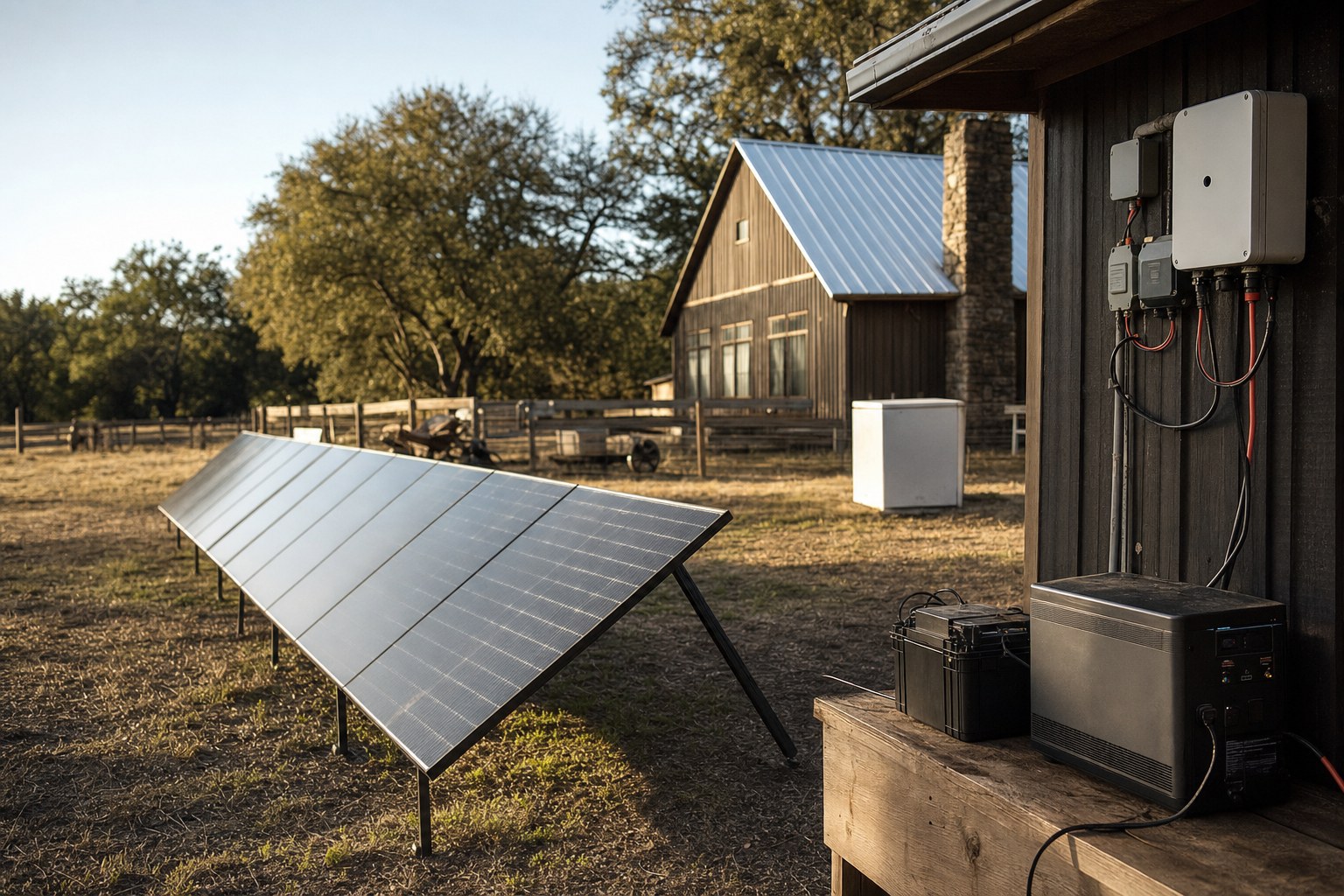
Off-Grid Solar System for a Homestead: What the Well, the Freezer, and Winter Actually Demand
The short answer
Three loads decide a homestead system, and they arrive together: the well pump's 2,000–3,500W startup surge, the chest freezer's around-the-clock compressor cycle, and winter, when the shortest days carry the heaviest draw. The sizing follows from that. A 120/240V split-phase inverter for the well, real surge headroom for the pump and freezer starting at once, and 2–3 days of storage autonomy for the overcast stretch, because a sunny-day average is not what breaks these systems. We started with the 70 homestead-rated LiFePO4 systems holding 5kWh or more of storage, 65 of them 240V-capable, and ranked the 5 that carry an entire property by real value per watt-hour.
Three loads, arriving together, that break undersized systems
A homestead is not a single appliance. It is a stack of the hardest off-grid loads running at once, and undersized systems fail on the combination rather than on any one item.
- ◈The well pump pulls a 2,000–3,500W locked-rotor surge every time it starts (a ½ HP submersible runs near ~750W and spikes 3–5× that). A 240V deep submersible wants a 120/240V split-phase inverter, not a 120V unit. The full breakdown lives in the well pump sizing guide.
- ◈The freezer (and fridge) surge 3–5× on their compressors as well, and they cycle 24/7, quietly taking the largest share of daily watt-hours. A hot summer outbuilding makes that worse.
- ◈Winter. The days demanding the most power (heat, longer lighting, a pump working a cold line) hand back the least sun. That mismatch is why a homestead sizes on autonomy, meaning days of stored energy, instead of a sunny-day average.
Our load calculator and verdict engine model all three at once. Size your own stack in the load calculator.
The verdict: size for surge, split-phase, and days of reserve
Our failure engine fires three separate blockers against a homestead stack:
> Well pump: locked-rotor inrush trips inverters sized to the running watts. Use a low-frequency 3,000W+ or split-phase inverter, pure sine only. > Fridge/freezer: compressors surge 3–5× and run around the clock. Add roughly 30% in heat. > Resistive heat: space and water heat are brutal, near-constant draws, and the quickest way to flatten a bank in winter.
Put those three together and the requirement writes itself: a 120/240V split-phase inverter (65 of the 70 kits here qualify), real surge headroom for the pump-and-freezer overlap, and 2–3 days of storage to cover the winter cloudy stretch. A "3,000W" 120V power station that looks perfectly adequate in July will not run a 240V well in January, which is exactly why this cohort filters the way it does. See how the methodology works and how real build cost is calculated.
A submersible well pump can trip an inverter that's sized for its running watts
A ½ HP pump runs at ~750W but its motor draws 3–5× that for a split second on every start (locked-rotor inrush) — a 2,000–3,500W spike. Plenty of 2,000W inverters shut down on it even though the running number looks fine.
Fix: Use a low-frequency (transformer-based) inverter rated 3,000W+, or fit the pump with a soft starter / CSCR control box. Pure sine only.
Electric resistance heat is the #1 way off-grid systems get blown out
A 1,500W heater run a few hours a day can need more panel and battery than the rest of your loads combined. Solar almost never pencils out for primary electric heat.
Fix: Heat with propane or wood and keep the electric heater as occasional spot backup only. If you must, budget a much larger array + bank specifically for it.
Fridges and freezers surge hard and never turn off
Compressors pull 3–5× their running watts to start, and because they cycle 24/7 they quietly dominate your daily watt-hours — especially in summer heat. Modified-sine power makes them buzz and shortens compressor life.
Fix: Pure-sine inverter, and size the battery for the all-day cycling load. In hot climates add ~30% to the fridge's estimated draw.
The 5 systems that carry an entire property
All five run LiFePO4 and pure sine, rated for homestead duty, and sized for real winter autonomy with one exception, the entry Anker's smaller bank. Ranking here goes on value per watt-hour at homestead scale. The $0.51/Wh EG4-based value pick takes the top spot, the 32,000Wh Elite holds the deepest winter reserve, and the $4,797 Anker is the least expensive route onto true 240V. The single buy link sits on the #1 value pick. Every kit name opens its full audit, with real build cost and 6-month price history.
Match the bank to your winter rather than your July. A mild-climate homestead with a shallow pump is well covered by the value or surge picks, while a cold-climate property running heat and a deep submersible should step up into the 28–32kWh tier. Run any head-to-head compare or browse the full whole-home pool.
#1 · Best value, native 240V
PLUS 4.4kW — EG4 6000XP, 14.3kWh LiFePO4Where most homesteads should start. The EG4 6000XP underneath it is a 6,000W 120/240V split-phase inverter, so a deep well pump runs off it directly with no hub in between. Behind that sits 14,300Wh of LiFePO4 at $0.51/Wh, the lowest cost-per-watt-hour on this board. That bank covers the well, the freezer, and lights across a two-to-three-day cloudy run, at a number a working property can defend. If the well is 240V and hardwired, this is the first stop.
#2 · No-compromise winter autonomy
$0.54/WhThe largest bank on the page at 32,000Wh, feeding a 19,500W inverter, with a premium closed-loop battery that communicates with the inverter for tighter charge management. $0.54/Wh buys the version of this decision where winter reserve is not up for debate: a property where a week of overcast still cannot be allowed to thaw the freezer or silence the pump. Whole-property, run-everything capacity.
#3 · Least expensive route to true 240V
$0.62/WhThe cheapest door into a homestead-grade 240V system. Two Anker F3800 units on a Double Voltage Hub produce real split-phase 240V along with 7,680Wh, plug-and-play, with no electrician needed for the unit itself. $4,797 clears the well-pump inrush, carries a freezer, and leaves room to expand later. The catch is the bank size. This is a starter homestead or a critical-loads backup, not full winter autonomy.
#4 · All-in-one with surge to spare
$0.60/Wh7,500W of continuous inverter leaves generous surge headroom, enough to absorb a well pump's locked-rotor spike and a freezer's compressor kick in the same instant without complaint. 10,000Wh at $0.60/Wh makes this a capable all-in-one for a mid-size homestead whose problem is stacked startups rather than multi-day autonomy.
#5 · Big-bank value for a serious property
$0.55/Wh28,600Wh behind a 16,000W split-phase inverter at $0.55/Wh, landing close to the no-compromise pick's capacity for less money. Value gets strong here once the requirement crosses into true whole-homestead storage: well, freezer, winter heat, and daily loads with days held in reserve. Take it over the Elite when the bank matters more than the closed-loop premium.
The receipt: what your money actually buys
These systems arrive component-complete, with panels, batteries, inverter, and controller all in the box, so the required missing-parts cost is $0. What a homestead actually spends past the kit is installation. A 120/240V whole-property system means a manual transfer switch or main-panel interlock, rated cable, and, for a hardwired well, a licensed electrician plus a likely permit (budget $500–$2,000 installed, depending on the panel and the run). The kit price is honest and complete. The tie-in to the house and the well is the line item nobody itemizes. The receipt below measures days of autonomy, not buried hardware.
| Kit | Listed | Storage | Fridge runtime, no sun | Days autonomy |
|---|---|---|---|---|
| PLUS 4.4kW — EG4 6000XP, 14.3kWh LiFePO4 | $7,309 | 14.3 kWh | ~29 hrs | ~1.2 |
| PLUS 7.92kW — Sol-Ark 15K, 32kWh LiFePO4 | $17,389 | 32.0 kWh | ~64 hrs | ~2.7 |
| F3800 PLUS Dual Kits - 7,680Wh / 6,000W/6,000W | $4,797 | 7.7 kWh | ~15 hrs | ~0.6 |
| PRO 3.2kW — Rich Solar 6K, 10kWh LiFePO4 | $5,989 | 10.0 kWh | ~20 hrs | ~0.8 |
| MAX 10.6kW — EG4 FlexBoss21, 28.6kWh LiFePO4 | $15,789 | 28.6 kWh | ~57 hrs | ~2.4 |
Runtime ≈ usable storage ÷ ~500W effective fridge draw (running watts + inverter overhead, before summer derate). A real receipt for integrated stations is hours of runtime, not missing parts.
Still on your list: tying the system into the house and the well
The kits themselves are complete. Connecting one to a homestead is the part product pages leave out.
- ◈240V well / whole-house — confirm the inverter does 120/240V split-phase (all five here can, the two EG4 WallMount kits natively), then add a manual transfer switch or main-panel interlock plus rated cable. A hardwired well brings in a licensed electrician and a likely permit, so budget $500–$2,000 installed.
- ◈Freezer placement — keep chest freezers out of hot outbuildings, where the compressor works ~30% harder. Every watt-hour not spent cooling a hot shed is autonomy you keep.
- ◈Winter margin — if any of your heat is resistive electric, size the bank against the worst week you actually get, or plan a generator or wood backup for the deepest cold. The inverters and power conversion explainer walks through the split-phase wiring.
Re-run the numbers with your real pump, freezer, and heat loads in the calculator, and check data sources for where kit prices come from.
Buy now or wait?
| Kit | Current | 6-mo low | Above low | Signal |
|---|---|---|---|---|
| PLUS 4.4kW — EG4 6000XP, 14.3kWh LiFePO4 | $7,309 | $6,549 | +12% | Wait |
| PLUS 7.92kW — Sol-Ark 15K, 32kWh LiFePO4 | $17,389 | $17,389 | at low | Buy now |
| F3800 PLUS Dual Kits - 7,680Wh / 6,000W/6,000W | $4,797 | $4,797 | at low | Buy now |
| PRO 3.2kW — Rich Solar 6K, 10kWh LiFePO4 | $5,989 | $5,989 | at low | Buy now |
| MAX 10.6kW — EG4 FlexBoss21, 28.6kWh LiFePO4 | $15,789 | $15,489 | +2% | Buy now |
6-month price history — PLUS 4.4kW — EG4 6000XP, 14.3kWh LiFePO4
Price History
— AT AVERAGELast observed at retailer: Jun 20, 2026. Days between observations carry the most recent known price — not new data.
Why these won — and why others failed
Why these won
- ✓Every pick is pure-sine LiFePO4 and, apart from the entry unit, sized for 2–3 days of winter autonomy. Across the 70-kit cohort, 65 handle 120/240V split-phase, so they drive a deep well directly.
- ✓The podium covers the actual homestead range, from the least expensive true-240V entry to a 32kWh no-compromise bank, so the recommendation fits the property instead of a one-size number.
- ✓Specs, prices, and 6-month price trends all come from live data, and the verdict stacks three sourced failure notes (well, freezer, resistive heat) that no single-brand blog can assemble.
Why others failed
- ✕A 120V-only power station cannot run a 240V submersible at all, whatever its watt count claims. It is the most common homestead mismatch there is.
- ✕Anything sized to a sunny-day average goes flat during the first multi-day winter overcast, precisely when the well and the heat are working hardest.
- ✕We cut sub-5kWh units, too little for whole-property autonomy, along with mis-parsed inverter-only and fused-kW records that cannot carry the stack.
Frequently asked
How big a solar system does an off-grid homestead need?
Three requirements have to be met at the same time: a 120/240V split-phase inverter for the well (2,000–3,500W of surge headroom), enough continuous inverter capacity for the freezer and pump to start together, and 2–3 days of battery autonomy for winter overcast. In practice that lands on a 10–32kWh LiFePO4 system behind a 6,000W+ split-phase inverter, which is the range the picks on this page cover.
Can one off-grid solar system run a well pump and a freezer at the same time?
It can, provided the inverter carries surge headroom for both to start at once and outputs 120/240V split-phase for a deep submersible. Startup pulls 2,000–3,500W on the well, and a freezer compressor surges 3–5×. The picks here run 6,000–19,500W continuous for that exact reason: overlapping startups should not trip the system.
How much battery does a homestead need for winter?
Enough to cover your longest realistic cloudy stretch, not the average one. Winter hands over the least sun exactly when heat, lighting, and a hard-working pump ask for the most, so homesteads size to 2–3 days of autonomy. For a cold-climate property running a freezer and any resistive heat, that commonly means 20–32kWh.
Methodology, freshness & corrections
Cohort: LiFePO4 systems rated for homestead duty at 5 kWh+ of storage, 65 of the 70 capable of 120/240V split-phase → 70 kits clear the bar; the podium is drawn from the 65 clean, complete primaries left after dropping variants and incomplete listings. Prices auto-refresh from multiple retailers every 6 hours; this page last refreshed 2026-07-03.
See how real build cost is calculated, our methodology, data sources, and editorial policy. Found an error? Tell us — we correct fast.
Different use case? See the best off-grid solar generator for every load.