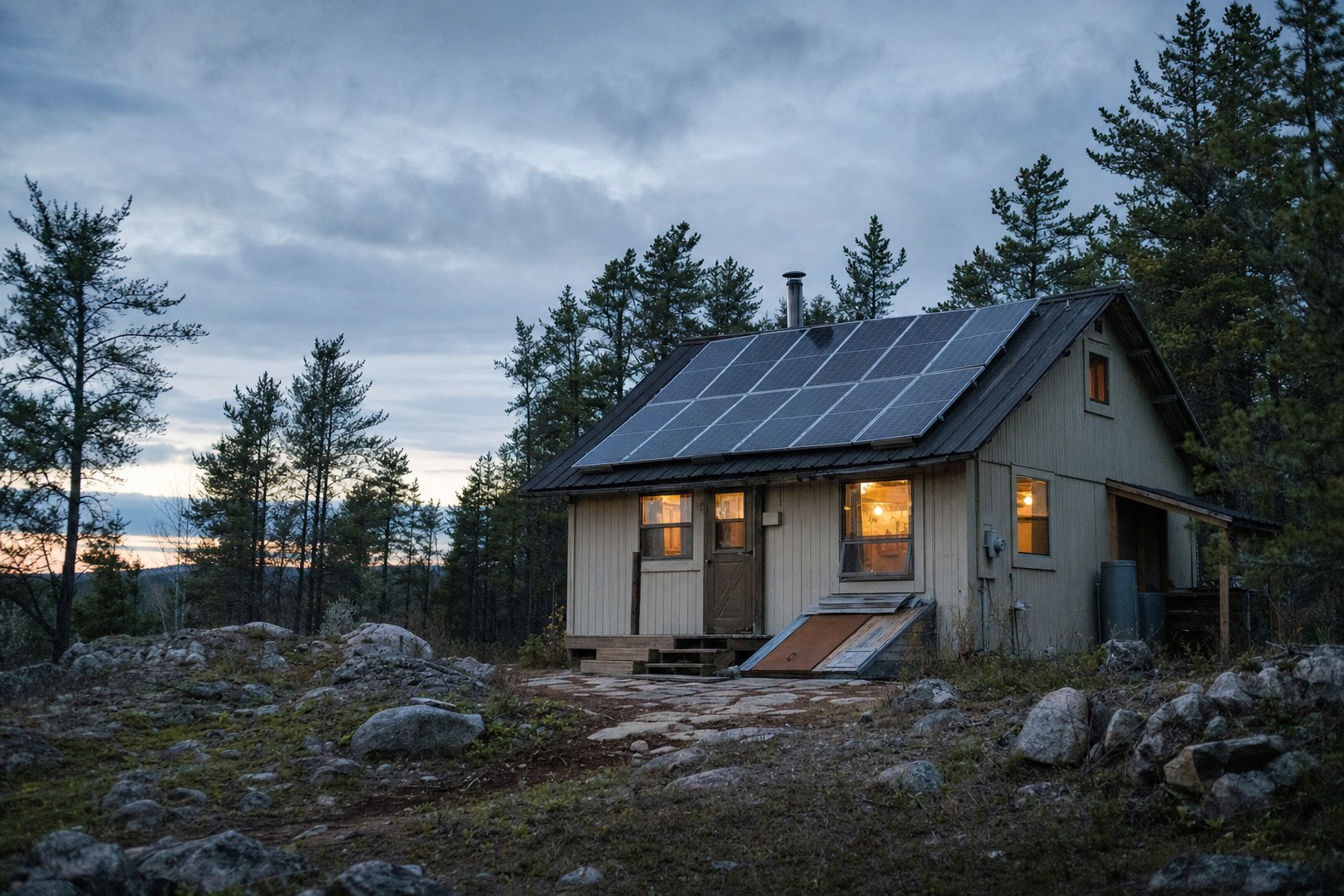
Off-Grid Solar Kits for a Cabin: What 56 Kits Cost Once the Parts List Is Honest
The short answer
Cabin kits get picked on panel wattage. That is the wrong number. The kit that works is the one whose inverter survives a well pump's startup spike and whose battery carries a fridge that never sleeps. We screened 143 cabin-rated kits with a 2,000W+ inverter, then ranked the 56 clean, paneled primaries. The surprise runs in the buyer's favor: the best cabin kits are near-complete integrated LiFePO4 stations (missing-parts cost ~$0), so the hidden cost is not a battery. It is panel mounts, monitoring, and a soft starter for the well. The five below rank on cost-per-watt-hour, surge headroom, and a verifiable 6-month price signal.
The load profile: a cabin is a surge problem, not a panel problem
A cabin sits between an RV and a house, which is to say it is a short list of stubborn loads that punish undersized kits. Run the realistic figures: a fridge at roughly 1.2–1.5 kWh/day (add ~30% in summer), LED lighting, a Wi-Fi router or Starlink (~1.8–2.4 kWh/day on satellite), an intermittent microwave, and the budget-breaker, water pumping.
Draw a hard line between a *weekend cabin* you visit and a *full-time off-grid residence*. The second one needs 2–3 days of autonomy so a cloudy stretch does not leave you sitting in the dark. That is the assumption underneath the shortlist below.
The number that decides whether the cabin actually works is not panel watts. It is inverter surge. A ½-HP submersible well pump runs at ~750W and spikes 2,000–3,500W on every start, and plenty of "2,000W" inverters shut down on that spike while their running figure reads perfectly fine. Size your own loads with the load calculator before shopping, but understand that the surge bar is what the podium below is built around.
The verdict: three loads decide the whole build
A typical cabin load trips three failure patterns, and two of them are blockers. They do not merely trim your runtime, they shut the inverter down or wreck the budget:
- ◈The well pump (blocker). Running draw is ~750W, but inrush spikes 2,000–3,500W on every start. The fix is a low-frequency 3,000W+ pure-sine inverter or a soft starter / CSCR control box. That is why anyone on a submersible well belongs on the 3,000W–5,000W kits (the Bluetti, Jackery, and Anker), not the 2,000W ones.
- ◈The fridge that never sleeps (warning). Compressors pull 3–5× running watts to start, and they cycle around the clock, so they quietly dominate the daily watt-hour total, worst of all in summer heat. Size the battery for all-day cycling, add ~30% in hot climates, and stay pure-sine, since modified-sine cuts compressor life short. Every kit here is pure-sine.
- ◈Electric resistance heat (blocker). Nothing blows out an off-grid system faster. A 1,500W space heater running a few hours a day can demand more panel and battery than every other load combined. Heat with propane or wood, and keep electric for spot backup only.
Hence the filter on this page: ≥2,000W inverters, with 3,000W+ pure-sine recommended for anyone on a well. For why these notes are trustworthy, read how we calculate real build cost and our methodology.
A submersible well pump can trip an inverter that's sized for its running watts
A ½ HP pump runs at ~750W but its motor draws 3–5× that for a split second on every start (locked-rotor inrush) — a 2,000–3,500W spike. Plenty of 2,000W inverters shut down on it even though the running number looks fine.
Fix: Use a low-frequency (transformer-based) inverter rated 3,000W+, or fit the pump with a soft starter / CSCR control box. Pure sine only.
Fridges and freezers surge hard and never turn off
Compressors pull 3–5× their running watts to start, and because they cycle 24/7 they quietly dominate your daily watt-hours — especially in summer heat. Modified-sine power makes them buzz and shortens compressor life.
Fix: Pure-sine inverter, and size the battery for the all-day cycling load. In hot climates add ~30% to the fridge's estimated draw.
The shortlist: what survives the screen
All five picks run LiFePO4 and pure-sine, clear the 2,000W inverter floor, and carry a real 6-month price history. The podium ranks on the three things a cabin cares about (battery per dollar, surge headroom, and how close the build is to a real wired system), and the page's single buy link rides on the #1 value pick. Each kit name opens its full audit.
The split is worth naming. The Bluetti, Jackery, and Anker F3000 are integrated stations whose big inverters (3,000–5,000W) survive a well pump. The Renogy and Anker C2000 are smaller 2,000–2,400W systems, better matched to a pump-free cabin or one running a soft starter. Only the Renogy is a true wired, mountable, expandable component build (completeness 100), which is the right shape if the plan is to grow the system later. Put any two side by side, or move up to the 2,000W solar kit class.
#1 · Most battery per dollar
RV5 - /5,000W + Unit OnlyStorage per dollar peaks here: 5,120Wh of LiFePO4 at $0.25/Wh. The 5,000W inverter treats a ½-HP well pump's 2,000–3,500W startup spike as a non-event, and that spike is the single biggest reason cabin kits fail. Add 1,800W of panels to refill the bank and this becomes the pick for a fridge, a pump, and a couple of cloudy days. One item to confirm on the retailer page: the "unit only" listing reads as an integrated bundle in our data (panels, battery, inverter, controller, wiring, and mounting all flagged included), so verify the panel array before you buy. Price has held flat at $1,299 across all 37 points of its history, meaning timing buys you nothing on this one.
#2 · Best balance, and the clearest buy-now signal
$0.48/WhThe most even system on the page: 4,085Wh of LiFePO4, a 3,000W inverter with real margin over a well pump's inrush, and app monitoring in the box, all at $0.48/Wh. It carries the cohort's strongest timing signal too. It sits at $1,979 today against a $4,399 peak across 167 price observations, a steep fall, and it has never been cheaper than this. One box, a full cabin load, and a good month to buy it.
#3 · The only true wired component build
$0.74/WhEverything else on this page is a sealed box. This one itemizes a wired build: 400W of panels, a 40A MPPT controller, a 200Ah (2,560Wh) LiFePO4 battery, a 2,000W pure-sine inverter, and Bluetooth monitoring, which earns a completeness score of 100, the highest in the cohort. At $0.74/Wh it is also the priciest per watt-hour listed here, and that is the honest trade: the premium buys a mountable, expandable, rack-style system rather than a closed appliance. The 2,000W inverter sits exactly on the floor, so add a soft starter if a submersible well is in the picture. Its price history holds a single observation, and one dot is not a trend, so read list price as current.
#4 · Best value integrated station
$0.42/WhA large-inverter all-in-one caught at its 6-month low: 3,072Wh of LiFePO4, a 3,600W inverter with room to stack a microwave or a pump on top of the fridge, and 2,400W of panels, at $0.42/Wh. It lists at $1,299, the floor of its $1,199–$1,699 range over the last six months, so the price signal points to buying now. The integrated unit ships near-complete (completeness 86, missing-parts cost $0).
#5 · Lowest entry price
$0.37/WhThe way in on the smallest budget: 2.05kWh of LiFePO4 at $0.37/Wh, sitting behind a 2,400W pure-sine inverter, carrying $0 in buried parts. Nothing on the podium asks for less money than its $749, and it covers a weekend cabin's lights, fridge, and electronics. It ships as the main unit only, so panels get added to recharge between visits. Step up if you want more than a couple of cloudy days of autonomy.
The receipt: what your money actually buys
This is the part cabin solar pages leave out, and for once it breaks in the buyer's favor. Unlike most brand catalog kits, these five are near-complete (completeness 86–100, missing-parts cost $0). Nobody is nickel-and-diming you into a second $800 order for the battery. The real cabin "build cost" is not a missing component, it is the surge-and-cold tax the brand pages skip past: panel mounts (~$60–$150, omitted by several cohort kits), remote monitoring (~$30–$80, a common omission), a soft starter for a well pump (~$50–$70), and an optional transfer switch (~$150–$300) if you plan to backfeed the cabin panel. What the money actually buys in this class is autonomy: roughly two days of a real cabin load before the sun has to show up.
| Kit | Listed | Storage | Fridge runtime, no sun | Days autonomy |
|---|---|---|---|---|
| RV5 - /5,000W + Unit Only | $1,299 | 5.1 kWh | ~23 hrs | ~1.0 |
| 2000 Plus + PackPlus E2000 Battery + 2x 200W Panels (4085Wh) | $1,979 | 4.1 kWh | ~19 hrs | ~0.8 |
| 400W 12V — 200Ah LiFePO4 | $1,899 | 2.6 kWh | ~12 hrs | ~0.5 |
| SOLIX F3000 3,072Wh/3,600W + Main Unit Only | $1,299 | 3.1 kWh | ~14 hrs | ~0.6 |
| SOLIX C2000 Gen2 2,048Wh/2,400W + Main Unit Only | $749 | 2.0 kWh | ~9 hrs | ~0.4 |
Runtime ≈ usable storage ÷ ~220W effective fridge draw (running watts + inverter overhead, before summer derate). A real receipt for integrated stations is hours of runtime, not missing parts.
The receipt, and the short list of parts still to buy
In this cohort the receipt lands well: these five list for roughly what they cost to *run*, at completeness 86–100 with a missing-parts cost of $0. No second order for the battery. That is rare, because most brand catalog kits are nowhere near this complete.
"Complete enough to run" and "complete for a cabin" are still two different things. The small, real gaps the brand pages bury, with a realistic dollar band on each:
- ◈Panel mounts ($60–$150) — ground racks or roof Z-brackets, omitted by several cohort kits (confirm inclusion on each kit page).
- ◈Soft starter ($50–$70) — the blocker fix for a well pump or an AC compressor sitting on a 2,000W inverter.
- ◈Remote monitoring / shunt ($30–$80) — a common omission on budget kits.
- ◈Transfer switch + inlet ($150–$300) — only for backfeeding cabin circuits instead of plugging loads in directly.
- ◈Extra LiFePO4 — for 2–3 days of winter autonomy at a full-time residence.
Which line items a kit includes and which it omits from its own BOM is flagged on every kit page. The receipt matters here not because the gap is large, but because it is small and finally visible.
Buy now or wait?
| Kit | Current | 6-mo low | Above low | Signal |
|---|---|---|---|---|
| RV5 - /5,000W + Unit Only | $1,299 | $1,299 | at low | Buy now |
| 2000 Plus + PackPlus E2000 Battery + 2x 200W Panels (4085Wh) | $1,979 | $1,979 | at low | Buy now |
| 400W 12V — 200Ah LiFePO4 | $1,899 | $1,899 | at low | Buy now |
| SOLIX F3000 3,072Wh/3,600W + Main Unit Only | $1,299 | $1,199 | +8% | Fair price |
| SOLIX C2000 Gen2 2,048Wh/2,400W + Main Unit Only | $749 | $699 | +7% | Fair price |
6-month price history — RV5 - /5,000W + Unit Only
Price History
— AT AVERAGELast observed at retailer: Jun 20, 2026. Days between observations carry the most recent known price — not new data.
Why these won — and why others failed
Why these won
- ✓All five run LiFePO4 and pure-sine, beat the 2,000W inverter floor, and arrive with their own panels, so a cabin can genuinely recharge them off-grid.
- ✓Surge headroom is real on the three big-inverter picks (5,000W / 3,000W / 3,600W), enough for a ½-HP well pump, the load that quietly kills undersized cabin kits.
- ✓Every price, spec, and rank comes from live data measured against the other 55 cabin kits: cost-per-watt-hour plus a verifiable 6-month price history, not a brand talking up its own box.
Why others failed
- ✕AGM and generic Li-ion chemistries got cut on cycle life. A cabin wants LiFePO4 that holds charge for months and deep-cycles daily.
- ✕Anything under ~2 kWh of storage cannot carry a real cabin's fridge-plus-pump load through a cloudy stretch, so it never reached the shortlist.
- ✕Modified-sine and sub-2,000W "solar generators" trip on the well pump's startup surge and cook compressors. They read rated on paper and die in the field.
Frequently asked
What does an off-grid solar system cost for a small cabin?
Budget roughly $1,300–$2,000 for a near-complete LiFePO4 station that clears a cabin's surge loads. Our five picks list from $749 to $1,979. Since panels, battery, and inverter all ship integrated, the real build cost lands close to the sticker. Set aside another ~$100–$300 for panel mounts, monitoring, and a soft starter if there is a well involved.
How much solar power do I need for an off-grid cabin?
Size to the loads, not to a round number. A typical cabin (fridge, lights, router, intermittent pump) draws ~2–4 kWh/day. That means at least 2 kWh of LiFePO4 storage and 400W+ of panels for a weekend cabin, or 4–5 kWh with 2–3 days of autonomy for a full-time residence. Whatever the array, the inverter still has to clear the biggest surge, and a well pump needs 3,000W+.
Will a 400W solar panel run a fridge?
Over a full day it can keep one topped up, but never on the panel alone. A battery has to ride through the cycling and the night. A 400W array makes roughly 1.5–2 kWh on a good day, which covers a typical fridge's ~1.2–1.8 kWh/day, but only alongside 2 kWh+ of storage and a 2,000W+ pure-sine inverter to clear the compressor's startup surge. Three of the five cabin picks here are exactly 400W-panel systems.
Methodology, freshness & corrections
Cohort: cabin-rated on top-two fit, with an inverter of 2,000W or more → 143 kits clear the bar; the podium is drawn from the 56 clean, complete primaries left after dropping variants and incomplete listings. Prices auto-refresh from multiple retailers every 6 hours; this page last refreshed 2026-06-19.
See how real build cost is calculated, our methodology, data sources, and editorial policy. Found an error? Tell us — we correct fast.
Different use case? See the best off-grid solar generator for every load.