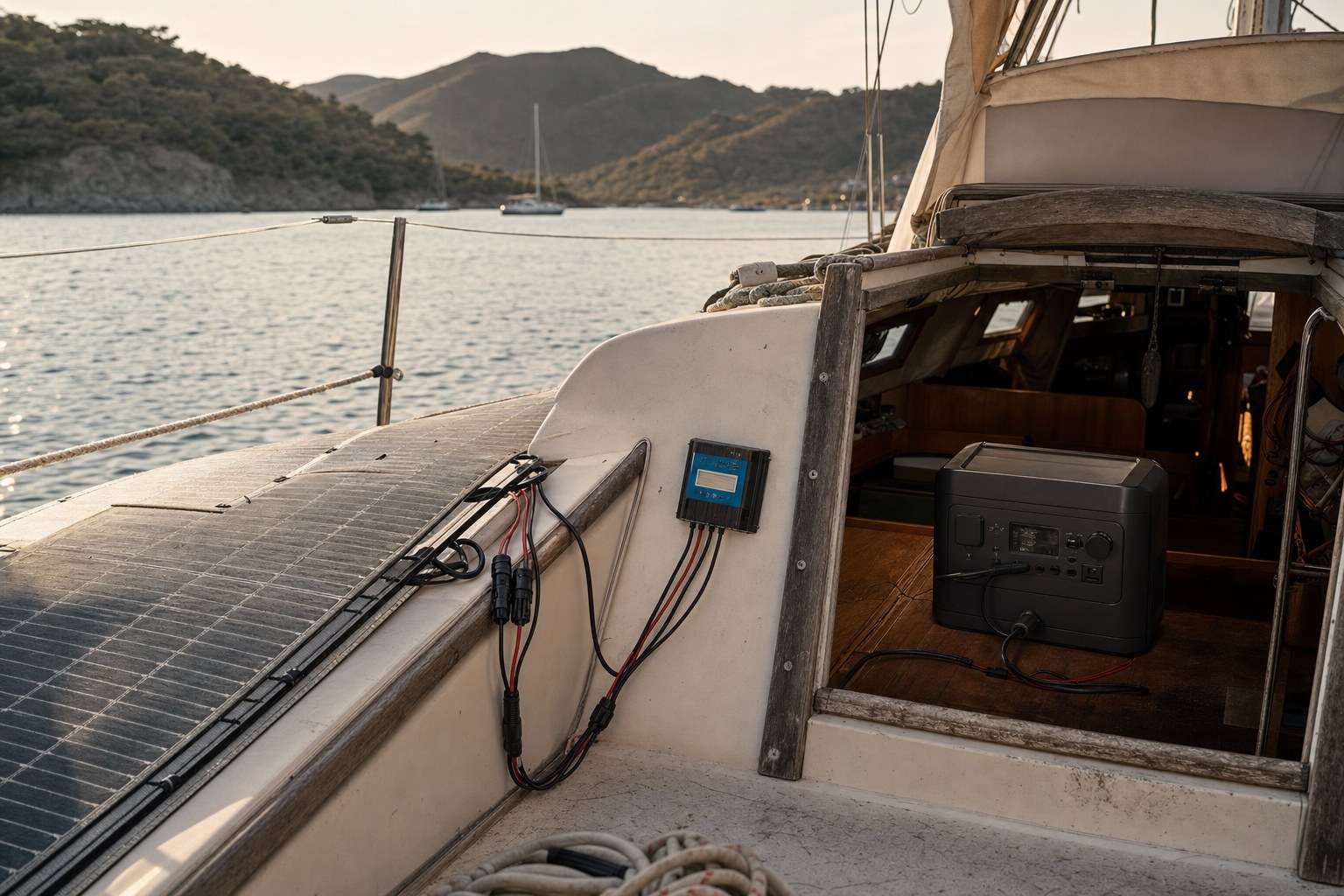
Marine Solar Kit for a Boat: We Sized 246 Systems Against a Night at Anchor
The short answer
Short version: on the water, the loads that never switch off write the bill. A marine fridge cycles 24/7, and Starlink at anchor holds a steady 75–100W through the night, so a quiet evening on the hook burns 2.5–3.5kWh with nothing but deck solar and an occasional engine run to replace it. The sizing target is therefore storage that carries the dark hours and panel that refills the bank by afternoon, in LiFePO4 for the depth-of-discharge and the weight, rather than a large inverter that spends its life half-loaded. We started with 246 boat-rated LiFePO4 systems, filtered to the 79 in the cruiser band (1–5kWh with an inverter), and ranked the 5 that hold up against a boat's real overnight draw.
The load profile: what actually empties a house bank
Marine loads are rarely large, which is why peak watts barely matter afloat. The drain that counts is the 24/7 draw at anchor, and it comes from two places:
- ◈The fridge/freezer, the classic boat killer. It cycles around the clock, surges 3–5× on the compressor, and leans harder still in a hot cabin or warm water. On most boats it is quietly the single biggest consumer aboard.
- ◈Starlink at anchor, which rewrote the arithmetic. A steady 75–100W, all night, works out to ~1.8–2.4kWh a day that older boats never budgeted for. Stack the fridge on top and a quiet night on the hook costs 2.5–3.5kWh, with no shore power and only so much deck solar to answer it.
Two rules fall out of that. Size the battery to ride the night, size the panels to refill it by afternoon, and run LiFePO4 for the deep discharge and the weight it saves over lead. Put your own boat's numbers through the load calculator.
The verdict: bank rides the night, panel refills the day
Two loads trip our failure engine, and between them they decide a boat's whole system:
> Fridge/freezer: compressors surge 3–5× and cycle 24/7, with roughly 30% more draw in heat. The dominant daily consumer on most boats. > Starlink (always-on): a continuous 75–100W, ~1.8–2.4kWh/day whether anyone is watching the screen or not. Budget it as a base load, not an accessory.
The number that decides the purchase, then, is overnight watt-hours, not inverter size. Few boats ever need more than a 2,000–3,000W inverter. Every boat needs enough storage to cross from sunset to a productive solar afternoon, and enough panel to put the bank back before the next night arrives. Hence the filter: the 1–5kWh cruiser band, with credit for bundled solar. Details live in how the methodology works and the inverters & power conversion explainer.
Fridges and freezers surge hard and never turn off
Compressors pull 3–5× their running watts to start, and because they cycle 24/7 they quietly dominate your daily watt-hours — especially in summer heat. Modified-sine power makes them buzz and shortens compressor life.
Fix: Pure-sine inverter, and size the battery for the all-day cycling load. In hot climates add ~30% to the fridge's estimated draw.
Always-on Starlink is often the single biggest line item
At ~75–100W running 24/7, that's ~1.8–2.4 kWh every day — and in low-sun winter it's frequently the load that drains the battery first.
Fix: Size the battery for 2–3 cloudy days, or put Starlink on a scheduled/idle power cut overnight. It's a continuous load, not a peak one.
One day of battery autonomy is thin for the critical loads you listed
You have loads that can't simply wait for sun — fridge/freezer, a pump, medical gear, or always-on connectivity. A single overcast stretch can take the bank to empty before noon.
Fix: Plan 2–3 days of autonomy for critical setups. Bump the "days of autonomy" input and re-check the battery size.
The 5 that carry a boat
Every pick below is LiFePO4 and pure sine, and boat-rated in our data. Ranking runs on overnight capacity measured against value. The 2,048Wh EcoFlow takes the podium as the balanced cruiser pick, the 4,085Wh Jackery banks the most for a liveaboard, and the $449 EcoFlow is the cheapest door in. The page's one buy link rides on the #1 pick, and each kit name opens its full audit with real build cost and 6-month price history.
Size to how the boat gets used. Coastal hoppers running the engine daily can go smaller. Liveaboards holding Starlink and refrigeration 24/7 belong at the biggest bank. Run any two head-to-head, or work through the whole portable power pool.
#1 · Best all-round for a cruiser
DELTA 2 Max 2048Wh + 400W PanelCoastal cruising is where this one settles. Its 2,048Wh carries a night of fridge-plus-Starlink with margin left over, and the bundled 400W panel puts that back on a sunny afternoon at anchor. Value is honest at $0.44/Wh, and the flat case slides into a lazarette with no marine electrician involved. Most weekend-to-coastal boats stop here.
#2 · Liveaboard / biggest bank
$0.48/WhNothing else in the group banks as much: 4,085Wh, plus two 200W panels in the box. That is enough to push a fridge, Starlink, and nav electronics through a cloudy night with reserve still on the meter. At $0.48/Wh it suits a liveaboard, or a longer passage where daily sun is a hope rather than a plan, and the bank expands as loads pile on.
#3 · Cheapest way in (weekender)
$0.44/WhLowest entry price on the board at $449. The 1,024Wh and a 220W panel cover a weekender's fridge and lights with room for a phone-and-Starlink top-up. A 24/7 liveaboard Starlink load is beyond it, but on coastal hops where the engine runs daily anyway, this is the cheapest start that is still honest.
#4 · Best value if you already have marine panels
$0.37/WhCost-per-watt-hour bottoms out here: 2,048Wh at $0.37/Wh, as a main-unit-only bank. Boats that already carry deck or arch solar with a controller get real LiFePO4 storage for the least money by pairing this with the panels on the rail rather than buying a bundled one twice.
#5 · Room to grow / expandable
$0.42/Wh3,072Wh at $0.42/Wh on a bank that stretches past 12kWh. Reach for it when the boat is still being outfitted and the load list keeps growing (watermaker, a second refrigeration box, induction). Main-unit-only, so marine-rated panels get chosen separately. More headroom than the cruiser picks, without paying liveaboard money.
The receipt: what your money actually buys
The receipt here is unusually clean. Each of these is a complete power station, so required missing-parts cost is $0. The box, however, does not account for the boat around it. Three marine realities land outside the carton: secure mounting for a seaway (a station that slides across the cabin in a knockdown is a hazard), corrosion-aware placement clear of salt spray and bilge damp, and a DC-DC or shore-charge path (≈$100–$300) if charging underway matters. So the receipt below counts hours on the hook rather than hidden hardware: how long the bank rides the overnight draw before sun or engine refills it.
| Kit | Listed | Storage | Fridge runtime, no sun | Days autonomy |
|---|---|---|---|---|
| DELTA 2 Max 2048Wh + 400W Panel | $899 | 2.0 kWh | ~16 hrs | ~0.7 |
| 2000 Plus + PackPlus E2000 Battery + 2x 200W Panels (4085Wh) | $1,979 | 4.1 kWh | ~31 hrs | ~1.3 |
| DELTA 2 1024Wh + 220W Panel | $449 | 1.0 kWh | ~8 hrs | ~0.3 |
| SOLIX C2000 Gen2 2,048Wh/2,400W + Main Unit Only | $749 | 2.0 kWh | ~16 hrs | ~0.7 |
| SOLIX F3000 3,072Wh/3,600W + Main Unit Only | $1,299 | 3.1 kWh | ~24 hrs | ~1.0 |
Runtime ≈ usable storage ÷ ~130W effective fridge draw (running watts + inverter overhead, before summer derate). A real receipt for integrated stations is hours of runtime, not missing parts.
Marine reality: mounting, charging, and salt
The same station behaves differently on a boat than it does on a garage floor. Three things change:
- ◈Mount it for a seaway. Anything free to slide across the cabin in a knockdown is a hazard, so strap or bracket it low and central. Product photography skips this step entirely.
- ◈Plan the recharge, not just the discharge. Deck or arch solar refills the bank through the day. A DC-DC charger or a shore-power path (≈$100–$300) covers topping up off the engine alternator or at a marina.
- ◈Respect salt and damp. Direct spray and bilge humidity both need to stay away from the unit. Corrosion kills marine electronics quietly, long before anything obvious fails.
Feed your real fridge and Starlink hours back through the calculator to re-check the overnight figure, and see where our kit prices come from.
Buy now or wait?
| Kit | Current | 6-mo low | Above low | Signal |
|---|---|---|---|---|
| DELTA 2 Max 2048Wh + 400W Panel | $899 | $849 | +6% | Fair price |
| 2000 Plus + PackPlus E2000 Battery + 2x 200W Panels (4085Wh) | $1,979 | $1,979 | at low | Buy now |
| DELTA 2 1024Wh + 220W Panel | $449 | $419 | +7% | Fair price |
| SOLIX C2000 Gen2 2,048Wh/2,400W + Main Unit Only | $749 | $699 | +7% | Fair price |
| SOLIX F3000 3,072Wh/3,600W + Main Unit Only | $1,299 | $1,199 | +8% | Fair price |
6-month price history — DELTA 2 Max 2048Wh + 400W Panel
Price History
▼ 40% BELOW AVGLast observed at retailer: Jun 20, 2026. Days between observations carry the most recent known price — not new data.
Why these won — and why others failed
Why these won
- ✓All five picks are pure-sine LiFePO4, boat-rated, and sized against a genuine overnight fridge-plus-Starlink draw, which is the metric that settles a marine system rather than peak inverter watts.
- ✓The podium covers the ways people actually cruise: a cheapest weekender, a balanced coastal all-rounder, a liveaboard bank, and two main-unit-only options for boats already carrying deck solar.
- ✓Specs, prices, and 6-month price trends come from live data, and the verdict hangs on the two sourced 24/7 loads (fridge cycling, always-on Starlink) that a generic marine blog waves past.
Why others failed
- ✕Sizing to peak watts instead of overnight watt-hours. The fridge and Starlink empty the bank between sunset and a good solar afternoon, and storage picked on the wrong number dies in the dark.
- ✕Treating Starlink as an accessory rather than a 24/7 base load. It adds ~1.8–2.4kWh a day without announcing itself, on boats whose systems were designed before it existed.
- ✕Sub-1kWh units are out, since they cannot ride a night. So are lead-acid and DC-only records, which either weigh too much or cannot run AC marine loads at all.
Frequently asked
What size solar system do I need for a boat with a fridge and Starlink?
Size to the overnight draw rather than peak watts. A marine fridge plus Starlink at anchor consumes roughly 2.5–3.5kWh a day, which puts most cruisers at 2–4kWh of LiFePO4 storage with enough deck solar (300–600W) to refill it by afternoon. Liveaboards holding both loads 24/7 belong at the top of that range or past it.
How much power does Starlink use on a boat?
It holds a steady 75–100W the entire time it is on, which comes to roughly 1.8–2.4kWh a day if it stays live at anchor. That is base-load territory, not accessory territory. On plenty of boats, Starlink and the fridge are the two largest consumers on the house bank.
Do I need a special marine solar kit for a boat?
The hardware itself does not have to be marine-specific, since a quality LiFePO4 power station handles the job. The installation is where marine rules apply: mount it securely for a seaway, keep it clear of salt spray and bilge damp, and plan a recharge path (deck solar, with an optional DC-DC or shore charger). Curved decks are the one case where marine-rated flexible panels earn their premium.
Methodology, freshness & corrections
Cohort: the cruiser band: boat-rated LiFePO4 stations from 1–5 kWh carrying an AC inverter → 246 kits clear the bar; the podium is drawn from the 79 clean, complete primaries left after dropping variants and incomplete listings. Prices auto-refresh from multiple retailers every 6 hours; this page last refreshed 2026-07-03.
See how real build cost is calculated, our methodology, data sources, and editorial policy. Found an error? Tell us — we correct fast.
Different use case? See the best off-grid solar generator for every load.