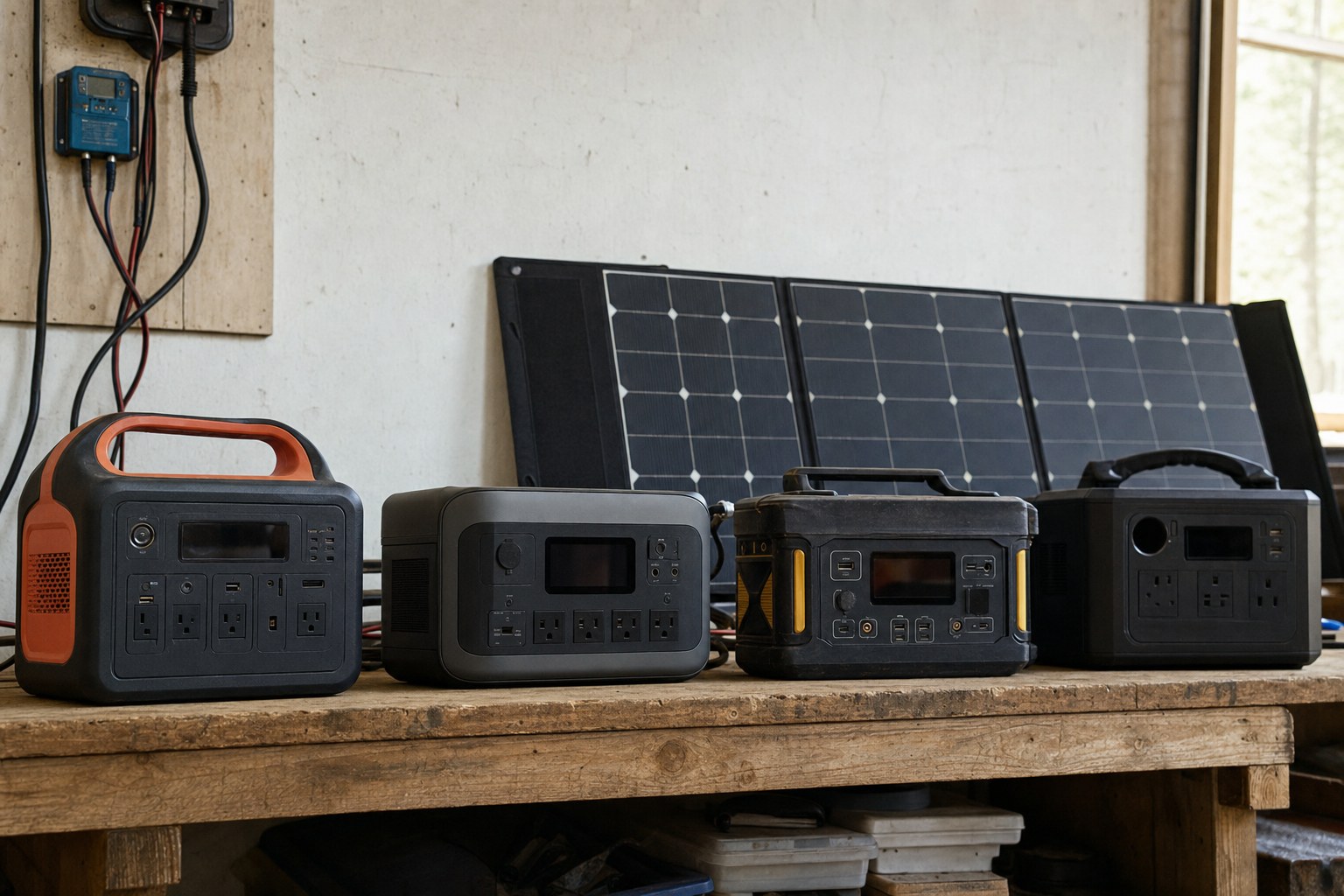
Best Off-Grid Solar Generator: 10 Winners, One Per Load, Because a Flat Ranking Lies
The short answer
Any page that crowns one best off-grid solar generator is guessing. What decides the machine is the load that breaks the others: a well pump's startup surge, a fridge's 24/7 cycle, a CPAP's runtime, a homestead's 240V. A flat ranking cannot hold all four, so we skipped it. Below, each real use case gets its own winner, pulled straight from the #1 pick on that load's evidence page, carrying its real build cost, its price history, and the failure mode it sidesteps. Locate your load, read the call and the reasoning behind it, then open the guide underneath. If nothing on the list matches, we also lay out the cases where the honest answer is to buy no solar generator at all.
The question 'best off-grid solar generator' has no answer
Put "what's the best off-grid solar generator?" to anyone who has actually measured one, and the reply comes back as another question: "best at what?" Loads at opposite ends of the catalog demand opposite machines. A CPAP needs a compact, efficient bank tuned for *nights of runtime*. A well pump needs a big inverter that survives a *startup surge*. A homestead needs 240V split-phase plus days of winter storage. Nothing in one box is best at all three.
That is why this page is built as a router rather than a flat "top 10." Start from the load that actually dictates your system, and the page hands you the unit that wins it, along with the full evidence guide standing behind the call: real build cost, 6-month price history, and the specific failure mode that unit avoids. A generic listicle cannot manufacture that layer, which is also why one ranking keeps sending people home with the wrong machine.
Best by use case
Best for a refrigerator
Holding a fridge or freezer cold through an outageBeats a compressor's startup surge and arrives with its own panel for recharging. Of the units that genuinely run a fridge, this one carries the best price-per-watt-hour.
Avoids: Budget units that choke on the 3× compressor inrush, or that ship with no way to refill the battery.
Best for a well pump
A well pump, off-grid or grid-downContinuous inverter capacity to absorb a locked-rotor startup spike with margin left over, plus the storage to cycle a pump through a full day.
Avoids: 120V power stations that trip on the 2,000–3,500W inrush, or that have no 240V output at all.
Best for a CPAP
A CPAP that has to run night after nightThe strongest runtime per dollar for a small overnight medical load, with a 12V DC output that skips the inverter's overhead.
Avoids: Banks too small to reach a second night, and modified-sine units that stress the electronics.
Best for a homestead
A full homestead: well, freezer, winterNative 120/240V split-phase drives a deep well directly, and a large LiFePO4 bank covers multi-day winter autonomy. Best value at homestead scale.
Avoids: Portable units with no 240V and no chance of riding out a cloudy winter week.
Best for a boat
Fridge and Starlink on a boat at anchorOvernight storage sized to a boat's 24/7 draw, a bundled panel to refill it by day, and a flat form factor that stows aboard.
Avoids: Sizing to peak watts rather than to the overnight fridge-plus-Starlink drain.
Best for a cabin
Lights, fridge and electronics at a weekend cabinA cabin-scale system priced honestly, with the parts a bare kit leaves out already counted in.
Avoids: Advertised 'kits' that still need hundreds of dollars in missing parts before a cabin runs.
Best for an RV
Boondocking in a van or RVA complete boondocking build with the mounts, wiring and fuses already in the box, not a panel-and-hope bundle.
Avoids: RV 'kits' that short the tie-in parts, so real build cost lands well above the sticker.
Best for a shed or workshop
A small shed or workshop on a tight budgetOnce the hidden costs are counted, the cheapest complete way to light and power a small structure.
Avoids: Budget kits whose sticker quietly omits the panel, battery or wiring you still have to buy.
Best for home backup
Fridge and furnace fan through a multi-hour outageStorage and surge enough to carry the critical home loads (fridge, sump, furnace fan) across a multi-hour outage.
Avoids: Small stations that cannot start a sump pump, or that run flat mid-outage.
Best for running a window AC
A window air conditioner running off solarSurge headroom to start a window unit straight out of the box, plus the exact soft-start parts that make a near-fit kit work.
Avoids: Inverters sized to the AC's running watts, which then trip on the 3× compressor surge.
How a winner earns its slot: the audit does the picking
No editor's hunch put anything on this page. Each winner below is the #1 pick of that load's full evidence page, and those pages rank a real, filtered cohort on objective metrics (cost-per-watt-hour, storage, surge headroom, real build cost after missing parts). Build-time assertions guard the result. Should a price move or a data update change which unit sits at #1, the build fails until this hub is corrected, so the hub cannot quietly contradict the guide it routes to.
There is no editor's pick and no pay-to-play. A unit takes a use case by clearing that load's specific math in the live data, and it links straight to its full audit and its own kit page, so the numbers stay yours to re-check. The mechanics are written up in how the methodology works and how real build cost is calculated.
The cases where the right move is to buy nothing
Sometimes the most valuable line on a "best solar generator" page is don't buy one. A portable solar generator is the wrong tool for central air conditioning, electric heat or an electric range running continuously, and it is the wrong tool if what you want is a permanent whole-home system. Both of those call for a fixed 120/240V split-phase system wired into your panel (the homestead systems guide is the place to start), not a box you plug into.
It is also the wrong buy at the other end of the range. If the real requirement is a few hours of grid-down lights and phones, a small portable power station costs less and weighs less than a "generator." Measure the actual loads first with the calculator. Often the honest output is a smaller unit, a fixed system, or nothing at all.
Why these won — and why others failed
Why these won
- ✓Each winner arrives as the #1 pick of a full evidence page, decided on real build cost, 6-month price history, and a failure-mode verdict rather than an editor's hunch.
- ✓If any winner here stops matching its source guide's top pick, the build fails, so this hub cannot drift away from the evidence it routes to.
- ✓No editor's pick, no pay-to-play. A unit wins by clearing its load's specific math in live data, and every one links back to its full audit.
Why others failed
- ✕Flat 'top 10 solar generators' rankings pretend the load doesn't matter, when a fridge, a well pump, and a CPAP pull in opposite directions.
- ✕Nameplate watts and sticker prices are all a generic list quotes, which skips the startup surge, the missing parts, and the real build cost that decide whether a unit works at all.
- ✕A no-sale earns nobody a commission, which is why most roundups never tell you when to skip a solar generator entirely.
Frequently asked
Is there a single best off-grid solar generator?
No. It hinges on the load that decides your system, and a CPAP, a well pump, a fridge, and a homestead each want a different machine. Work the by-use-case matrix above to find the winner for your specific need. Every one of them is lifted from that load's full evidence page.
How were these winners picked?
Every winner is the #1 pick from that load's dedicated guide, ranked on objective live data: cost-per-watt-hour, storage, surge headroom, and real build cost after missing parts. Build-time checks fail the build if a pick ever stops matching the evidence. No editor's pick, no sponsorship.
When is an off-grid solar generator the wrong purchase?
Continuous central AC, electric heat, or a 240V well all sit outside a portable unit's range. Size a fixed 120/240V split-phase system for those instead. At the small end, if a few hours of lights and phones is the whole job, a small portable power station costs less than a 'generator.'
Methodology, freshness & corrections
Cohort: the full tracked field of off-grid solar generators, filed under the one use case each unit genuinely wins → 355 kits clear the bar; the podium is drawn from the 10 clean, complete primaries left after dropping variants and incomplete listings. Prices auto-refresh from multiple retailers every 6 hours; this page last refreshed 2026-07-03.
See how real build cost is calculated, our methodology, data sources, and editorial policy. Found an error? Tell us — we correct fast.